
Effort underway to save, restore, reopen Muskrat Blind as educational venue at Montour Preserve
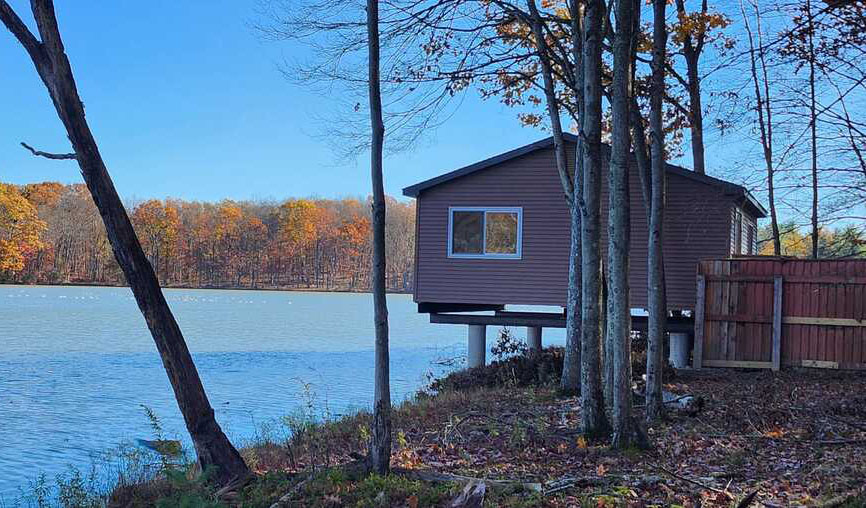
PHOTO PROVIDED Muskrat Blind is shown in this photo by the Middle Susquehanna Riverkeeper Association. Muskrat Blind’s resurrection project has recently been completed via the Vernal School Environmental Education Partnership, a subsidiary of the Middle Susquehanna Riverkeeper Association, in collaboration with work with the Montour Area Recreation Commission.
After a lengthy process of stabilization, permitting, construction and final details, the $60,000 Muskrat Blind resurrection project has recently been completed via the Vernal School Environmental Education Partnership, a subsidiary of the Middle Susquehanna Riverkeeper Association, in collaboration with work with the Montour Area Recreation Commission.
“The name doesn’t necessarily do it justice. It is more an educational observatory than simply a wildlife blind, and that is exactly the value we saw in it when we decided to salvage it before it fell into the lake as one of several major deferred projects MARC was weighed down by back in mid-2023,” said Middle Susquehanna Riverkeeper John Zaktansky. “The goal of the Vernal School has been to intentionally connect people to nature, to inspire new stewards, and this building located in the protected nature preserve section of the preserve is perfect for that.”
During the summer of 2023, MARC was struggling to cover a growing number of major deferred projects around the Montour Preserve due to funding concerns. The Muskrat Blind had been lifted off its then-wooden piers by a high-water event and when it shifted back onto them, it started leaning more and was about to fall into Lake Chillisquaque.
“At that point, a decision needed to be made to either save the blind, let it fall into the lake and clean up the mess afterward, which would have been a nightmare on pretty much every front, or take it down before that happened,” said Zaktansky.
Thanks to a grant from the 1994 Charles B. Degenstein Foundation in late 2023, the Riverkeeper Association formed the Vernal School Environmental Education Partnership to help tackle a variety of needs around the preserve and resurrect programming, field trips and resources. One of the first projects was to stabilize the building until necessary permits and other needs could be met. The group contracted with Doolittle Construction, of Turbotville, to secure the building and later to help plan and implement the project.
“MARC had exhausted its available funding and had resigned itself to the eventual removal of the Muskrat Blind,” said MARC Director Bob Stoudt. “As important as the blind was to the environmental educational offerings at the preserve, we simply didn’t have enough funding to do all that needed to be done. Now, not only has the blind not gone away, it’s better than it’s ever been.”
The building now sits on four cement pillars and large I-beams and is higher than it was previously to avoid another high-water issue like was experienced in 2023. A wheelchair-friendly wooden ramp was added to the entrance.
“The Muskrat Blind is a highly valuable educational resource. It allows visitors to observe many wildlife species in their natural environment encouraging curiosity and a connection to the nature,” said Vernal School Program Supervisor Marissa Crames. “It opens many doors to enhance our place-based learning opportunities at Montour Preserve.”
Windows that had been in the building for quite some time had started to cloud and obscure visibility, but “all been replaced thanks to Wayne Stahl, who used to work for the company that manufactured the windows and got a really good price and MARC who contributed $630 toward the project (from county hotel tax funds) to help get them in and installed,” said Zaktansky.
“Now, when you are in the building, you have incredible sight across this amazing cove that is off-limits to boaters and hikers – it is as natural as you can get anywhere in the county. You are perched out over the water and see so many cool species, from migrating birds to fish and turtles, it is not only a place for great education, but also research.”
To enhance that, a recent donation of $1,500 from M&T Charitable Giving is being invested into some new field guides, binoculars and other items that will be available securely at the site for scheduled programming.
“We have cameras up that double as both security but also research on various wildlife species that frequent that part of the preserve’s woods and lake and are looking into some other cool tech options to enhance what we can not only detect, but perhaps even livestream for people eventually,” said Zaktansky. “The goal is to use this site responsibly so that it stays rustic and a safe place for wildlife that uses it as a refuge, but also as a place where we can learn and teach others sustainably. I know it is one of my personal favorite places to be, to just sit and observe and appreciate nature.”
Inside the building is a large hand-painted mural by local artist Ken Hunter as well as numerous wall resources for bird identification and a map that illustrates migration routes. Groups such as the PA Master Naturalists and Seven Mountains Audubon Society have used the Muskrat Blind regularly in the past.
“It allows a relatively large (or small) group to easily observe migratory and non-migratory waterfowl,” said Seven Mountains Audubon Society President Bill Tyler. “Without the blind it would be difficult to get as close to these birds including ducks, herons, Belted Kingfisher and some raptors like Bald Eagles and sometimes Osprey. It is a wonderful asset.”
The Middle Susquehanna Riverkeeper Association serves an 11,000-square-mile watershed of the Susquehanna River, including Sullivan, Lycoming, Clinton, Union and Northumberland counties. Read more at www.middlesusquehannariverkeeper.org.
Outdoors
Effort underway to save, restore, reopen Muskrat Blind as educational venue at Montour Preserve
Outdoor community calendar for Week of Dec. 2
HOLIDAY WREATHS WITH PETE GSTALDER WHERE: Rider Park WHEN: Sunday, Dec. 7 (1-3 p.m.) NOTES: Rider Park is ...
Montour County solicitor clarifies rezoning hearing will be legislative and outlines steps for public participation
Reflections in Nature: Looking more closely at the porcupines
Recently I have been asked several questions concerning an animal. One question was what could be chewing on an ...
Could it be possible that birds enjoy playing?
Reflections in Nature: Many animals seek shelter, dens in winter
Are you prepared for another Pennsylvania winter? Our furnace and chimney have been cleaned, filters have been ...