
Speaker outlines 4 steps to building community
Trending
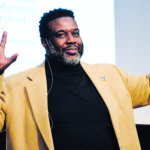
Getting "your MLK on" doesn't mean that you're living out the dream of inclusion, the Rev. Dr. Jamie Washington, president and founder of Washington Consulting Group, of Baltimore, told his audience at the George S. Klump Academic Center during his speech Thursday to conclude Dream Week.
Folks can participate in events celebrating the Rev. Dr. Martin Luther King Jr. and his ideals all they want, but taking home flyers and the pride of attending is not enough, Washington said. Instead, change happens when people initiate it based on the acknowledgement that they treat people differently based on defining characteristics.
"We absolutely do still judge people on the color of their skin … their religion … their sexual or gender identities," Washington said. "Acknowledging that there are differences is not the problem. For us to live out the full value of inclusion, we must have a problem" with treating people differently, he said.
"You can't simply acknowledge it and then hope we get out of here on time," he added, jokingly.
Washington emphasized four key steps toward building a more inclusive environment during his speech, entitled "The Content of Our Character: Doing the Work to Live Out the Dream of Inclusion."
The first step, he said, is to be more self-aware. This means to acknowledge one's own experiences and characteristics. What do defining traits mean to oneself and how have they affected one's life?
"I've been black all my life, as far as I know," he said, amidst laughter. "But just because I've been black doesn't mean I've always known what it means to be black."
In conjunction with being self-aware, people need to be more aware of others, Washington continued.
He admitted that, growing up as a Christian, he didn't have much interaction with non-Christians. Figuring out how to be more inclusive of the unknown can be possible only with awareness.
"You cannot build greater inclusion if you do not know what you are not aware about," he said.
The third step is to take courageous action, he said.
"We must be willing to move beyond our comfort zone … to have conversations we don't have lot of experience with," Washington said.
This step starts with telling the truth to oneself -- Washington used the example that he is often uncomfortable with talking to non-Christians and with people who identify as gender-variant, gender-fluid, etc., because he is unfamiliar with such people.
"I don't know what to say to them. I might get it wrong," Washington said. "It's about moving through our fear and expanding our comfort zones."
The final step is collaboration.
Though many people will have a different way of "getting there," Washington said, working with one another is a must for building King's Beloved Community.
Washington acknowledged people make mistakes, and not everyone wakes up in the morning with intent to do harm.
"Well-intentioned people can do harm, and your best can sometimes look pretty pitiful," he said. "We must allow ourselves to still be learners."
He addressed some sentiments he has come across in his 30 years of working toward the Beloved Community, such as what he calls the "blame shame game."
Sometimes people will say black community members should move on, using the excuse, "We didn't have slaves! We weren't around then!"
Not being at fault does not mean that one is not responsible for initiating change, he said.
"I know you weren't around then. Neither were we. We did not create it," Washington said, referring to the air of racial tensions and exclusion. "It is not our faults, but we must accept responsibility."
He also addressed the common "wish" that race, gender and other identities should be ignored and "we can all just be human."
"'We wish, we wish, we wish,'" he mimicked. "I often tell them, 'A wish bone will never suffice where a backbone is required.' You cannot wish us into inclusion. We are going to have to do the work."