
Eagle released after life-saving rehabilitation
Trending
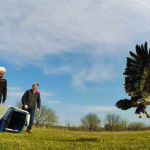
A juvenile bald eagle suffering from lead poisoning and a severe bacterial infection was released at the South Williamsport park complex Thursday morning after four months of rehabilitation.
The eagle, only a year and a half old, would have died from complications from lead poisoning weakening its immune system if it wasn't hit by a truck on Route 15 in November, according to Robyn Graboski, a licensed wildlife rehabilitator with Centre Wildlife Care in Port Matilda.
Soon after the bird was struck by the truck, local master falconer Mike Kuriga, who has owned and worked with eagles of that size for years, was called to the scene by a witness.
"As I tried to approach it, it tried to fly up Route 15 and would have been squished," Mike Kuriga said. "I yelled for my grandson to get a blanket and he quickly covered it."
Ethan Kuriga, 14, Mike Kuriga's grandson, has worked
with birds all his life, but had never worked with a bird as big as the female eagle.
"I was a little nervous and wasn't sure what state the bird was in," Ethan Kuriga said. "I'm used to working with hawks so I wasn't used to how big it was going to be."
Mike Kuriga swiftly put the bird in the possession of Graboski, who set to work to take care of its wounds from the collision. That night the eagle was standing up and seemed to be feeling better due to a dosage of pain medication, according to Mike Kuriga. The bird's rehabilitator noted however, that its droppings were a shade of green, indicative of lead poisoning.
Lead poisoning is rampant in the area, according to Graboski, who treats dozens of lead poisoned birds every year.
"Most of the eagles we see have lead poisoning and about half of those die," Graboski said. "What the lead does is it depresses the immune system and other infections take hold."
Birds that are infected with lead poisoning usually come into contact by scavenging carcasses of game animals that were killed by lead bullets. Lead shot is banned for hunting waterfowl, according to Jay Cole, Northcentral Region state game warden, who said the lead can get into the water, poisoning fish and the birds eating the fish. Hunting deer with lead bullets still is legal, but many believe that the laws should be changed.
"People are really paying attention to it, and I would expect some changes are going to happen," said Mike Steingraber, information education supervisor for the Northcentral Region Game Commission.
While the eagle was infected with lead, the damage to its immune system had given it a bacterial infection that would have killed it, Graboski said. Treating the bird cost the rehabilitation center thousands of dollars in antibiotics and antifungal medicine. Female bald eagles are generally larger than their male counterparts, according to Graboski, and even with an eagle as sick as she was, her caretakers had to take precautions.
"Usually after a week they are eating on their own. She was so sick she wouldn't eat for months," Graboski said. "When you are force-feeding them, you have to handle them four times a day. You have to have personnel that are not only trained but strong enough to handle an eagle."