
Trending
Ever hear of the 1894 firestorm in Hinckley, Minnesota? No? How about flames reaching 1,000 feet into the sky? Or fires so fierce they warped train tracks, melted boxcars, lifted stacks of lumber high into the air and leaped across a river to ignite the opposite shore?
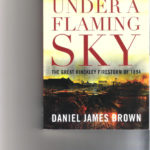
I'd never heard any of this either -- till I picked up Daniel James Brown's "Under a Flaming Sky." Horrific and hypnotic, it's the most gripping book I've read this year.
Brown is the bestselling author whose "Boys in the Boat," about a rowing crew in the 1936 Olympics, has just been optioned for a film to be directed by Peter Berg ("Lone Survivor," "Deepwater Horizon").
"Under a Flaming Sky" is a meticulously researched and masterfully written account of the demonic wildfire that swept through Hinckley in 1894, leaving more than 400 dead and devastating roughly 300,000 acres.
Brown also details an earlier conflagration in Peshtigo, Wisconsin. The deadliest fire in American history, it may have killed as many as 2500 people, wiping out 1.5 million acres and generating winds so strong that one houseboat, whose owner was trying to escape across a lake, got pulled into the flames and instantly incinerated, along with everyone on board. (Though far worse than Hinckley, Peshtigo received less attention because it occurred on the same day as the famous Chicago fire of 1871.)
Blazes of this magnitude create their own weather, including near-hurricane winds as they suck in all available oxygen; many Hinckley victims died not from flames but from asphyxiation. Such fires generate tornado-like whirlwinds of flame, convection columns rising miles into the air and bubbles of plasma-like gas that float out ahead of the flames and explode in mid-air, raining death on those below. Worsened by a summer-long drought that had sucked moisture even out of buildings -- and by piles of easily combustible scrap left over from mass logging -- the Hinckley inferno reached 1600 degrees, releasing as much energy as "a Hiroshima-sized nuclear bomb going off every five to fifteen minutes."
Brown's book is doubly fascinating as he expounds on 19th-century medicine; the frightening pathology of burn wounds; and PTSD -- about which so little was known at that time, and which, it turns out, is especially pronounced in the case of massive fires.
Wisely, he humanizes the tragedy by focusing on a handful of individuals: railroad conductor John Blair, whose quiet heroism saved many lives; telegraph operator Olive Brown, who stayed at her post for 36 hours; engineer Jim Root, who helmed one of two burning trains that rescued hundreds from the doomed town; and Norwegian immigrant Evan Hansen, about whom Brown reveals a startling secret late in the book.
Though moderated somewhat by the courage of these heroes and the generous national response to the disaster, Brown's account is not for the faint of heart; it is often shattering in its relentless horrors, especially in the fire's gruesome aftermath.
Though "Boys in the Boat" is headed for the screen, "Flaming Sky" might be even more cinematic; it would be tough to watch -- but it sure is a blood-curdling story.