
Needlecast on coniferous trees: an arborist’s take
Trending
Conifers are commonly planted in North America to provide year-round screening, as windbreaks, or as focal trees in the landscape. However, conifers planted in northern areas of North America are experiencing a myriad of issues causing a general decline in health, vigor and resilience. There are many factors contributing to the widespread decline of conifers in these regions, and isolating a single cause has been challenging. Within our region, decline has mostly notably attributed to needlecast fungus. However, both climate change and soil issues appear to be major contributors. With a changing climate, weather patterns become less consistent and extreme weather events (e.g., prolonged drought or excessive rainfall) become more common. Since 1990, the majority of North America has experienced a shift in at least one plant hardiness zone toward a warmer climate. For example, Colorado blue spruce is ideally planted in zone 3, however almost all of the northern United States where this species is traditionally planted is now in zone 5 or 6. These abiotic issues lead to stressed trees that become more susceptible to diseases and pests. Currently, researchers are studying many of these issues and how to best maintain the health of these trees. With needlecast being the most common cause for decline in our region, this article will focus on needlecast infection.
Needlecast and needle blight are terms applied to a variety of foliage disorders of many coniferous species. These diseases are usually more severe on young trees or on trees growing outside of their natural range. Disease severity and corresponding defoliation vary from year to year depending on climatic conditions. Although it usually takes trees a long time die as a result of infection and defoliation, these diseases are considered serious because of the unsightly condition and loss of vigor of affected trees. Many times trees infected with these needle diseases become so unsightly, homeowners want to remove them. If caught in time, this is a disease that can be treated and decline can be reversed.
Cause
At least 40 different species of fungi are known to cause needle diseases, but only seven genera are of major importance. These are Rhabdocline on Douglas fir and Rhizosphaera, Chrysomyxa, Stigmina, Phaeocryptopus, Ploioderma, Mycosphaerella, and Lophodermium on other conifers including pine, spruce, fir, larch and juniper.
Symptoms
One- and two-year old needles of infected conifers (except larch) may develop spots and become yellowish-brown to red by early spring. Early discoloration symptoms rarely involve an entire needle. By early to mid-summer most of the infected needles have dropped or cast, leaving only the current season needles. On spruce and larch, however, the diseased needles remain attached beyond the normal time.
Signs
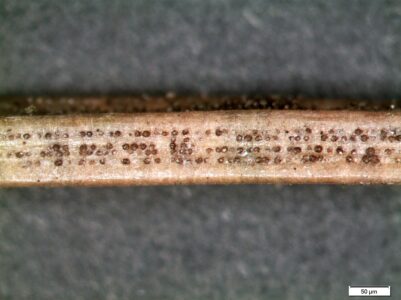
In most cases, fruiting bodies of the causal fungus erupt through the surface of the infected needle area before defoliating. During moist weather, the mature fruiting bodies discharge spores, which may be carried to nearby unaffected needles.
Management
Needlecast and needle blight diseases can be managed by making protective applications of a properly registered fungicide when the needles are actively growing, and in some cases another application is needed in late summer. With ongoing treatment, these infected tress and shrubs can still live a long life even with the looming pressures of these diseases.
Cody Kouneski is an arborist representative with Penn State Mont Alto Forestry and an International Society of Arboriculture Certified Arborist.