
Historic weapons to be displayed at Mifflin museum collection
Trending
MIFFLIN -- The Juniata County Historical Society does not have a large collection of weapons, but it is fortunate enough to have what is widely considered to be the "forefather" of all bolt-action rifles.
The Tuscarora Academy Museum currently houses a long rifle made by Snyder County native and gunmaker Samuel Loudenslager.
"Many of the weapons we possess have stories connected to their owners and to our local history," explained Austin Willi of the historical society's properties committee.
Steve Renno, a gun collector from Perry County, will display firearms from his collection at the museum on Antique Firearm Day, from 1:30 to 4 p.m. on Sunday, Aug. 11. Included in Renno's collection are two long rifles made by gunmakers from Juniata County.
These rifles are often referred to as "Kentucky Rifles." Long rifles of this type were first made in Lancaster County, which means they should actually be coined "Pennsylvania Rifles."
One of the rifles Renno will showcase was made by Samuel Loudenslager, a gunmaker who was born in Penn Township, Snyder County, and later moved to Juniata County. He lived in Walker Township, near the village of Center. Loudenslager's tombstone is in Center Lutheran Church Cemetery.
Another long rifle to be displayed was made by John Watts, born on Nov. 2, 1813, and died on Independence Day 1885. Before moving to Mifflin County, Watts lived in both Lack and Tuscarora townships.
While living in Lack Township he made rifles from a shop located in the spring house on the property of Squire John Patterson of Peru Mills. Most of these rifles had maple stocks and were readily sought by members of the community.
Renno's collection includes weapons ranging from smooth bore flintlocks to rifled percussion types like those used in the Civil War.
One of the percussion rifles that will be on display is a 1853 Enfield Rifle that was used primarily by Confederate soldiers. However, Lt. Col. George McFarland who led the 151st PA Infantry regiment at Gettysburg, stated that his regiment were issued Enfield Rifles like the one on display.
McFarland served as principal at Lost Creek Academy in McAlisterville and many soldiers in his regiment were pupils at the academy before being recruited by McFarland.
His nine-month regiment, who were less than a month away from completing their term of duty, suffered mass casualties at Gettysburg - estimated to be 72 percent - and McFarland was wounded in both legs and one had to be amputated.
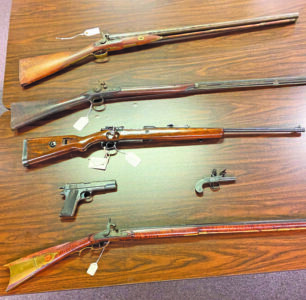
Another story is connected to a Model 98 Mauser because it was owned by Major Gen. Homer M. Groninger, Willi said.
The displays in the Military Room upstairs at the Academy provide historical information about Groninger's distinguished service. The model 98 Mauser was designed in Germany by Paul Mauser in1898. Many of these former military rifles have been "sporterized" and were favored by hunters.
Two weapons in the academy's collection are especially valuable because they were assumed to be lost forever. They were a 1911 Colt and a flintlock pistol from the American Revolution era.
These weapons, along with a Civil War fife, were recently returned to the museum last year after they were stolen 45 years ago and had been mostly forgotten.
The 1911 Colt was carried by a Juniata County native, Alfred J. Bartram, who was badly wounded during the Argonne Offensive of WWI and was awarded the Purple Heart. Colt model 1911 was adopted by the US Army on March 29, 1911 and then by the Navy, and the Marine Corps in 1913.