
Lottie and Ruby Wood: A mother, a daughter, and a circus
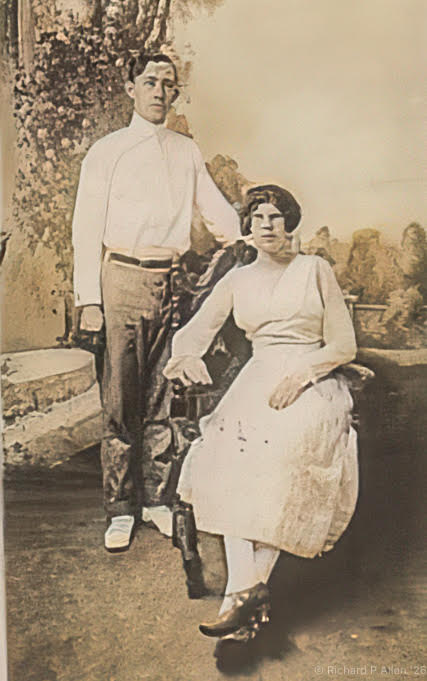
PHOTO PROVIDED Ruby and her husband, Harry Dalvine, shown in an early twentieth-century portrait. Ruby later became associated with equestrian and circus entertainment.
You never know when a story is waiting for you — or where it will lead once you begin to follow it. Sometimes it arrives quietly, disguised as an ordinary afternoon. Sometimes it pulls you somewhere unexpected.
It was a brittle February day, the kind when the cold settles deep into the bones and refuses to leave. Outside, the Susquehanna lay steel-gray and unmoving. Inside the Genealogy Library at the Taber Museum, the air carried the faint scent of aging paper and polished wood — the perfume of memory.
I was stuck.
Anyone who writes knows the feeling: that uncomfortable stillness when inspiration refuses to stir. When that happens, I rely on instinct. I reach for a book, any book, and let history decide.
My hand fell on History of Little Pine Valley by Harry Stephenson, Sr. (1992). I opened it idly.
That was when I met Lottie Wood.
The Last Stagecoach Driver
Lottie was born in Waterville in 1878, the daughter of Michael and Margaret Harrison Wolf. It was a world of mud roads and hard winters, where survival depended on muscle, endurance, and grit. Her father, Michael, was a farmer — but more than that, he had secured a contract to supply horses for the stagecoach line. The animals were housed in his stables, and the rhythm of Lottie’s childhood was the steady thud of hooves against packed earth.
She did not merely grow up around horses; she grew up understanding them. She learned their moods, their tempers, the subtle shift of weight before a bolt. Where other girls might have learned embroidery, Lottie learned harness leather and reins worn smooth by calloused hands.
In 1897, a photograph captured her seated high on the stagecoach bench, posture straight, hands sure on the reins. Her father sits in the passenger seat beside her — not guiding, not correcting — simply present. The image speaks volumes. She is young, but there is no hesitation in her expression. The valley road stretches ahead, and she intends to master it.
She married Frank Wheary and had five children. Then in 1909, fire tore through her life. Frank died before his youngest son was even born. One imagines the smoke, the chaos, the silence afterward — the weight of widowhood settling on a woman not yet thirty-one.
Many might have folded under such loss. Lottie did not. She married George Wood, a local carpenter, and continued forward. Through grief and responsibility, through the raising of children and the daily demands of rural life, she kept her hands steady.
She became the last stagecoach driver in Little Pine Valley.
I thought this was the story. It wasn’t.
A Daughter Named Ruby
In 1904, before tragedy struck, Lottie gave birth to Ruby June.
If Lottie carried steadiness, Ruby carried spark.
Ruby grew up perched beside her mother on the stagecoach bench, boots barely reaching the floorboard, absorbing the language of leather and wind. She watched how her mother handled a skittish team, how she squared her shoulders against rain, how she never allowed doubt to show.
Children do not just inherit skills; they inherit atmosphere. Ruby inherited courage as something ordinary.
But the valley was small. The roads, though winding, always led home.
The Call of the Circus
By the 1920s, America was restless. The Great War had ended. Jazz drifted through open windows. Women had secured the right to vote. The country was in motion.
And so was the circus.
When the circus came to town, it did not simply arrive — it transformed. Posters bloomed on brick walls overnight. A parade wound through the streets, brass bands blazing, elephants swaying, riders standing upright on galloping horses. For a few dazzling hours, ordinary life stepped aside.
Names like P. T. Barnum and Ringling Brothers became legend, but the true heartbeat of the circus lay with its performers — the women who balanced, leapt, and rode beneath canvas ceilings that snapped in the wind.
Press agents invented romantic backstories: heiresses fleeing privilege, waifs rescued from poverty. The truth was often simpler and braver. The circus offered wages. Travel. Applause. It offered women visibility at a time when independence was still radical.
For Ruby, the circus was not spectacle. It was invitation.
Running Toward the Ring
In 1922, Ruby ran away to join the circus of Rhoda Royal, known for wild animal acts and equestrian exhibitions. Her uncle performed there, billed flamboyantly as the “world’s greatest bareback rider and leaper.”
In a 1974 interview in the Tampa Tribune, Ruby recalled visiting him — seeing the tents rise like temporary cities, smelling sawdust and horse sweat mingling in the humid Pennsylvania summer. One can imagine her pulse quickening, recognizing something both familiar and thrillingly new. Horses she understood. Applause she had never known.
Her first escape was brief. Lottie brought her home.
Picture that meeting. A mother who had carved her own path in a man’s world standing firm before a daughter determined to carve hers further still. Lottie knew the cost of hard living. Ruby saw only possibility.
The cycle repeated. Ruby left. Lottie retrieved. Love tugged from both sides.
Eventually, Lottie understood something only the strongest parents grasp: some callings cannot be argued away. They must be ridden out.
Riding Under the Big Top
Performing under her middle name, June, Ruby stepped fully into circus life.
She rode with the Al G. Barnes Circus out of Culver City, the Sells Floto Circus, and eventually the grandest of them all, Ringling Brothers Barnum & Bailey Circus.
Under the big top, the air was thick with anticipation. Sawdust softened the ring floor. Gaslights — later electric bulbs — cast a golden haze. When the band struck up, June would mount, muscles coiled, skirts flashing white against the dark sheen of a galloping horse.
Bareback riding demanded absolute trust. A misstep meant injury. A lapse in focus meant disaster. She stood balanced on a moving animal, guiding with knees and subtle shifts of weight — the same language her mother had taught her on valley roads, now amplified beneath thunderous applause.
She performed alongside Tom Mix, the celebrated cowboy film star and Pennsylvania native. In 1926, she rode with him in the Tournament of Roses Parade, accompanying the “I’m Sitting on Top of the World” float — a fitting title for a woman who had once stared beyond a small valley and chosen motion.
Crowds cheered. Cameras flashed. Programs bore her name.
Yet circus life was not all glamour. It meant constant travel, long rehearsals, injuries hidden beneath costumes, friendships forged quickly and parted just as fast. It meant living in motion.
In 1965, failing health forced her to retire. She settled in Gibsonton, Florida — a town known quietly as winter refuge for circus folk — where the extraordinary became ordinary once more.
She died on February 13, 1983, at seventy-seven.
Her obituary was brief. It mentioned that she had come to Florida from Pennsylvania. That she had been a circus performer.
It did not mention the thunder of hooves. The gasps of crowds. The long conversations between mother and daughter about risk and belonging.
History is often economical with words.
Two Eras, One Courage
I thought I was writing about a stagecoach driver.
And Lottie Wood’s life alone was remarkable: born in 1878, widowed young, raising children, mastering horses, guiding a stagecoach into the edge of modernity. Strength defined her.
But strength shifts shape with each generation.
Lottie’s courage was endurance — staying the course when roads were rough and options few.
Ruby’s courage was departure — choosing uncertainty over safety, applause over familiarity.
Yet Ruby did not reject her mother’s life. She expanded it.
The reins Lottie once held against winter winds became, in Ruby’s hands, tools of performance and freedom. The same balance, the same nerve, the same understanding of powerful animals carried from valley roads to circus rings.
Two women. Two eras. One shared inheritance of grit.
And it began in a quiet barn, in a narrow valley, where a little girl watched her mother drive forward without fear — and learned that courage, once seen, can never be unseen.
Jo Ann Tobias, a volunteer at the Lycoming County Genealogy Library, enjoys uncovering inspiration wherever she finds it.
Lifestyle News
Anti-trafficking group receives grant
Fierce Love 4 Good recently announced that it has received a generous grant from the Century Fund for Human ...
Lottie and Ruby Wood: A mother, a daughter, and a circus
Soil is the foundation of a garden — keep it healthy
‘Salute to America’ concert coming
“A DREAM that a stirring patriotic concert would be presented in Williamsport to celebrate the 250th Anniversary ...
Library to host free family fun day
The James V. Brown Library, 19 E. Fourth St., will host its annual Sips & Stories Free Family Fun Day, ...
James V Brown Library resumes Community Book Club program
The James V. Brown Library, 19 E. Fourth St., has resumed its Community Book Club program, hosted by Phoebe Wagner, ...