
Trending
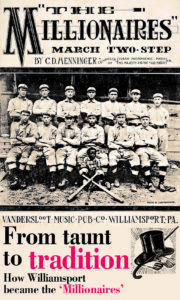
Few school nicknames capture a city's history as vividly as the Williamsport Millionaires. Today, the image of a top hat resting above white gloves, crossed by a cane and sometimes accented with a carnation, is instantly recognizable across uniforms, publications, and school organizations. Yet both the name and the symbol trace back more than a century--to the rough-and-tumble world of early professional baseball.
The story begins in the early 1900s, when Williamsport fielded a team in the Tri-State League. The league itself occupied a gray area in organized baseball and was sometimes described as an "outlaw league," operating outside the formal structure of the National Association. It competed aggressively for talent, offering salaries that rivaled those of major-league clubs.
Backed by the considerable wealth of local lumber interests, Williamsport became one of the league's most ambitious franchises. The city's businessmen--many of whom had made fortunes during the lumber boom--were willing to spend heavily to secure top players, including established major-league talent from clubs such as the Cincinnati Reds and the Philadelphia Athletics. Rival cities took notice--and took offense.
Sportswriters in Harrisburg, Altoona, and other Tri-State League towns began referring to the club as the "Williamsport Millionaires." The name was intended as a jab at the team's free-spending approach and at the city's reputation for wealth. Contemporary newspaper accounts show the nickname appearing during the 1905 season in game reports and league standings, suggesting it was quickly adopted in regional coverage. No comparable usage appears in 1904 or earlier accounts, indicating that the term emerged in direct response to Williamsport's aggressive player recruitment that year.
Williamsport embraced the label. What began as a taunt became a point of pride. The name gained further legitimacy when the team captured the Tri-State League championship in 1905, cementing its place in the city's sporting identity.
Contemporary coverage also shows that the nickname retained its sharp edge even after it became widely used. A 1906 Harrisburg newspaper article referred to Williamsport as the "haughty Millionaires," reflecting lingering resentment among rival cities.
By 1911, however, the Williamsport franchise itself had disappeared from league play. The team was gone--but the name endured. Over the following decades, "Millionaires" migrated from professional baseball into the broader culture of Williamsport athletics.
By 1929, newspaper accounts referred to Williamsport High School basketball players as "Millionaires," and by the late 1930s the term appeared regularly in the school's yearbook, La Memoire. Other nicknames -- such as "Wolfmen" and "Rockmen"-- appeared briefly, tied to particular coaches, but none matched the staying power of "Millionaires," which resonated with the city's history.
That history, of course, lay in the extraordinary wealth generated by the lumber industry in the late nineteenth century. At its peak, Williamsport was said to have more millionaires per capita than any city in the United States. The grand homes along West Fourth Street became known as Millionaires' Row, reinforcing the association of the moniker to the city and its prosperous past.
Yet for all its longevity as a nickname, the Millionaires identity remained purely a word for decades. The now-familiar visual symbol did not appear until the early 1960s. The logo was created by Thomas B. Mikan, a student in the sign-painting program at Williamsport Technical Institute (now Pennsylvania College of Technology). His design distilled the idea of a Gilded Age gentleman into a simple, striking composition: a tall top hat resting above a pair of white gloves, with a cane angled across the image and a carnation tucked alongside.
What is particularly revealing is how the logo seems to have entered school culture. The earliest known appearances are in the early-1960s editions of the high school yearbook, La Memoire, where the image appeared atop pages labeled "Patrons," listing individuals who financially supported the yearbook. The symbol then migrated to student nickname pages and later to senior recognition sections--suggesting it initially represented wealth and distinction before evolving into the school's athletic emblem.
By the late 1960s, the Millionaires symbol had established a foothold in school publications. Although its exact transition into athletic use remains to be pinpointed, the design's clarity and simplicity made it ideally suited for broader adoption. Over time, it became the standard emblem for Williamsport teams and organizations.
Today, the Millionaires identity extends well beyond athletics. The school's band performs as the Marching Millionaires, and the symbol appears in student media, including the Billtown Banner. The image created by a sign-painting student more than sixty years ago has become one of the most enduring visual symbols in the region.
The evolution of the name and logo tells a larger story about Williamsport itself. A nickname coined in 1905 as a criticism of a free-spending baseball team was embraced, preserved, and ultimately transformed into a lasting expression of community pride.
Today, the symbol of the Williamsport Millionaires appears throughout the entire school district. Banners bearing the familiar top hat, gloves, and cane hang outside Cochran Primary School--on land that once formed part of Athletic Park, the city's principal ballfield at the turn of the twentieth century and home of the Williamsport Millionaires from 1904 to 1910. More than a century after rival sportswriters coined the nickname in jest, the "Millionaires" have come full circle--transformed from a jeer into a lasting emblem of community pride and identity.