
Pedaling to independence: Williamsport women and bicycles
Trending
Today, most women have choices for transportation, exercise, and recreation. But in the mid 19th century , there was little thought given to exercise other than an occasional game of croquet, and participation in sports was ill advised for such delicate constitutions. Although women had to assume more household responsibilities during the Civil War, life was still centered on church and home.
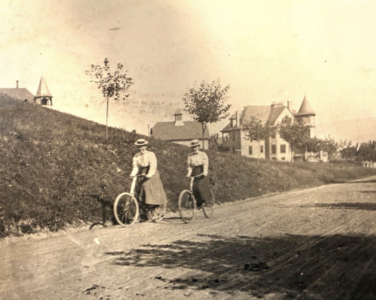
But as the 19th century continued, multiple influences were at play. Women of a certain class had more flexible time to participate in what was to become the women's club movement. The rise of the popular magazine introduced a common culture, and it was the age of invention. Bicycles were to become tools of change for women so that they could take advantage of all life had to offer them.
The Bicycle Fad
The bicycle craze would touch the lives of both men and women. Bicycles saved money as convenient transportation, and there was a new emphasis on getting fresh air and exercise which brought about a demand for better roads for riding. In this age of innovation and invention, the design of the bicycle became affordable and could be constructed with women in mind as well.
Of course, there were naysayers who said women were too frail for such activity or at least should limit their time riding. There was also the matter of being unchaperoned and their morality could be questioned. It was one step from becoming a fallen woman, and there was a further claim that cycling encouraged women to take up smoking.
An article in the April,1898, Williamsport Sun promoted the safety of the tangent bicycle with its dropped frame to allow for skirts. The column took another approach, stating that " Two neat looking women riders together on a tandem make a pleasing sight to the passerby...."
Riding Clubs
Men had especially enjoyed the camaraderie of riding clubs. The all-male Tivy Wheel Club in Williamsport rode together for 15 years but held reunions for 32 years afterward.
Public and social spaces belonged to women, too. An article in the June 1897, Williamsport Dailey Gazette and Bulletin explained that women riders are competent to indulge in trips of 40-60 miles a day without showing signs of fatigue. Club members had to face the fact that unless wives and sisters could take part, many members would have to drop out. Besides, men acted better with women along for the ride.
A New Vocabulary
With the bicycle craze came new vocabulary words and phrases-- lady cyclist, wheelwoman, pedal pushers, bloomerite, wheeling, safety bicycle. Popular magazines began to circulate widely during this time period, and frequently utilized the jargon in advertisements, news articles, and fiction stories, thus romanticizing bicycle culture even further.
Although bicycle design tried to accommodate long skirts, bloomers now made so much more sense. Williamsport newspapers carried numerous articles about women wearing bloomers in major cities throughout the world -- New York, Chicago, Rome , Paris. Bicycles and bloomers were twins with the one necessitating the other, until the local newspaper reported that at a party in Chicago, women wore bloomers without a bicycle in sight.
There were variations on appropriate clothing for female cyclists, not just bloomers, and skirts were coming above the ankle. A local newspaper ad in 1895 invited women to send to Pope Manufacturing company in Hartford, Connecticut for a selection of "ladies bicycle costumes by noted designers." More importantly, women now had the flexibility to choose a manner of dress that fit their particular life style.
Bicycle Week
Bicycle Week in April brought many competitive bicycle ads to local papers each year. An article in the Williamsport Sun and Banner in 1898 carried the headline, "No Better Bicycles Built Anywhere." Demorest Manufacturing Company started as a sewing machine factory with an extensive facility on the west end of town at Oliver and High Street.
The company began manufacturing bicycles in 1891 and shipped them throughout the United States and to many foreign countries. One hundred employees working 14 hours a day turned out 75 bikes per day including three models for ladies. There was also the Tivy Cycle Manufacturing Company on Walnut Street that employed 35 men who worked 10 hours a day; and Elite Bicycles on Campbell Street also manufactured separate models for ladies.
By 1900, the ads during Bicycle Week included Adam's Sporting Goods, Kline and Company, and Harder Sporting Goods Company at 336 Pine Street. Harder sold ladies bicycles for about $30 with a discount for cash. The Reading Standard Manufacturing Company also distributed in Williamsport and its ladies bicycle models were the Light Roadster, the Standard, and the Royal.
Imagine Williamsport Women cycling to the Clio Club organized in 1897 to advance their interests in culture, education, social welfare, and international concerns. They could travel to the newly established local YWCA for services and programming just for women and girls, or perhaps they were heading for a meeting of the local Red Cross. They might be shopping at the Bush & Bull Dry Goods store or even working there as a shop girl. And of great significance , they could bike to the Suffrage Club organized in 1914 in the Park Hotel-- a journey for equality that continues today.
About the author:
Janet McNeil Hurlbert served as Associate Dean and Director of Library Services at Lycoming College's Snowden Library from 2000 until her retirement in 2013. She also spearheaded the Lycoming County Women's History Project. After retiring, she returned to her hometown of Ames, Iowa, where she has remained actively involved in her community. Her work includes volunteering with the Boone Historical Society, playing oboe with the Heart of Iowa Senior Band and the Des Moines New Horizons Band, serving meals with Food at First and Lasagna Love, and contributing to committee work for Green Hills Retirement Community.