
4-Hers learn about biology, livestock at animal science day camp
Trending
On June 30, Lycoming County 4-H hosted its first-ever animal science day camp, Barnyard Bonanza, giving youth the opportunity to explore livestock through hands-on learning, demonstrations, and educational activities. According to a news release. the camp focused on livestock species and introduced participants to a variety of animal science topics.
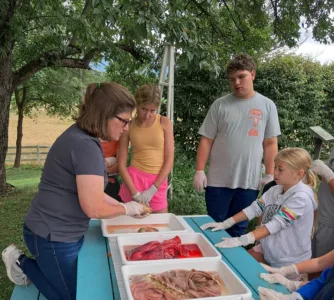
During the morning session, participants welcomed Dr. Jody Kull, an animal science professor from Penn State University, as a guest instructor. Dr. Kull brought a dystocia cow model, a physical teaching simulator used to demonstrate difficult calvings and the proper positioning of a calf before birth. Participants had the opportunity to glove up and experience what it would be like to examine the inside of a cow using only their sense of touch. They then worked together to safely deliver the calf from the simulator, gaining a better understanding of the challenges that can occur during calving.
"Participants also explored a variety of animal tissue samples, including a swine heart, sheep lungs, a ruminant stomach, and a calf," the news release said. "Youth were able to examine and feel the samples while learning about the different organs and their functions. Some participants also had the opportunity to assist with a calf dissection."
Dr. Kull continued the morning with a lesson on livestock health and anatomy. Participants examined various animal skulls and learned about common "creepy crawlies" that can affect livestock, including worms, mosquitoes, and ticks. Youth were able to view specimens under a microscope, providing an up-close look at organisms that can impact animal health.
In the afternoon, participants rotated between two hands-on learning stations. The first group completed a livestock skillathon, a contest-style activity designed to test participants' knowledge of livestock, the news release said. The Barnyard Bonanza skillathon included 25 multiple-choice questions covering a variety of livestock species, including horses and llamas. Questions challenged participants to apply what they knew about animal characteristics, anatomy, and management. For example, participants were asked, "Which of the following is not a ruminant: sheep, horse, cow, or deer?" The correct answer was horse.
The second group learned about meat cuts and livestock anatomy by completing interactive meat-cut puzzles featuring sheep, swine, beef, and poultry. The puzzles included detailed visuals of meat, bones, cartilage, and skin, helping participants understand how an animal is broken down into retail cuts. Youth also used cow and swine models to explore both the internal and external anatomy of these species.
"To finish the afternoon, participants practiced ear tagging using cow and swine simulators," the news release said. "They learned why livestock are identified with ear tags and the importance of proper animal identification. Youth were able to practice the technique using the simulators before working with live animals, providing a safe and hands-on introduction to an important livestock management practice."
Barnyard Bonanza provided Lycoming County 4-H members with a unique opportunity to explore animal science through hands-on experiences that went beyond the traditional classroom. From anatomy and livestock health to meat science, identification, and skillathon activities, participants gained knowledge and practical skills that can be applied to their 4-H livestock projects.
"The success of Lycoming County 4-H's first animal science day camp demonstrates the value of providing youth with engaging, experiential learning opportunities. Barnyard Bonanza gave participants the chance to learn, explore, and get hands-on with animal science while building skills they can carry into their future 4-H projects and beyond," the news release said.
For additional information on 4-H programs in Pennsylvania, contact your county Penn State Cooperative Extension office at extension.psu.edu/counties or visit the Pennsylvania 4-H Program web site at extension.psu.edu/programs/4-h.
Administered in Pennsylvania by Penn State Extension, 4-H is a community of more than 6 million young people across America learning leadership, citizenship, and life skills. Penn State Extension 4-H youth development educators in all 67 counties throughout the commonwealth administer local 4-H programs through non-formal education and outreach. To find your local program, visit the Penn State Extension website at https://extension.psu.edu/programs/4-h.
Penn State College of Agricultural Sciences research and extension programs are funded in part by Pennsylvania counties, the Commonwealth of Pennsylvania, and the U.S. Department of Agriculture. Where trade names appear, no discrimination is intended, and no endorsement by Penn State Extension is implied. Penn State encourages persons with disabilities to participate in its programs and activities. If you anticipate needing any type of accommodation or have questions about the physical access provided, please contact Alexandria Armstrong, 570-433-3040 in advance of your participation or visit. This publication is available in alternative media on request. Penn State is committed to affirmative action, equal opportunity, and the diversity of its workforce.