
Boscov’s continues to thrive
Trending
Filing for Chapter 11 bankruptcy often means the end for a company.
A good example is the former Bon-Ton store at the Colonial Park Mall in Lower Paxton Township - its sign still on the building - the last reminder of the former department store chain.
But bankruptcy isn't always the death knell for a business. Quite the contrary. Sitting at the other end of the Colonial Park Mall is Boscov's. Fifteen years after the retailer filed for bankruptcy, the company isn't just surviving, it's thriving.
Boscov's strategy seems simple enough: be fiscally responsible, don't take on debt, fill in the void in certain retail areas, advertise, don't expand too fast, offer good value, provide a broad assortment, rely on longtime customers and above all else, offer something that is harder to find these days - good customer service.
For the 105-year-old department store chain, which includes stores in Selinsgrove, Wilkes-Barre and Hazleton, that strategy seems to be working.
Boscov's CEO Jim Boscov said the Reading-based company is expected to make $1.2 billion this year and has zero debt. Being fiscally responsible might be what allowed it to survive the long closure during the pandemic in 2020.
"We have no debt so we could survive being closed for three months and continue to pay healthcare for our co-workers," Boscov said. "We have good relationships with our vendors so that even when other companies were struggling to get inventory on the shelves, we were OK."
Boscov said he was never worried that the retail chain wouldn't survive.
"Every morning I met with a core group of people and we dealt with the problems of the day, but at no point did I worry that we weren't going to survive," he said. "People look at me and they think how is that possible? That was never going to be an option. We had money in the bank and we had liquidity so that we could survive for an extended period of time."
Boscov talks a lot about customer service and personal connections. And he practices what he preaches. He tries to visit a store each week if possible to talk to employees. Last year he visited 38 of the company's 49 stores.
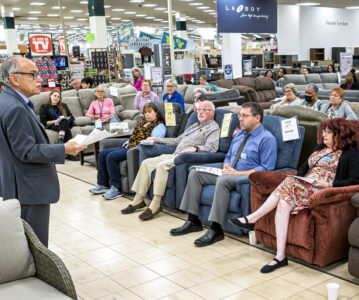
On a recent Friday morning in April, he visited the Colonial Park Mall. The furniture section doubled as a meeting space as he talked to about 30 employees.
One of the main reasons for this particular visit was to dispel rumors that the 37-year-old store at the struggling mall is closing. He wanted to tell them in person that the store will remain open rather than just send a note.
"We're going to be here for the next 100 years," he told the employees and then joked, "I'm probably not going to be here that whole time."
He also informed the employees that he recently found out the mall has a buyer - Stonewall Capital.
"Here's the good news, you have a prospective purchaser who's really good," he said, adding that the store is doing very well even as the mall struggles.
'Socks have become the new ties'
In an ever-changing retail world, Boscov said the company continues to learn and evolve but takes its time to make decisions, adding that the company is always looking for new opportunities.
"I think that's what retailing is," he said. "You look at areas that need to be improved."
After Toys 'R Us closed in 2018, many retailers, including Boscov's, put extra focus on the toy business during the holiday shopping season but Boscov said it's something they focus on all year long.
"Kids have birthdays every month of the year and birthday parties every month of the year," he said. "So if you have toys only in November and December, you're missing out on something."
At one time, the maternity category was dominated by Destination Maternity, a leased department. Then in 2019, the company went bankrupt.
"We said we're good at this stuff - this retailing stuff," Boscov said. "Let's send our buyers out into the market and build our own department and offer a better assortment, offer greater value, and watch this grow. It's a great challenge for our buying division. They're doing a good job. We're going to continue to be better there."
The company is increasing its stock of women's dress shoes to target that market and has hired a buyer to grow that area.
"In ladies' shoes, we are the comfort and walking capital of the world," he said. "We are. But we're selling so many wonderful dresses for social [events] and we have wonderful handbags but we didn't have a big enough assortment of dress shoes."
The increase in dress clothes is something that seemed unthinkable a few years ago when many people were working from home and not going to social events.
But Boscov said that has changed dramatically in the last year.
"Dresses just went through the roof - same thing with men's suits," he said.
The pandemic did change the way customers shopped for a while. Boscov said e-commerce jumped about 5 percent but has since settled back down.
Home décor, furniture, mattresses, draperies, and shower curtain sales increased when people were spending a lot more time at home but those sales have since decreased.
Boscov said that people have become more casual. Ties are out. Socks are in.
"Socks have become the new ties," he said. "So if you look at our sock department, it's much bigger, much more flamboyant ... socks have become a source of expression."
'Wait a minute, let me post this'
Boscov's is making changes. Tailoring, restaurants, and catering are out of its stores. Self-checkouts are getting a try. Wi-Fi is being added.
About 14 Boscov stores this year will experiment with self-checkouts, but Boscov said this is for customers who prefer self-checkout and will not replace employees.
Boscov said an interaction with a customer showed him why adding Wi-Fi to the company's stores is important.
"There was a woman in her 40s that came in," he said. "She had two teenage kids. She said 'I haven't been in the store before ... I can't believe what Boscov's has. You have all the stuff my kids are going to other stores for and you've got it at half the price.'"
"And at the end of the day I went to see her," he said. "She said 'I have to show you this.' She showed me pictures of her haul - $700 worth of stuff. She said 'I can't wait to tell my friends. Wait a minute, let me post this.' She couldn't post it because we had no Wi-Fi. It made the case very clearly to me [that] we need to [fix that] so I've been talking to IT."
Reaching the customer
This year, Boscov's is planning to open its 50th store, in Clarksburg, West Virginia. Boscov rattles off the media companies in the area - three newspapers, two television stations, and a number of radio stations - and said he visited most outlets in one day, adding that it's a self-contained market where the company should do very well.
"Our ability to advertise within a market is one of the things that leads to our success," he said.
Boscov said the company reaches customers differently than before, sending out more ads by mail as newspaper subscriptions have decreased. And it sends emails with links so customers can page through the insert.
Boscov's has been strategically slower in the area of digital marketing.
"We are doing more advertising online but we're being careful and we're learning about it," Boscov said. "A lot of companies just jump to digital marketing like crazy. They put a fortune into it without any proof that it was working. I'm a little different. I want to experiment with things but I want to test and measure. As we find that it works then we'll do it."
Boscov said he isn't on social media, but the company has increased its social media presence.
'Our stores become a destination'
In recent years the so-called "retail apocalypse" has gutted many malls. Boscov is so familiar with dying malls that when he talked to employees at the Colonial Park Mall store he explained the different phases of dying malls and gives an example of each phase based on the retailer's experience.
He said at first when malls began to struggle, there were concerns. But the company is not as worried anymore because they've learned that Boscov's is enough of a draw to survive on its own, even when a mall disappears.
"Our stores become a destination," he said.
He pointed to a Boscov's store in New Jersey as an example.
"Our Atlantic City store does very, very well at a mall that disappeared," he said, adding he has never moved a store because of a poor-performing mall.
'I don't believe that you hand them a handbook'
Boscov's was founded in 1918 by Jim Boscov's grandfather, Solomon Boscov. Jim Boscov worked for almost two decades under his uncle, Albert Boscov, before leaving to start his own business. He returned years later when Albert Boscov came out of retirement to save the business after it filed for bankruptcy.
In 2008, Albert Boscov and his family bought Boscov's assets out of bankruptcy court for $300 million that included $200 million in bank financing, $60 million of the family's savings and a $43.7 million loan from the federal Department of Housing and Urban Development. The loan was backed by the state and six Pennsylvania counties.
Boscov, 73, has been CEO since 2015. He said the business, with its headquarters in Reading, is 100% family owned and will stay that way.
Boscov said the company doesn't plan to expand rapidly but will open an additional store each year. In addition to Pennsylvania and New Jersey, the chain has stores in New York, Delaware, Maryland, Connecticut, Rhode Island, and Ohio.
Boscov said it's important to evaluate a location and make sure the company is with a mall or developer it is comfortable with and in a market where the store can be successful.
He added that teaching the culture of the company to new employees in new markets is very important. The retailer sends 150 people from its existing stores to help out for three to four weeks at the new outlet.
"We hire about 200-250 people to work in a new store but they have no idea what a Boscov's is," he said. "And I don't believe that you hand them a handbook and [say] go read this, this is what Boscov's is. I believe you have to work side by side with somebody."
Boscov said that at the end of the day, nothing replaces the personal service the company provides.
"It's the relationships that they [the employees] establish with the customers that you can't find anymore," he said.