
Industry magazine recognizes successes of foundry
Trending
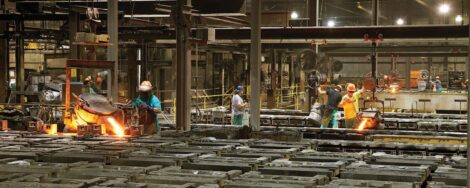
Benton Foundry operates in a clean and modern facility located in the mountains of central-eastern Pennsylvania according to Shannon Wetzel in an article for Modern Casting magazine. The world-class foundry showcases a commitment to smart, incremental and consistent reinvestment.
Recently, Benton Foundry has completed one of the largest expansions in the metalcaster's history. The expansion involved 70,000 square feet of renovated space and enhancement to coremaking capabilities. The expansion was completed in fall 2022. Due to this accomplishment, Benton Foundry has been named Modern Casting's "Metal Caster of the Year," according to the article.
"My father was very motivated to turn this into a successful business, as was his father AJ Hall," Jeff Hall, president of Benton Foundry, told Modern Casting. "And the mindset was always to keep the profits in the business and to reinvest them. As a result of that mindset, they started working off five-year CapEx, cash-flow budget plans in the mid-1970s. And we continue to do that to this day. We are now in our ninth five-year plan. So, our modernization mindset has been in place for basically 45 years."
Over nearly five decades of reinvestment Benton Foundry has allowed for a compact, efficient melt deck, automation, good visibility within the plant, excellent air control, an active apprenticeship program and production growth for 18 tons a day to now nearly 225 tons according to Wetzel.
Tim Brown, Benton Foundry vice president stated, "In that time, we've never lost money, and we've been a survivor in the foundry industry, having gone from 8,000 foundries to less than 2,000."
The most recent project had spanned 10 years, according to Hall. Operations worked to catch up the rest of the systems to the foundry's melting department which features two 10-metric ton Inductothermal induction furnaces and a dual track system with two 4-metric ton Inductothermal induction furnaces.
"We had more melt capacity than anything else," Hall told the magazine. "We could pour 300 tons a day, and at that time we were probably pouring 125 tons a day. So, we looked at our supporting systems and what our footprint would need to be to hit 225 to 250 tons a day. We"ve gone through several different phases since then to maintain or improve flow."
Benton Foundry relocated its 15,000-square-foot maintenance department to the northwest corner of the building and added functionality for engineering resources and high density storage in 2015, according to the article.
"The next phase in 2017 was adding another sand silo for tempering our sand system," Hall said. "That way we had 725 tons of sand, or enough capacity to match up with that 300 tons a day on the melt side."
According to Wetzel the lab relocated a portion of pattern storage to free up floor space, while work was done to upgrade the way the foundry stored and retrieved its patterns.
"One of the objectives for the pattern storage was to eliminate the manual handling of the pattern." Hall told Modern Casting. "Now everything - location, work instructions, ect. - is digitalized."
By 2019, Benton Foundry has increased the capacity of its sand system to match its melt system, according to Wetzel. The foundry was able to make important chess moves with its maintenance and pattern storage to improve operational flow and make room for additional renovations.
The next focus, according to Modern Casting, was the coremaking, core assembly and casting cleaning and grinding. According to Wetzel, this launched the largest expansion Benton Foundry has launched to date. The expansion entitled the creation of a new core room, core sand system, moving shipping, adding more space for grinding, replacing the foundry's fleet of cleaning machines from the 1970s and adding more robotic equipment. According to the article, in 2019, Benton Foundry could process 5,000 tons of prepared core a year and the goal was to double that.
In the renovated core room features were added such as two new 200-ton rave sand silos plus a silo for bentonite, a mixer deck with 750-pound and 300-pound capacity OMCO mixers, a resin room with 6,000-gallon capacity resin tanks, a weigh deck for automatically measuring the sand additives, a Solex heating and cooling unit to control sand temperature, and two 12,500 cfm MT Systems scrubbers.
The foundry also created two new wetlands in its vicinity and fenced them in to protect them from deer. According to Brown the wetlands are meant to filter rain runoff to help clean up the Chesapeake Bay Watershed. Benton Foundry also added a riparian buffer to keep sediment out of the water.
According to the article, the $500,000 environmental expansion included 1.6 acres of engineered wetlands, the planting of over 1,200 native trees and shrubs, 0.17-acre rain garden and bioretention area to take the runoff from the main employee parking lot, 0.4-acre infiltration berm, o.25-acre amended soil zone to mitigate highway runoff, and 2.7 acres of vegetated swale with check dams and water quality filters.
"The goal is to have less rainwater flow into the Chesapeake Bay during surge events," Brown told Modern Casting. "The system that is underneath the blacktop is an elaborate system to slow the water and let the sediment fall out before reaching the stream. It is pretty ornate."
Benton Foundry was awarded the 2022 Green Foundry "Sustainability & Stakeholder Engagement" Award for these innovations.
"A key reason for our depth of talented people ties into our apprenticeship program and scholarship endowments we have," Hall said, according to the magazine. "In our in-house apprenticeship program, employees can apply to go through a qualifying round of interviews and testing. We evaluate their goals versus what our needs are and make sure our goals are aligned. It starts out as a two-year program where they work for 20 hours and go to school for 20 hours; we pay them for 40 hours of work, and we pay all expenses. When they're done with the two-year degree, they have to commit to staying with us for two more years. Our retention has been very, very high, and we've been doing this for probably 20 years."
According to the article, Benton Foundry also offers an apprenticeship program for a four-year master's degree. The foundry has accumulated a dozen associate-degreed staff, 20 with bachelor's degrees, and six people with master's degrees through this program.
"For an organization of our size and the iron industry, we think that's greater than most," Hall said. "We also have an endowment at the Pennsylvania College of Technology that helps fund that apprenticeship program. Typically, we have no less than two students going to school every semester."
Through the career opportunities and maintaining a positive working environment, Brown said, they are making inroads.
"The automation we are doing is part of that," Hall said, according to the magazine. "So is the improved lighting, housekeeping, and ventilation. It allows us to mitigate from the traditional young, male workforce to a larger pool of people, recruiting men and women of varying ages. Women are the greatest untapped resource in the foundry industry."