
Montandon woman’s optimism, positivity helped her through breast cancer treatment while persevering through additional difficulties
Trending
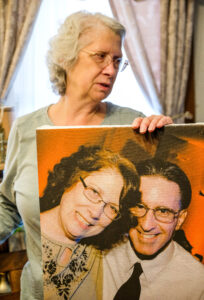
Teresa Meisinger, of Montandon, has endured quite a bit in the last couple of years.
She had surgery to repair three aneurysms. She lost her job during the pandemic. She lost her mother to COVID-19 and her father to Alzheimer's. Most recently, she lost her husband, Vince, to a stroke.
On top of all that, she was diagnosed with breast cancer last year. She has had surgery, four rounds of chemotherapy and 15 rounds of radiation.
Now she has a new job, is taking hormone blocking therapy to ensure her breast cancer will not come back and wants to share her story to encourage others.
Teresa's breast cancer journey began when she was diagnosed in November 2020. She went in for her annual mammogram, which she did faithfully every year, and it was clear.
Five months later she noticed discharge from her nipple and she knew something was wrong. She called her family doctor and he immediately scheduled her for a mammogram and ultrasound at Geisinger.
They found a mass and did a biopsy, which led to her breast cancer diagnosis. She was told it was in the very early stages.
A few weeks later Teresa met with Dr. Joseph Blansfield, a Geisinger physician in surgical oncology, who told her she would need a partial mastectomy. She underwent surgery before the end of May.
She then began four rounds of chemo, followed by 15 rounds of radiation, ending in October 2021. She now takes hormone medication to ensure the cancer does not return. Her oncologist, Dr. Victor Vogel, told her about the hormone medication, "It is proven that this works, without it you have a 40 to 50% chance of the cancer returning," he told Teresa.
How does she maintain her positive outlook?
"I have always considered myself a strong person," she said, "and I have a very strong faith in God, so that has a lot to do with it."
That positive outlook began the day Teresa received her cancer diagnosis from Dr. Monica Froicu.
"I had a gut feeling that was what the outcome was going to be, but the way she talked to me on the phone was incredible. She said, 'Look, I have seen a lot of people battle cancer, and the key thing is having a positive attitude through the whole thing,'" Teresa recalled. "'Listen to your team of doctors and nurses who are there to help you and I can't stress enough having a positive attitude through the whole thing.'
"I got off the phone with her and my daughter-in-law and I had a good cry. My husband came home from work and him and I had a good cry. He said, 'I have no doubt in my mind that we are gonna get through this,'" Teresa said.
"I believe in trying to have the best attitude possible to get through life's ups and downs, but it was her encouragement that started to keep me focused," she added.
The entire Geisinger team was phenomenal along the way, according to Teresa.
"I never felt alone between the care I got at Geisinger as well as my family, because they were all there for me," shared Teresa.
Not that there weren't bad days along the way.
"Chemo is rough, there are no ifs, ands or buts about it. After the first one, it's like, oh my God, do we have to do this," she said.
"I'd have chemo on a Thursday and by Sunday, I was done. I was toast for about three days. But you know you bounce back from that and you just keep going," said Teresa.
Teresa said it was a matter of doing what the doctors told her to do, "Because I wanted to get through the whole process and go on with life."
"The materials that I was given to keep myself educated on the whole process was phenomenal, and they were always a phone call away, from the doctors to nurse navigators to the oncology nurses, the whole nine yards, even after hours," said Teresa.
Serena Tripp, RN, breast nurse coordinator in the breast surgery clinic at Geisinger Danville, echoed the importance of having someone to help you navigate throughout the patient's treatment.
"This is an overwhelming time for patients. They have just gotten this diagnosis that they weren't expecting and as soon as they hear it they want everything done right away. So we try and kind of slow everything down and just really take it piece by piece. And explain that most of the times it is treatable and talk about what the treatment consists of and what to expect," said Serena.
"There are a lot of moving parts with breast cancer treatment. Here at Geisinger, we work closely as a team, medical oncology, genetics, pathology, radiology, all really important pieces of the breast cancer team," said Serena.
Serena says yearly mammograms are still the best screening tool for breast cancer. The comparison from year to year to see if there is any change is the gold standard for breast cancer screening. She also added being aware of personal breast changes is important as well as reaching out to your health care provider if you notice any changes.
Last November, Teresa had her yearly mammogram and everything was fine.
"I will have one again next month and honestly, I have talked to other breast cancer survivors and they tell me you hold your breath every time you go in to have a mammogram. And I certainly understood that feeling because when I went in for one last year, I was like, 'OK, this better be alright,' and it was."
"I have faith it's going to continue to be fine," said Teresa.
Teresa has some advice for women who put off having their mammograms.
"The biggest thing I can say is we women take care of everybody else but ourselves, and I can tell you through this experience I have learned, we can't do that. You have got to take care of you first. So having mammograms, having pap tests, having colonoscopy, the whole nine yards, is very important -- because you are not going to be able to take care of your family or anybody else unless you take care of yourself first," shared Teresa.
"I was fortunate I caught this early, I feel kind of blessed for that," said Teresa.