
‘Packaged differently’: BMX pro, Olympics coach Tony Hoffman shares journey through addiction at West Branch Drug and Alcohol Commission event
Trending
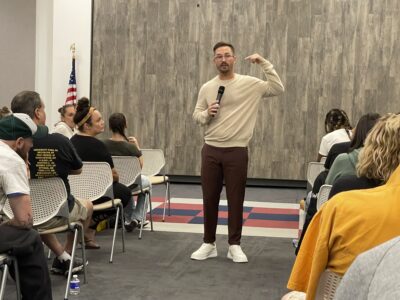
As he began to share the story of his journey through addiction, Tony Hoffman told those attending that it was OK to step out of the room if they felt uncomfortable with some of the things he was about to say.
"I want you to come back, though. What I've been through, where I've gone and how I've gotten there, I think everybody in here can benefit from," Hoffman said.
"That's really what I want out of me telling my story is for you to grab one thing that you can utilize for the rest of your lives," he added.
Hoffman, whose bio includes BMX Elite Pro, Olympics coach, ex-convict and addict, was the featured speaker at an event sponsored by the West Branch Drug and Alcohol Abuse Commission.
The room was nearly full of people there to hear how Hoffman struggled with mental health issues which led to his addiction and his plummet from his achievements in the world of racing BMX to sitting in a prison cell due to a home invasion to seek the drugs that controlled his life.
Hoffman grew up in California, living in a school district that was noted for its students' achievements in sports.
"What did you do in Clovis? You played sports," he said.
Although he found he was good at all sports, basketball was the one he wanted to pursue. He dreamed of going to the University of Michigan, graduating and then heading to the NBA.
By the time he went to sixth grade, coaches from the high school were coming to watch him play.
"It was clear by the time I got to sixth grade that the short white kid could play basketball," he said.
The next year, though, things changed for Hoffman.
"When I got to seventh grade, some things changed that people couldn't see and I wasn't talking about it. That's why they couldn't see it and didn't know that it was there," he said.
"When I got to middle school, I remember showing up to school and having this overwhelming feeling that I needed to kill myself," he shared.
He didn't know where the thoughts were coming from, didn't like those feelings, but couldn't make them go away.
"When I started to think that something was wrong with me, the more I started to think it, the more I started to come up with this plan that killing myself was the only way I could stop this stuff from happening," he said.
What he didn't understand at that age, Hoffman said, is that he was suffering from social anxiety.
He started isolating himself because he didn't feel like he fit in with his classmates who were more social.
"When I isolated away from people, I gave life to depression. When the depression kicked in, it took my drive to play sports away. It took my drive to get out of bed and show up to school. It started taking away my motivation in life...I started to have this self-hatred show up as a result," he said.
In addition to his struggle with depression, Hoffman was also experiencing problems in his relationship with his father. Not feeling validated by his father, Hoffman had told himself the reason his dad didn't come to see him play basketball was because he didn't love him.
At that age, he didn't understand that the reality was that his dad was working extra hours to buy the things his family needed.
"At 12 years old, I didn't realize that I was about to do something every single human being in this world -- every single adult that's in here right now -- has done, and every young person is about to do, and that's create a belief system about yourself," he said.
"That belief system that you create is the behavior that you go out and do in the world," he added.
One of his biggest mistakes, Hoffman said, was that he never talked to his father about how he felt and what was going on in his life.
"I had no idea that mental health and the stories we create about our experiences in our childhood for many of us in here are the reason we do what we do on a daily basis," Hoffman said.
"What I learned is the feelings and the experiences can be very real," he said, "but the story we tell ourselves, if we're not careful, it's so far from the truth."
"We start telling ourselves, I can't, I won't, I'll never be able, these things happen...when we start getting ourselves into that pattern, what we don't realize is we start behaving in the world in a way to confirm that we can't, we won't and will never be able. And the thing that fast tracks us there is when we find substances to regulate the experience that we're having and the emotions that come from it," he said.
For Hoffman, finding what he called "that one thing" that helped to regulate these emotions didn't happen until he was older.
At the time that he got kicked out of school for a few weeks in middle school, Hoffman's brother was racing BMX. His family made him go to the track to watch and then eventually got him a bike and he began racing.
"By the time I was 18, I was on the cover of the largest BMX racing magazine in the world. I was ranked No. 1 in the country for points. My natural gift in sports was showing up on a BMX bike," he said.
But, the acclaim he received as a BMX racer -- many thought he would turn pro -- could not compensate for what he was feeling about himself.
"When I took my helmet off, I still wanted to kill myself. When I took my helmet off, I still had anxiety issues. When I took my helmet off, I still had depression issues," he shared.
Eventually Hoffman decided not to go pro and stepped away from racing. He started going to parties, experiencing social anxiety, which kept him from enjoying himself -- until someone offered him weed.
"I couldn't stop laughing and laughing for hours...but it wasn't helping my anxiety and it wasn't helping my depression. It wasn't helping my suicidal thoughts. It was connecting me with like-minded individuals. The catch is it wasn't empowering for self and it wasn't empowering for others," he said.
At first he decided he wouldn't smoke weed every day like his friends.
"What we would have told you at 18 years old was that we were all just smoking weed for a good time. We were all just having fun. But then I learned later down the road that none of us were actually smoking weed for a good time. We were all smoking weed for some stuff we weren't telling nobody about and the emotions that we didn't have to cope with at that time with trying to change the way that we felt," Hoffman said.
When a job opportunity fell through in another part of California, Hoffman moved back to a place near where he grew up. He was still going to parties. Then a friend introduced him to Oxycontin.
"When I tried Oxycontin, instantly, no more anxiety. No more depression. No more suicidal thoughts. I was having fun at parties and I thought to myself, 'I'm fixed,'" he said.
"As soon as I take that, I feel the way I think I'm supposed to feel. What I didn't understand was stuff that comes out of the orange bottle, sometimes it's the same stuff that comes from the cartel -- it's just packaged differently," he said.
Because of that misconception, he and his friends all became opioid addicts.
He began selling weed to support his pill habit. His parents eventually kicked him out when they discovered a quarter pound of weed in his backpack.
Hoffman had convinced himself that he was taking the pills not because he lacked will power, but because he felt he was a better person than when he didn't take them.
When the pills were no longer available, Hoffman convinced his friends to rob a home where he knew there was a supply, which were for his friend's mother's medical condition. His friend had been supplying the pills until his mother caught him and locked up her supply.
"When she locked up the closet, we had to go to the streets and in the early 2000s...the pharmacies ran out," he said.
"We hit a drought. People started to do crazy things to stop themselves from feeling dope sick," he said.
Hoffman's crazy thing was an armed robbery, which resulted in him being arrested six months later.
At that time he was 21 and hadn't seen his family in three years.
At his sentencing, he received five years felony probation, one strike on his record and 90 days in a treatment center.
The judge had warned him that if he ended up back in court, his sentence would be 10 years.
Determined not to use pills again, Hoffman began drinking, until he suffered an injury for which he was given fentanyl to manage the pain.
"When they gave me the fentanyl, it started my brain believing again that the only way that I could function in this world was with these pills," he said.
He ended up walking away from his family for another two and a half years.
"My life would spin completely out of control. I couldn't afford the pills anymore. Heroin was on the other side of town for a quarter of the price. Cocaine didn't do what it did for me when I compared it with meth. So I started smoking meth. Then somebody showed me how to put needles in my arm," he said.
His friends eventually didn't associate with him anymore. He ended up sleeping on the streets for six months.
"If I was lucky, I got a Motel 6. If I was lucky, I got somebody's couch or floor to sleep on... there has never been a lower point for me emotionally than when I was sleeping on the street," he said.
"Every single person that you put yourself around by this point in your life is only there for one reason -- to take what you have and use it for themselves. Not one person is looking out for your best interest. Not one person at that point is trying to see you succeed or get sober," Hoffman said.
At this point in his life, he broke into a house to sleep, was arrested for violating his probation and sent to prison for four and a half years. He called this the "spiritual experience that changed my life."
He had just gotten settled in, made his bed, when he looked at the ceiling where someone had written, "Be careful what you think because your thoughts become your words. Be careful what you say because your words become your actions. Be careful what you do because your actions become your habits. Be careful what you make a habit because your habits become your character and your character becomes your destiny."
"Well, when I read this quote, I thought to myself, if this is the blueprint of how I ended up in here, then this is the blueprint I'm going to use to completely change the way I think and change who I am as a character and change the outcomes I've been getting in my life," he said.
While he was in prison, he set some major goals for himself -- race BMX professionally, go to the Olympics, start a nonprofit organization for kids and become a professional speaker.
Hoffman shared how he had read a "big book" in prison that said "if you can be trusted with little, you'll be trusted with much." That's when he decided that, to achieve his four goals, he needed to start with the small things.
"Your ability to do what needs to be done when you don't feel like doing it is what takes you to the place that you deserve to be or the place you want to go to make the changes that you need to make. So, I started learning how to do the small things," he said.
"One of the other things that I became really good at while I was imprisoned was asking myself this -- why do I feel this way? And why, every time I have this feeling, do I do this? It was one of the most profound questions I've asked myself because I used to just do things and then blame everybody else and justify why I had to do what I was doing," he said.
Prison offered him the opportunity to realize that it was the way he reacted that was the real issue.
When he left the prison in 2008, Hoffman said that he was a completely different person.
He shared his four goals with his parole officer, who declared that Hoffman would end up back in prison within the next 30 days.
Instead Hoffman went back to BMX racing until an injury put an end to his racing career. Six months later, he started his nonprofit organization. He started coaching BMX riders for free at first.
By 2016 he was one of the most requested mental health and substance abuse speakers in the country and by July of that year he had been asked to go to the Olympics with one of the top female athletes he was coaching.
"I became the first human being to start in a prison cell and participate in the Olympics. I just thought I was getting there as an athlete, but I ended up making it there as a coach.
"It was one of the best moments in my life -- not because I was at the Olympics, but because of how I got there," he said.
"I made a commitment when I was in that prison cell … I told God I don't want it easy. I want you to throw every wrench, every fork in the road. I want you to make me want to tap out. I want you to give me every freaking thing that you gave me as a kid and, when the going gets tough and I quit, I want you to give me that and double it. Because I'm going to show you how committed I am to what you told me I need to do," he shared.
"I was committed to myself. I was committed to others, and, for the first time in my life, I could look in the mirror and love who I saw," he added.