
Starlings a pest to farmers
Trending
I've recently noticed that the starlings have returned and are sporting their breeding plumage. During the winter months, the starling's plumage is heavily speckled, with either white or tan spots, and the bill is black. During the spring, the lighter tips of the feathers wear away, leaving the plumage a glossy black, and the male's beak becomes yellow. On April 5, I wrote in my diary that I saw the starlings carrying nesting material.
Starlings cause many problems for farmers and grainaries. Farmers find it impossible to keep the large flocks of starlings from entering their open-end barns. The starlings seem to know when the farmer feeds the cattle and they show up at feeding time.
In Shakespeare's Henry IV, the king orders Hotspur (a soldier) to never mention his brother-in-law's name (Mortimer) again. In rebellion against the king, Hotspur thinks of ways to torment him. Hotspur begins to fantasize about teaching a starling to say Mortimer. In the scene, Hotspur says, "Nay, I'll have a starling shall be taught to speak nothing but Mortimer, and give it to him to keep his anger still in motion."
Shakespeare had an extensive knowledge of ornithology and the starling was not the only bird that he wrote about. In his writings, Shakespeare mentioned many different feathered friends and also alluded to many bird folklore. He used birds to express dramatic purposes; the depth of romantic feelings (Romeo and Juliet) and to express foreboding death by the screech of night owls (Macbeth and King Lear).
It was Eugene Schieffelin who decided it would be a great idea to introduce as many of Shakespeare's birds as possible to North America. On a cold winter's day, Schieffelin released 100 starlings into New York's Central Park, hoping the starlings would breed.
At first, it appeared as if the starling would not make it in this new world. A few years after the release in Central Park only 32 of the original starlings were still alive. However, those 32 birds began to multiply and spread across the land. By 1916, the starlings had spread as far north as Rhode Island and as far south as Virginia. By 1924, they had reached Canada, and by 1928 they had reached the Mississippi River. In 1952, sightings of starlings had been reported in Alaska. A decade after Schieffelin's release the U.S. Federal Government began taking steps to prevent the introduction of new bird species to the United States. In 1900, Congress passed the Lacey Act, which allowed the Secretary of the Interior to ban the importation of animals which could threaten either people, industry or the environment. Starlings were prohibited. However, by then, it was too late. Today, the starlings cause more than $800 million in crop damage each year.
There are several more reasons why the starling has a bad reputation. Since starlings are cavity nesters, they compete with native cavity nesters. The starlings are aggressive and drive other birds from their nest sites; destroy their eggs and kill their young. Starlings also have a habit of collecting in large flocks in urban areas.
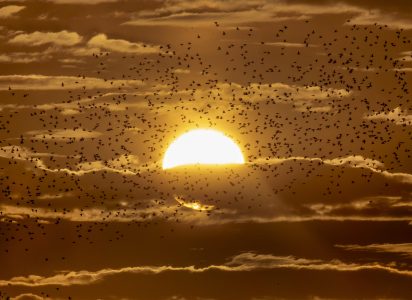
At times, their noise becomes unbearable and their droppings contaminate everything, including buildings, trees and plants. Starlings roost on buildings, bridges and other man-made structures. Perhaps the greatest danger with starlings comes from being near our airports. In 1960, a jet taking off from a Boston airport flew into a flock of starlings and crashed, killing 62 people.
By 1939, the American Wildlife Institute formed a club, which was named the Starling Luncheon Club, for the purpose of controlling the starling. The club's members planned to make the starling a game bird, with the idea to popularize the bird as a food source. Hunters would be able to shoot the starlings, with no limit. This would not only provide food but at the same time control the starling population. This idea never took hold.
When I first read the article about the Starling Luncheon Club in the January 1940 issue of the Game News, I thought it was a joke. But the club had a group of important conservationists backing their plan. The article gave an account from Jack Miner, a well-known conservationist of his time, who ran a bird sanctuary in Canada. In the article, Miner stated the starlings arrived at his sanctuary in 1924. At first, he was happy to see the new arrivals. By 1931, the birds had become so numerous Miner declared war on them. He built a starling trap, and in three months, Miner had trapped and killed 17,000 starlings. He wrote that for every starling killed another appeared.
In Europe, it was common to eat songbirds. Blackbird pie was a favorite dish of the English. Perhaps you remember reciting this nursery rhyme?
"Four and Twenty blackbirds baked in a pie,
When the pie was open the birds began to sing,
Wasn't that a dainty dish to set before the king?"
The starling is neither a blackbird nor a close relative of the blackbird family. Its scientific name is Sturnus vulgaris. Sturnus is the Latin name for starling; vulgaris, which is also Latin, means ordinary or commonplace. The starling was also introduced into South Africa, Australia and New Zealand.
Bill Bower is a retired Pennsylvania Game Commission Wildlife Officer. Read his blog and listen to his podcasts on the outdoors at www.onemaningreen.com.