
Norway spruce are some of the most recognizable trees

ASSOCIATED PRESS FILE PHOTO Norway spruce are so popular, they’re often used for the large Christmas tree each year at Rockefeller Center.
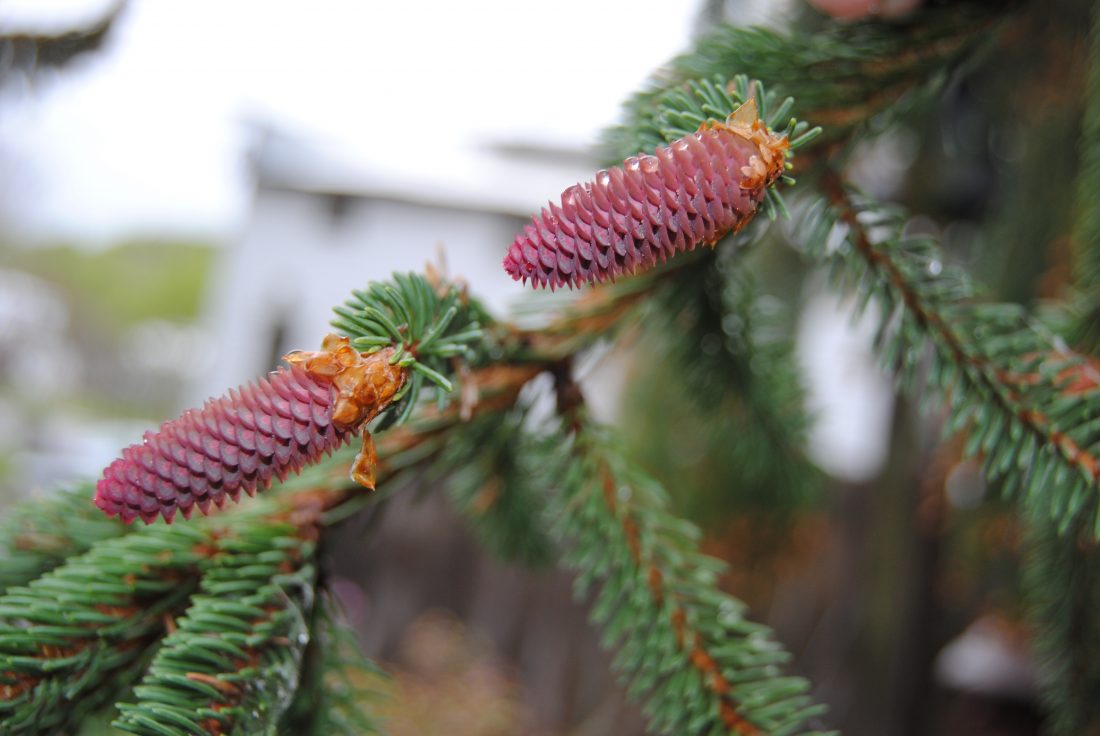
PHOTO PROVIDED Cones have already begun to form on the Norway spruce outside the home of Bill Bower.
ASSOCIATED PRESS FILE PHOTO Norway spruce are so popular, they’re often used for the large Christmas tree each year at Rockefeller Center.
PHOTO PROVIDED Cones have already begun to form on the Norway spruce outside the home of Bill Bower.
Trending
At breakfast, Mary Alice had been looking out the window when she saw a bird land on a limb of our Norway spruce tree. This small movement caused a cloud of yellowish-green smoke (pollen) to appear. With the abundance of pollen produced this year, this is a common occurrence whenever the wind blows. Everything, including plants, is covered with the yellowish-green pollen.
Plants, such as animals, must obey the laws of eugenics, which is the science of improving by selective breeding. Eugenics is a Greek word, meaning good stock. The most unrelenting of these laws is inbreeding weakens a race; whereas, cross-breeding strengthens and perpetuates. An organism equipped with a variety of characteristics can cope with life better than an organism with a single set of characteristics.
The pollen from our Norway spruce tree's male flowers has gone traveling, searching for the female flowers (pistils) of another Norway spruce. When and if the pollen grain arrives at the tip end of a receptive pistil, the pollen will adhere because the tip end of the pistil is sticky.
When considering the pollen's target -- which is the size of a pinhead -- must be hit by a microscopic grain of pollen at exactly the right time, and also that the pollen might have to travel for miles, one has to wonder how this tiny grain can hit the target? The pollen lacks any motive power of its own and depends on the wind to take it on the journey.
Wind pollination calls for vast numbers of grains to be discharged into the air, and by the law of average, a small pinhead target is waiting for the pollen of its species to be hit. Although this method is efficient, the waste is staggering since there will most likely be only one of the million grains thrown into the air used.
Most trees concentrate male flowers on their lower branches, while female flowers appear on their higher branches. This serves an evolutionary role of preventing self-fertilization.
Male flowers, which are separate structures from female flowers, tend to be small (1/2-inch or less in length) and not as long lasting (often disappearing in days or weeks). Male flowers produce pollen for a short time in the spring, and after fertilizing female seeds, their job is done, and they die.
A Norway spruce could be the tree most easily identified from a distance. With the outline image in mind, a person will be able to recognize the Norway spruce while driving down the highway. A Norway spruce is an evergreen tree, with short, dark needles. These Norway spruce trees, which usually grow 50-80 feet tall and two feet in diameter often, have branches that are almost to the ground. The branches, which grow off the main trunk, arch upward, while those branches growing from the main branches are long and hang down.
Most trees are wind pollinated but the following are some exceptions: fruit, locust, horse-chestnut and magnolia trees. The wind pollen tree flowers are designed not only to multiply anthers but also to make it easy for the pollen to be snatched up by the wind.
The spruce trees are in a large and successful group of forty-five evergreens that are wind pollinated and grow in both the Eastern and Western hemispheres. In North America, we have seven native species plus the introduced Norway spruce.
The common name of spruce comes from the conical looking shape of the tree. Since the 16th century the name has meant smart, dapper or fashionable. The word spruce came into vogue in England, during the reign of Henry VIII, when the flashy dress of Prussian noblemen had been adopted. For centuries anything from Prussia to do with fashion had been referred to as pruce, with the 'S' added later in the evolving language. Today, spruce up means to tidy up.
The spruce tree's genus name is picea, which comes from Latin for pitch, due to the resinous quality of the tree. The spruce's needles have long been used for medicinal purposes. The Native Americans used the bark and the needles to prevent scurvy. It is said the black spruce saved the lives of Jacques Cartier and his men when they became marooned on the ice-bound St. Lawrence River during the winter of 1535. After losing twenty-five men to scurvy, Jacques turned to the local Indians, who told him about the medicinal value of the spruce.
Spruce beer was made in many a lumber camp, and spruce gum, which was once a thriving industry, is still collected in Nova Scotia. Today, one can purchase spruce gum from L.L. Bean.
The most well-known use of spruce was in the making of musical instruments. Antonio Stradivarius, of Italy, topped his violins with Norway spruce and backed the instruments with maple. Craftsmen have been trying to duplicate the acoustic abilities of the Stradivarius violins; however, the secret has so far been eluded. Most craftsmen now agree the acoustic sounds of the Stradivarius violins came from the varnish that he used during the 17th Century, which unfortunately cannot be reproduced.
New cones are appearing on our Norway spruce tree, and in October we will see a little red squirrel scurrying through the tree's branches cutting down the green cones to get the seeds inside.
Bill Bower is a retired Pennsylvania Game Commission Wildlife Officer. Read his blog and listen to his podcasts on the outdoors at www.onemaningreen.com.