Reflections in Nature: Learning about the yellow-shafted flicker
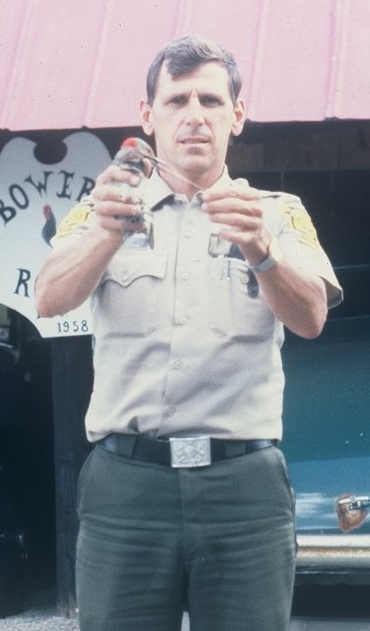
PHOTO PROVIDED A young Bill Bower shows the long, 3-inch length tongue of the flicker.
Recently, I received photos of a yellow-shafted flicker that were taken by Wes McNett’s daughter, Amber Owen of Canton.
The yellow-shafted flicker is now referred to as the northern flicker. Its scientific name is Colaptes auratus. Colaptes comes from the Latin word kolapter, meaning a hammer or a chisel and also from the Greek word kolapto, meaning to peck with a bill. The species name is auratus, which is Latin, meaning gilded, ornamented with gold, in reference to the yellow linings of the bird’s wings and tail.
Auratus is now the species name for all three similar species, the gilded, red-shafted and the yellow-shafted (aka northern flicker), of North American flickers.
The common name of flicker apparently comes from the bird’s action of striking lightly, with a quick jerk of the bill, and also the fluttering or flapping of its wings without flying.
The yellow-shafted flicker is the most colorful of all North American woodpeckers. It’s the only woodpecker in Pennsylvania that is found on the ground. Forty-five percent of its diet consists of ants.
This woodpecker will land on an ant hill and scratch until the tunnel leading into the ant colony is opened. The bird inserts its long and sticky tongue into the tunnel, and thinking it’s a worm attacking their home, the ants will grab hold of the tongue. Once on the tongue the ants cannot escape, and “old yellow shaft” pops the tongue back in its mouth to feast upon the ants. Entire ant colonies are sometimes annihilated.
However, the yellow-shafted flickers also gather food just as other woodpeckers do. Insects are located by tapping on trees, and after a hollow spot is detected, the drilling begins. Once an insect tunnel is broken into, the barbed end of the flicker’s tongue is thrust into the tunnel. If the flicker stabs an insect or grub, the tongue is popped back into its mouth. These birds create many homes for other birds and wildlife by drilling for insects.
The yellow-shafted woodpecker also uses its stout bill in courtship. A prospective male will rap on tree trunks, telephone poles, downspouts, and anything else that will make enough noise to attract a female. After mating, the male and female will continue to communicate with each other by tapping on objects.
One would think the woodpecker would have many headaches from hitting its head against a tree, often 100 times per minute and several hundred times a day. It’s like running into a brick wall. I read somewhere that the bird closes its eyes when its head strikes the tree. Wildlifers believe this is done to prevent wood chips from harming the eyes.
I have often heard it said that perhaps the bird’s eyes close so they do not pop out of its head. I’m sure this has been said in jest. Actually, the hard beak is connected to the skull by a sponge-like-rubbery tissue, which absorbs the shock when hitting the tree.
The flicker is able to work on the sides of trees because of its two toes that point forward and two toes that point backward, with claws that grasp the tree; also, the strong, pointed quills that extend beyond the tail feathers are used to prop the bird up when clinging to the side of the tree. These stiff quills prevent the scraping on the trees that would destroy the tail feathers. If destroyed, the bird would soon have no control while flying. The quills are replaced during the bird’s molt; however, no quill will be shed until a new one is fully developed.
In Alabama, the yellow-shafted flicker (yellow hammer) is the state bird. During the Civil War, soldiers from Alabama could always be identified by a feather from the old “yellow hammer” worn in their hats. (I’ll bet there is no reference to the feather as one from a northern flicker.)
The male can be distinguished from the female by what appears as a mustache at the base of its bill. This really isn’t a mustache, only black feathers.
When the fall migration for the yellow-shafted flickers begins it is poorly defined. However, the migration is usually evident along the mountain ridges from the second week of September to the third week of November. The peak of the fall migration occurs approximately the third week of September until the second week of October.
The yellow-shafted flickers return to our area in early March. The “whicker, whicker, whicker” mating call rings out along with the hammering on the trees. The female goes to the male and a nest site is selected. Both the male and the female share the duties of nest building, incubating the eggs and feeding of the young. At first, feeding is done by regurgitating. Later, the parents hide food under the bark of trees and the young are taught to hunt.
Although the flicker is one of our state’s most widespread and common species, its numbers have been declining over the last 40 years. The reason for this decline is that the starlings will steal the flickers’ first and even second excavations for their own nest sites.
When we see small flocks of yellow-shafted flickers during the month of September, it is a sure sign the fall migration has begun.
Bill Bower is a retired Pennsylvania Game Commission Wildlife Officer. Read his blog and listen to his podcasts on the outdoors at www.onemaningreen.com.
Outdoors
Reflections in Nature: Chimney swift birds are one of Pennsylvania’s latest migrators
Last week Stan Strong of Canton stopped at our home to give me a dead chimney swift, which was in a mummified ...
Outdoor community calendar for Week of March 31
JOY TO THE EARTH FAMILY FUN WHERE: Selinsgrove Commons (2 N. Market Street, Selinsgrove) WHEN: Saturday, April ...
Birding out of country allows for unique sightings
What do northern pike eat?
As predators pike are opportunistic feeders, taking a bite at anything that presents itself. That being said, they ...
Time of year for antler shed gathering