
Reflections in Nature: Finding safe spot for nest can be a challenge
Trending
Many of our feathered friends have returned from their winter quarters. The males have been seen performing their mating rituals. We have watched a pair of doves in our backyard that are busy carrying nesting materials. Also, we have watched grackles going in and out of a hole in the siding of our neighbor's house, where a pair nested last year.
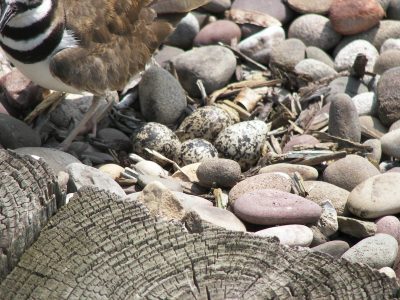
There are as many types of nests as we have species of birds. Usually, when we think of a nest we think of the robin's familiar bowl-like construction, built with grasses, mosses and mud. However, there are birds such as crows, great-blue herons, hawks and eagles, that build nests made of big sticks. Other birds, such as turkey vultures, simply lay their eggs on the bare ground, usually in an inaccessible place. Killdeer scrape cups in the gravel ground. Woodpeckers use their bills to dig out holes in trees, while the kingfishers and bank swallows burrow into sandy banks, using their bills and feet to dig tunnels into the banks.
Each, of the 9,000 species of birds, needs to have some type of home (nest), especially during the mating season because eggs are laid by all species. Unlike mammals, no bird gives birth to live young. A bird lays an egg, with a protective shell that is incubated outside the body. Birds have greater mobility than mammals but at the cost of being unable to carry its developing young inside its body.
Female birds can only produce one egg at a time due to the egg's size making it difficult. Since carrying eggs inside her body would make flying difficult and require more energy, the female must dispense with the fertile egg as soon as it is formed. Due to this, a nest is needed to lay its eggs.
Although some animals, such as deer, elk, antelope, bison, bighorn sheep, moose, etc., do not have homes, they do have a home range.
Finding a safe place to lay and hatch their eggs and then raise young until they can leave the nest is a challenge for birds. Intricate and complex nests are built that have no equal in the animal kingdom.
The shape of the egg is such that it can withstand considerable pressure before breaking. This is important because the egg must withstand the weight of the sitting bird during incubation. According to one book that I read, it takes 26 pounds of pressure to break a swan's egg and 120 pounds to break the egg of an ostrich.
There are two systems that birds use in raising their young, precocial and altricial. Precocial comes from the Latin word praecox, meaning to ripen beforehand. These birds, which are usually ground nesters, cannot afford to have their young in the nest for a long period of time. Their chance of survival is greater if they leave the nest quickly.
In this type of hatching process, the birds spend a long time inside the egg; however, when hatched out, they are fully feathered (usually covered with down); eyes are opened and they are able to leave the nest within one hour.
The other hatching process is called altricial, which is also Latin and comes from the Latin word altrix, meaning nurse or wet nurse. It is the term used for young birds that hatch in a helpless condition. These young are hatched out as soon as possible, usually twelve days. The chicks are only half formed, with closed eyes and no feathers. They are very weak and helpless, surviving the first few hours on the egg yolk that their stomachs have absorbed. It is estimated that less than one third of the very fragile altricial born birds survive to maturity. Altricial parents will have two and sometimes three sets of young in one mating season.
Perfect examples of precocial birds are the turkey and grouse. Both of these birds nest on the ground, and egg hatching takes almost a month -- 24 days for grouse and 28 days for turkeys. The young will brood under the mother until able to fly short distances, which is about two weeks for turkeys.
Most songbirds are altricial. In this system, raising young can be exhausting for the adult birds. It usually takes about two weeks for the altricial birds to hatch out the eggs, with the young remaining in the nest approximately fourteen days. During this period, the parents must provide food for the young from dawn to dusk.
It has been recorded that a pair of wrens made 1,217 trips to the nest in one day while carrying food for their young. A young robin can eat up to 14 feet of earthworms in a day. With three or four young in the nest, the parents are constantly bringing food to the young.
In 1957, Margaret M. Nice made a study of altricial birds, in which she discovered that hole-nesting birds -- such as titmice, tree swallows, etc. -- were more successful in raising their young, with 66% of birds fledged from the nest compared to 49% for birds that built open nests on or above the ground. However, open nesting birds tend to raise more broods each season than the hole-nesting birds, which is compensated by the end of the season. The precocial birds, such as pheasant, turkey, grouse, etc., had a 45% success rate.
No matter how birds build their nests, all wild birds have one thing in common, and that is their reliance on materials found in nature.
A good project for you to do with your children is to challenge them to build a bird's nest, one that would safely hold an egg and use only natural materials. This means that tape, glue and tools cannot be used. After the project is completed, I'm sure each child will have a good idea of how hard birds work to build their homes.
Bill Bower is a retired Pennsylvania Game Commission Wildlife Officer. Read his blog and listen to his podcasts on the outdoors at www.onemaningreen.com.