
Reflections in Nature: Seeing flash of colors of Baltimore orioles is a special treat
Trending
For quite a few years, our neighbor Joe had Baltimore orioles visiting his backyard feeder. Joe has told us that he puts out grape jelly, which they must like since they return each spring. Mary Alice also puts out grape jelly but has had no luck in attracting even one Baltimore oriole.
Joe suggests that only small amounts of jelly be put out so the birds don't soil their feathers
Baltimore orioles also seek out ripe fruit such as oranges cut in half and hung from trees, and special oriole feeders filled with sugar water, which supplement the flower nectar that Baltimore orioles gather.
Edgar Fawcett (1847-1904), an American playwright and poet, wrote the following poem about the Baltimore oriole.
How falls it, thou hast come to fly;
In tropic splendor through our northern sky?
At some glad moment was it nature's choice;
To dower a scrap of sunset with a voice?
I wonder what Fawcett would say if he knew that the name of the Baltimore oriole was changed to the Northern oriole? Our oriole's genus name is Icterus galbula. The Icterus is from the Greek word ikteros, meaning jaundice. This was an early name given to yellow birds because of the Greek belief that a jaundiced person was cured at the sight of this bird.
The sub species name galbula is Latin and means a small yellow bird. The common name of Baltimore oriole comes from the bird's colors, of bright yellow and black, which resemble those chosen by Sir George Calvert (1580-1632), an early colonist of Maryland and the first Baron of Baltimore. The oriole is the state bird of Maryland.
For many years, the Baltimore oriole was considered a distinct species, but in 1973, the Ornithologist Union classified it as a subspecies of the Northern oriole. To make matters more confusing, our oriole spread west to the plains and prairies, where interbreeding often occurs with its western counterpart the Bullock's oriole.
Hush! Tis he!
My oriole, my glance of summer fire,
Is come at last; and ever on the watch,
Twitches the pack-thread I had lightly wound
About the bough to help his housekeeping.
Both orioles belong to the Tropical family. There are 91 species of birds in the family, with the name coming from the habit of gathering in a large flock or troupe.
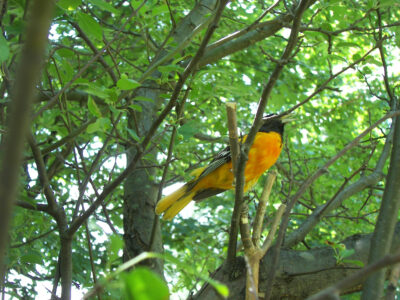
The male oriole is colored a bright orange and black, with one narrow white-wing bar, a black head, neck, upper breast and wings; orange-yellow under parts on rump and outer tail feathers. The all-black head distinguishes it from the male Bullock's oriole. Young male Baltimore orioles do not molt into bright-orange adult plumage until the fall of their second year. Females become a deeper orange with every molt and some older females appear almost as bright orange as males.
Twitches and scouts by turns, blessing his luck,
Yet fearing me who laid it in his way.
Nor, more than wiser we in our affairs,
Divines the providence that hides and helps.
The Northern (Baltimore) oriole females are among the best nest builders in the bird world. The female's nest gracefully swings from out at the very end of the high branches of tall trees, usually 25-30 feet above the ground. The nest, which is woven into a long flexible, waterproof pouch, is built of bits of string, horsehair, shreds of bark, milkweed stalks and almost anything else the female can find.
The nest, which is lined with fine grasses and hair, is about six inches deep, partially closed at the top to conceal the female as she is sitting on the eggs.
The female lays 4-6 white eggs, with black to brown blotches, that will hatch in 12-14 days. The young are fed grubs, spiders, snails, worms, flies and caterpillars, especially the hairy and spiny kind. They also feed upon the fall webworms and tent caterpillars. The young grow fast and will leave the nest in about two weeks.
Although orioles are helpful in controlling some insects, they are also responsible for some crop damage, especially fruits, such as grapes, blueberries and blackberries. They also feed heavily on peas; hence, the common name of pea-bird.
The oriole spends its winters in Mexico and South America and then migrates north in April and May. The male precedes the female by about a week.
The oriole will come to feeding stations, especially for a mixture of suet and peanut butter. A half of an orange nailed to the feeder will also attract orioles. Some of the orioles have begun wintering further north than usual due to the many backyard feeders. Although still widespread and common, surveys show declines in recent decades. In the mid-20th century, Dutch elm disease killed many of the American elms that were frequent nesting trees for this species in the past.
I will continue to think of the oriole as the Baltimore oriole and to hear its song and see its flash of colors on a summer's day will always be a special treat.
Bill Bower is a retired Pennsylvania Game Commission Wildlife Officer. Read his blog and listen to his podcasts on the outdoors at www.onemaningreen.com.