
Beekeeping class offers people a look into unique hobby
Trending
Dadant and Sons Williamsport branch manager Jim Wilson has been involved in the world of bees and beekeeping for quite a while. He got into the business roughly 14 years ago. Sitting in his office on West Fourth Street, Wilson mentioned how years ago when he was at another company, he'd go stand about 10 feet near a beehive they had and, when stressed out, would just watch the bees take off and land.
Some may be wary getting near stinging insects, especially ones like bees that may swarm at any moment. But for Wilson, it was relaxing watching bees fly around their hives.
"A lot of times even when I was at another place, we had hives at buildings. We'd do demonstrations and things like that. There were times I'd just go there and stand about 10 feet in front of hive when I was stressed out and I'd just watch the bees take off and land," Wilson said. "It's kind fascinating what they do and how they just zoom in and out. They have their own air traffic control system for lack of a better term. It was actually relaxing being out there and watching the bees come back and forth."
This Saturday, Wilson will be holding a beekeeping class for interested individuals at the Dadant and Sons location on West Fourth Street, and perhaps another person will start an interest in bees like Wilson did all those years ago. Interested individuals in the beekeeping class can contact Dadant and Sons at 570-980-9831 or 1-877-532-3268 to register for the class.
The class, according to Wilson, will entail the entire first year of what people can expect during beekeeping, including what equipment people will need, protective clothing and what they can expect throughout their first year. Wilson said the class is limited to 50 people and more than 20 individuals signed up last week.
"Even though they're insects, who can change their mind on a second's notice, it's everything to get them through the first year," Wilson said.
Wilson has put on about 12 beekeeping classes over the course of 14 years. And while they haven't been able to for a few years because of the COVID-19 pandemic upending things, this year they're back at it and already have a good turn out signed up for it.
"It is very specialized area, people call you crazy for getting around 70,000 stinging insects, but yes, it is very rewarding to see that out there," Wilson said of the turnout who signed up.
Individuals shouldn't expect a ton of honey in their first year, Wilson noted you'll get "just enough to give you a test" due to bees needing to get an infrastructure inside the hive built up.
"If they make it through the winter, that's the crapshoot right now with all the issues, but you basically don't have to buy the bees next year. They'll just repopulate. They'll go down small and come back strong," Wilson said.
And of course, individuals can get more than simply honey out of bees. That includes candles, lip balms and salvs.
"You can make a lot of things out of what honey bee puts off," Wilson said.
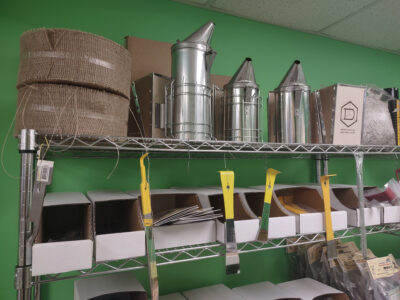
Dadant and Sons is a sort of one-stop-shop for anything bee related, from someone who wants to have just one hive to commercial beekeepers who do it for a living.
"Not only do we sell directly to individuals, we sell to other places that do it for a living. I'm in charge of that division of the company as well as this branch. I'm national dealer and sales manager for the company and I also manage the location here. We basically take care of all the northeast, which is the biggest beekeeping zone in the United States."
Honey bees account for an annual economic boost of roughly $20 billion throughout the country. In Pennsylvania alone, Wilson noted that honey bees account for a $2 billion industry. That's not bad for an insect that isn't native to the United States.
"Honey bees are actually not native to North America. They came over with the colonists from Europe. There's many different times of strains of honey bees, but they're not native, so technically they're considered an invasive species if you get down to technical term. But they provide about $20 billion annually to the national economy," Wilson said. "About $2 billion here roughly in Pennsylvania, it's one of bigger states. They help get the environment better, better harvest for the farmers and even just around your house: brighter flowers, brighter fruits, bigger fruits is also very good for you too."
The honey bee population has unfortunately dwindled over the last few decades, due to a number of issues.
According to the U.S. Department of Agriculture's National Agriculture Statistics Service, the United States had 2.88 million honey bee colonies in 2017. While that number appears high, it's actually a 12% decrease from the record-high 3.28 million in 2012. The honey bee population has increased since 1969, when there were 1.42 million colonies, but the 2.88 million reported in 2017 is the lowest since 2.35 in 2002.
Honey bees are extremely important for pollinating, and Wilson more than anyone knows that. For those interested in beekeeping, it's a way to help maintain a bee population.
"Right now as we all know, the honey bee population has been declining because of all the issues with colony collapse disorder, which is not just one particular thing, its a group of many things," Wilson said. "Basically what the backyard beekeepers have done is keep those numbers kind of steady. They're helping the environment, helping get better fruits and vegetables out there. If honey bees disappear, they say we will in about five years as well."
One piece of advice that Wilson has for people interested in beekeeping is to take a bee class and to join a local bee club or sit in on a meeting. There are three bee clubs in the area: Centre County Bees, Beekeepers of Susquehanna Valley and Lycoming County Beekeepers.
"They are a good source. I'd say 99% of all beekeepers are friendly, there's always that 1% (who aren't), but you can talk to them," Wilson said. "A lot of times they'll say 'come on up. I'm going out to my bees this weekend, you want to come out and see what it's like?' But I definitely suggest you join a bee club and take a bee class."