
Reflections in Nature: Goldenrod grubs are a favorite bait by anglers
Trending
On a walk in the woods on a wintry day, many items can be found to either start or add to a collection. When the trees are bare of their leaves, it is a good time to collect a paper wasp.
These nests are often too high up in a tree to collect, but you could be lucky and find a nest within your reach. Wes McNett of Canton taught me how to use the paper nesting materials as wadding for my old double barrel muzzle loading shotgun.
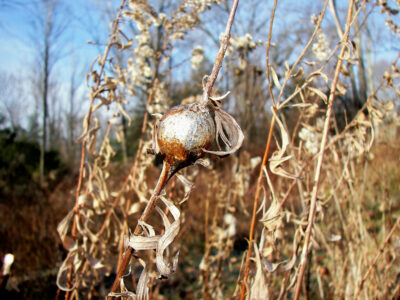
While on a walk in the winter woods, goldenrod plants with galls attached to the stems can be found. After taking several pictures of the galls, I usually cut one open to check the grub inside. These goldenrod grubs are a favorite bait used by ice fishermen. Since the goldenrod and asters bloom when most pollen supplies are becoming scarce, the honeybees really work on the plants.
The goldenrod and aster plants are probably what enable the honeybees to put in their winter supply of food. Over 1,000 different species of beetles, flies, butterflies and moths feed on the goldenrod plant.
Linneaus gave the scientific name of Solidago to the goldenrod. Solidago is Latin and means to make whole. A tea made from its leaves, with lemon and honey added, was said to ease sneezing, runny nose, and itchy eyes.
Although the goldenrod plant is blamed for causing many people to have allergies, in the fall, it is wrongly blamed. The real culprit is the ragweed plant.
The goldenrod plant, which appears in the spring, is a very fast-growing plant that flowers in the fall. In late spring, the stem of this flower will become the winter home of the goldenrod gall fly. Here this small fly lays tiny eggs on the stem of the plant. After ten days, the eggs hatch and the larvae begin to eat their way into the stem, where a living chamber is formed. A chemical that is either injected with the egg or produced by the larvae causes the plant to grow a gall around this chamber.
At first, this ball gall is a shiny green. As the gall grows, the leaves nearest the gall turn brown, and the gall becomes mottled with purple, appearing as an apple, hence a second name of apple gall.
Another type of gall found is spindle-shaped and more elongated than round, and this is the home of the goldenrod gall moth. In late summer, this moth emerges through a hole at one end of the gall. The moths mate and eggs are laid in the foliage near the base of the goldenrod plant.
After the larva over winter, they burrow down the stem of the new growth during the following spring to make a new gall.
As fall approaches, the apple gall takes on the consistency of wood. During the winter months, the larvae, which at the time are about one quarter of an inch, are sheltered inside the gall. The larvae then slow their growth and replace much of their body water with glycerol, a compound that acts as an anti-freeze, for protection from the winter's cold.
In the spring, warm weather stimulates the larva to eat a narrow passageway to the outermost part of the gall, stopping short of breaking through and then returns to the main chamber. As spring continues, the larva forms a pupa, which is the stage between larva and adult that lasts about two weeks, and then emerges as an adult fly.
This fly cannot eat and if the maggot had not made a passageway to the outer shell of the gall, the fly would have died inside the gall. The fly crawls to the outer edge of the gall and pumps body fluid into a special pulsating knob on the top of its head. By using this pulsating knob, the fly breaks through the thin outer layer of the gall and flies away. The adult fly, which lives only 10-14 days, does not eat and its sole purpose is to find a mate to start the cycle all over again.
Not all larvae make it through the winter months because of the many predators that feed upon the maggots. The downy woodpecker and the black-capped chickadee will peck holes in the galls to get at the maggots. There are ways to identify which bird has attacked the gall.
The downy woodpecker tends to make a tiny narrow hole, with its slender beak; while the black-capped chickadee picks at the gall to break off bits, making a large irregular hole.
During the summer, a parasite wasp seeks out the galls, and by using its short-pointed ovipositor to penetrate the gall, she lays her eggs in the chamber. After these eggs hatch out, they feed upon the maggots and then chew their way to freedom.
Nature is certainly amazing.
Bill Bower is a retired Pennsylvania Game Commission Wildlife Officer. Read his blog and listen to his podcasts on the outdoors at www.onemaningreen.com.