
Reflections in Nature: Wood frog breeding season is early spring
Trending
Diary entry for March 24: "A friend phoned to say that the spring peepers are calling." Later that day I stopped at the spot where he heard them calling and realized that he was hearing wood frogs instead of peepers. The breeding season for the wood frog is in the early spring, earlier than that of the more well-known spring peepers.
Often, the wood frog's breeding season starts with patches of snow still on ahe ground and ice on the water's edge. The wood frog migrates to water to breed. Most of the time these water breeding sites are ephemeral areas, lasting only a short time and nothing more than a low area that has filled with water from the spring runoff. Because these water areas are short lived the wood frog breeding season must be early and quick. Occasionally, the adults and eggs will freeze from a cold snap.
According to the Pennsylvania Fish and Boat Commission's book, Pennsylvania Amphibians and Reptiles, the eggs do not die but simply lie dormant and await warmer temperatures to develop.
Male wood frogs seem to arrive at the breeding ponds at the same time. To entice the wood frog from hibernation, it usually takes a warm rain and the temperature to reach fifty degrees. This sometimes occurs in late February, however in the Troy area, it is most often the middle or end of March when I hear the male wood frogs calling.
While floating on the surface of the water, the male starts to make a series of short, raspy duck-like calls. The call alone is not very loud, but a chorus of hundreds of frogs can be heard a long way off. Usually, in a day or two, after the males begin to call, the females are attracted to the water Once a female enters the water, the males dash to her and a slight scuffle occurs.
The winning male clasps the female around the body with his forelegs, a position referred to as amplexus; after which both male and female swim away to an egg laying site, usually in a sunny area. After the female deposits two to three thousand eggs into the water, the male will fertilize the eggs.
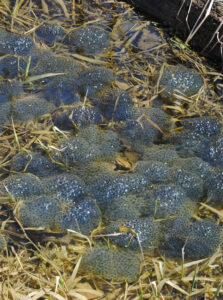
The egg cases, which are black and encased in a clear jelly mass, attach themselves to submerged vegetation. The black of the egg collects the sun's heat, while the jelly coating helps to insulate the egg.
Also, heat is generated by a normal metabolic process, and this increases the temperature of the embryo.
Sometimes, there are communal egg-laying sites in which a female deposits eggs into another female's egg masses. Sites have been documented where several females laid their eggs in one large mass.
When this occurs the eggs on the inside of the egg mass are about six degrees warmer than eggs on the outside.
After being in the water for about a week, the egg masses begin to flatten and then float upward to the surface, where they spread out, appearing to be green scum on the surface of the water.
From this point on, the tiny eggs take less than a month to hatch. The tadpoles leaving the eggs are a greenish olive in color, with a high tail crest. They remain as tadpoles for approximately two months.
After breeding occurs, the adult frogs depart the breeding area as quickly as they arrived. At the most, the wood frog's breeding season lasts for only a ten-day period. They will spend the summer far away from the water. The wood frog is found throughout Pennsylvania and is the only frog residing in the frosty environment found north of the Arctic Circle.
Since the favorite haunt of the wood frog is shade and moisture, woodlands are a likely area to find them. As winter settles over its wooden home, the wood frog burrows beneath the forest debris to hibernate among the leaves or beneath moss-covered logs.
Their bodies freeze in the winter, and both their hearts and breathing stop. As much as 65% of the water in the wood frog's body turns to ice. When spring arrives, the wood frog thaws and hops over to a breeding pond.
Frogs are amphibians. Our word amphibian comes from two Greek words, meaning "living in two places," which refers to the amphibians dividing their lives between land and water.
The wood frog is a diurnal amphibian, meaning the frog is most active during the day. However, it has a secretive and solitary manner, and its ability to blend in with the background makes it almost impossible to observe. The exception to this is during the breeding season.
Bill Bower is a retired Pennsylvania Game Commission Wildlife Officer. Read his blog and listen to his podcasts on the outdoors at www.onemaningreen.com.