
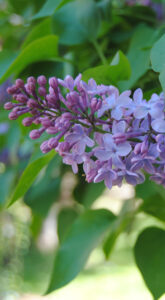
Reflections in Nature: Lilac bushes are in bloom and provide beautiful smell
Trending
Sunday was a day set aside to celebrate mothers and was the busiest day for restaurants while Saturday was the busiest for flower deliveries. I remember back to my childhood when my brothers and I picked bouquets of yellow flowers for our mom on Mother's Day.
Years later we realized that the flowers were dandelions. However it didn't matter what kind of flowers they were to our mom, she always gave us big hugs and kisses.
Every year I cut a bouquet of lilacs for Mary Alice, and of course, I get a hug and a kiss for my efforts. For several days, the fragrance of the lilacs fills our home. Lilacs do not make great cut flowers due to the blossoms wilting within a few days. The lilac's fragrance can be prolonged by re-cutting the woody stems, hammering the bottoms, and replacing the flowers in fresh water.
It has been said that when cutting lilacs for a bouquet, all flowers should not be cut from the same part of the bush because the bush will not flower in that area during the next spring.
The lilac bushes are now in bloom. The common purple lilac is easily recognized for its beauty and fragrance, which is one of the most powerful fragrances emitted by a plant. The common purple lilac produces suckers and new shoots from the base of the shrub. The shrub is very hardy and can withstand our cold winters.
In fact lilacs don't grow well in areas without significant frost.
Some of the flowers of the lilac are asexual, a type of reproduction by which offspring arise from a single organism and will inherit the genes of that parent only. Lilacs can be self-pollinated when the plant contains both male and female flowers. If another lilac bush is near, the plant can also be cross-pollinated.
The lilac that flowers on old wood produces more flowers if left unpruned. When pruned the plant responds by producing fast growing vegetation that does not produce flowers. If pruned severely, the lilac bush might not produce flowers for years.
The new growth must mature before producing flowers. However we do have a lilac bush that has grown in front of our house on a bank next to the road. Through the years, the roots have grown into an old concrete platform, which was used in horse and buggy days to aid exiting buggy passengers.
Most of the concrete has disintegrated and each year we repeatedly cut the bush down to ground level. Years ago, a backhoe was used to remove the roots, however enough roots remained for the bush to rebound each year to a height of three feet with white blossoms.
Lilacs have been called the "mother of memory" due to the fragrance they emit brings memories of childhood flooding back. Lilacs are a member of the Olive family and belong to the genus Syringa. Syringa is from the Greek word syrinx, meaning pipe because the pithy stems can be hollowed out. It is interesting to note that the state flower of New Hampshire is the lilac: a symbol of the hardy reputation of the men and women of the Granite State.
The genus Syringa consists of approximately 30 species of deciduous shrubs native to East Asia, Himalayas and southeastern Europe. There are no Native American representatives, but native or not, the lilac is a mainstay in American gardens.
Our word lilac comes from the Arabic word laylak and the Persian word nylac, both meaning blue. Lilacs are native to Eastern Europe and Asia. Their deep-green leaves enhance the beauty of the colorful flowers. The common lilac, which is sometimes known as the French lilac, was brought to this country by settlers before the 1700s. Since that time over 600 varieties have been introduced, ranging from white, blue and magenta to purple. In the language of flowers, a purple lilac means "love's first emotions," and a white lilac means "youthful innocence."
Lilacs usually grow in clumps and seldom develop a single stem. The bush can reach a height of 15-20 feet, while stems of older specimens can become a foot in diameter. On younger stems, the bark is smooth and gray, and on older stems, the bark splits into long fibrous threads.
The common lilacs are highly resistant to drought and able to withstand neglect. Lilacs seem to be day-neutral plants, meaning that flowering, growth, leaf fall and other events seem more dependent on temperature than on day's length. Due to this response to temperature, lilacs could have great value as climatic indicators and are being tested for this purpose.
American settlers planted lilacs in the front of their farmhouses, not for food value but for their beauty. Although the cleared fields have reverted to forests, the walls of farmhouses have crumbled and fallen in and the farmers and their families have long passed away, the lilac bushes remain, blooming in the spring as a reminder of the past.
Bill Bower is a retired Pennsylvania Game Commission Wildlife Officer. Read his blog and listen to his podcasts on the outdoors at www.onemaningreen.com.