
Reflections in Nature: Mayapple gets name because fruit appears this month
Trending
The spring turkey hunters that venture into the woods can have the opportunity to enjoy the sights and sounds that the spring woods have to offer. As the sun rises the woods will come alive with many different sounds and sights. One of the sights will be a patch of mayapples.
If a hunter took the time to check the plant, he or she would notice that the plant has already set a white flower. By the end of May, the plants will have already formed their apples.
Other common names for the mayapple are wild mandrake, umbrella leaf and wild lemon. The common name of mayapple was given because the fruit appears as apples during the month of May, and in some areas, the fruit will ripen during May. However, in our area, we find ripe mayapples later in the month.
Those who enjoy picking and eating wild foods are familiar with the mayapple's lemony yellow fruit, which is the reason for another of its common names. The common name of mandrake comes about because it is similar in appearance to the true mandrake.
After the apples ripen, the fruit is edible, but other parts of the plant are poisonous. The apples contain podophyllotoxin, a crystalline toxin that is a strong cathartic. An inflammation of the eyes and skin could result when eaten.
The plant is being used in experiments dealing with cancer and by plant breeders to induce polyploidy in plants, which results in new species. Apart from the ripe yellow fruit, the entire plant is deadly toxic. Even the seeds are toxic, and only a small amount of the ripe fruit can be eaten in a serving. Many accounts of mayapple poisoning have been recorded.
The mayapples' scientific name is Podophyllum peltatum. The generic name comes from a Greek word meaning foot leaf, with the species name referring to the large, conspicuous leaf.
The mayapples are one of the easiest plants to identify in the spring woods. The plant has a pair of large leaves that are shaped somewhat like an umbrella, which is the reason for another of its common names. The two large palmately divided leaves grow high on the stem, with a single flower standing erect on a short stalk that rises from the end of the thickened root. If soil conditions are good, the plant can reach a height of 18 inches. You will find non-flowering young plants, with only one leaf, that sometimes reach a foot in diameter.
A pair of large leaves hide the large, waxy white flower. Although I find that the flower does not have a fragrant odor, there are flies, bees and bumblebees that must find its odor attractive for the plant is visited often. The flower has no nectar but does provide pollen for the bees, which in turn cross-pollinates the plant.
An old mountain superstition warns about the digging up and moving of the mayapple. It seems that a girl who pulls up the root of the mayapple will soon become pregnant. This probably comes about because the true mandrake was at one time sold to women as an assurance of fertility.
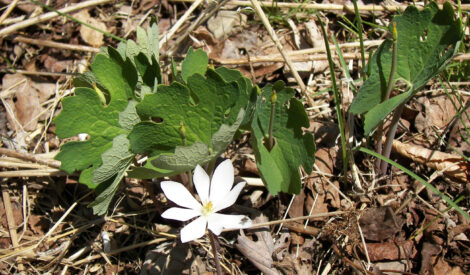
The other plant with a large white flower is the bloodroot. The bloodroot's white flower also grows on a stem that rises from the rootstock. Its single leaf has three to seven deep lobes.
The common name bloodroot comes from the deep reddish-brown sap that comes from the roots. The Native Americans used this sap as war paint and to dye cloth and baskets. The sap was also used on rattlesnake bites and as an insect repellent.
The sap contains an alkaloid that, if ingested, affects the nervous system and muscles of the body. The early colonists used a drop of sap on a lump of sugar as a cough medicine. The sap had to be used very sparingly when taken internally because of the poisonous roots.
Another common name for bloodroot is red puccoon, referring to the color of the juice that comes from the roots. The word puccoon is from the Indian word pak, meaning blood.
Since bloodroot is one of the early wildflowers, the plant is sometimes hit with a late frost, which causes the petals to fall off. The leaves that curl around the base of the stem give the flower some protection from the cold. The leaves only unfurl after the plant is pollinated and then continue to grow until mid-summer.
The thick rootstock of the bloodroot enables the plant to store food underground for the winter. Because of this available food supply, the plant can bloom earlier in the year than fibrous-rooted plants that must manufacture food in the spring for the preparation of blooming.
The blooming of the bloodroot occurs while the trees are leafless, allowing sunlight to penetrate onto the forest floor. The flower is pollinated by bees, and the resulting fruit is usually a one cell capsule.
A walk in the woods during the month of May always brings forth new surprises.
Bill Bower is a retired Pennsylvania Game Commission Wildlife Officer. Read his blog and listen to his podcasts on the outdoors at www.onemaningreen.com.