
Trending
On Memorial Day, we met our daughter's family at a beautiful country park near Pine Grove, in Schuylkill County. While driving to the park, we traveled through the Hegins area, where as a young lad, my family picked strawberries.
Early on a June morning, the four of us kids were told it was time to get up. My mother always packed a big lunch since there would be nine kids in all. After the farmer picked us up in his truck, we stopped at our aunt's home to give them a ride. At the strawberry patch, we were given boxes, and our day of strawberry picking began.
This was a way for our families to make extra money. What I remember most was that the early ride was very cold in the back of the pickup truck, however the cold ride was worth the strawberries that we were allowed to eat. When turning the calendar page to June, I still remember those days spent with family picking, and eating, strawberries.
Our word strawberry is an old English word, whose origin has long puzzled etymologists. The most plausible suggestions put forth are:
— the runners put out by strawberry plants reminded people of straw laid on the floor
— the word strawberry comes from small pieces of straw or chaff, supposedly in allusion to the fruit's chafflike external seeds or the berries appearing to be strewn or scattered among the leaves of the plant and the reason the plant first had the name strewberry, which was later changed to strawberry.
Strawberries are only one of a few fruits that have their seeds on the outside of the fruit.
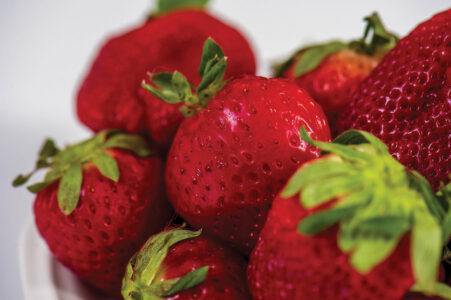
The fruit of the strawberry is different from a true berry because it does not have an outer skin around the seed. Strawberry fruit is a fleshy, swollen fruit, which has its dry yellow seeds on the outside. When the strawberry ripens, the petals of the flower fall off, and all that is left is the calyx, which is the leafy substance shaped like a star.
However, not every strawberry flower produces fruit. Some flowers do not have stamens. These must be planted near plants that have stamens, so that the seeds can be fertilized by the pollen.
The strawberry plant does not reproduce by seed. During the season when the fruit is developing, the plant sends out slender growths called runners that appear as strings. They grow on the ground and send out roots into the soil that produce new plants that grow fast and bear fruit. Sometimes, these plants are taken from the soil and replanted to start a new bed of strawberry plants.
Wild strawberries are found growing in Russia, Chile, and the United States Strawberries were written about before the rise of Christianity. A Roman poet named Virgil and a Roman scientist Pliny the Elder wrote of strawberries. Strawberries were grown as a cultivated plant in northern Europe in the 15th century. Although the colonies raised strawberries, the first American species of a strawberry plant was cultivated about 1835.
Today, although every state grows strawberries, the leading states are California and Louisiana.
The cultivated species of strawberries, of which there are many, are classified by chromosome numbers, with each having its own special characters. However, most people will agree that when it comes to taste, the wild strawberry is vastly superior to the cultivated kind and is about the most delicious of all our wild fruits.
The downside is that picking wild strawberries is a tedious job because they are quite small. After picking for several hours with an aching back, one might wonder if it was worth the effort when you see how few berries are in the pail.
However, when you taste that shortcake or jam made with the wild strawberries, you'll know your labor was not for naught.
When our son's children were young, we took the four of them up on the mountain to pick wild strawberries. Many berries were trampled on when searching for the plants and many never made into the pail. Although we heard "I'm tired" and "it's hot" over and over, we persevered and continued to pick until we had several quarts.
The precious berries were taken home and washed; hands were washed; aprons were tied on and the task of making freezer jam began.
Recently, Mary Alice purchased a quart of very large, bright red strawberries at the market and I know they will be good on shortcake. The taste won't be the same, tough, as berries picked by us at a local patch. Perhaps the companionship and effort in picking are what make the strawberries taste so sweet.
Bill Bower is a retired Pennsylvania Game Commission Wildlife Officer. Read his blog and listen to his podcasts on the outdoors at www.onemaningreen.com.