
Trending
In last week's article, I wrote about how the milkweed plant helped our country during World War II by supplying the U.S. Navy with milkweed fluff for its life preservers. This week you will read about chicory, the other plant that we turned to during the war.
During World War II, many items -- such as gasoline, tires, butter, sugar and coffee -- were rationed. On November 29, 1942, coffee joined the list of items rationed in the United States, despite record coffee production in Latin American countries. The growing demand for the bean from both military and civilian sources did not create a shortage of coffee beans. However, the demands placed on shipping required the limiting of its availability.
Scarcity or shortages were rarely the reason for rationing during the war. Rationing was generally employed to guarantee a fair distribution of resources and foodstuffs to all citizens and to give priority to military use for certain raw materials, given the present emergency. As U.S. shipping, including oil tankers, became increasingly vulnerable to German U-boat attacks, gas became the first resource to be rationed. Butter became another item rationed, with supplies reserved for military breakfasts. Along with the coffee, sugar and milk were also rationed.
Approximately a third of all food commonly consumed by civilians was rationed at one time or another during the war. Some items were removed early from the rationing list; coffee was removed in July 1943, but sugar continued to be rationed until June 1947.
This had been the second time when the people turned to the chicory plant. During the Civil War, the port at New Orleans was blockaded, and coffee became scarce. The result was that the New Orleanians developed a taste for chicory coffee, and the habit has persisted. A Big Easy chicory-laced coffee with beignets remains the idealized New Orleans breakfast. The chicory-infused coffee is often served with steamed milk and made to enjoy alongside fried beignets. Today, most locally owned New Orleans coffee shops mix their beverages with about 70% coffee and 30% chicory root.
Chicory is a native of Europe where it was cultivated for cattle food, and, for at least 5,000 years, its medicinal and culinary properties. During the American Revolution, Thomas Jefferson raised chicory from the seeds that he imported from Italy.
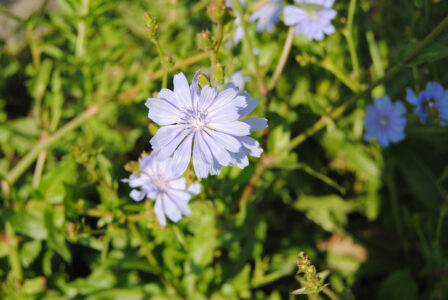
Jefferson praised the plant's value as cattle feed, calling it the greatest acquisition a farmer can have. However it wasn't until the 19th century, when European settlers came to the United States, that chicory came to grow permanently on our shores. Today, the blue, square tipped flowers are a common sight along our country roads; however, we now consider the plant a weed.
Chicory is not a plant that would invade your flower garden. The plant prefers to grow in a dry, sunny location. Linnaeus wrote that the brilliant blue flowers, which average one-and-a-half to two inches across, bloom for only a few hours each day. Each ray of the flower extending from the center is either notched or jagged on the end.
In Bradford County, the flowers open between 7 and 8 a.m. depending on the weather and begin to close at noon.
Although all parts of the chicory plant can be used for medicinal purposes and cooking, the best part is the root. The long taproots are best dug in early summer before becoming too woody. The young leaves are best gathered when they first appear and can be used as a poultice to ease swellings, inflammations, pimples, and sores.
Some say the crushed leaves work best if a little vinegar is added.
All flowers do not produce the same amount of nectar during the day, and certain insects are aware of the flowers that produce the most nectar. Chicory flowers are best in the mid-morning hours.
Chicory is a rather ragged looking weed that grows to a height of about four feet. The basal leaves are dark green, deeply toothed and taper toward the ends. The upper leaves are much smaller than the lower leaves, and the stems will exude a milky sap when broken.
Today chicory is considered a weed, but with all the history and lore written about this plant, we cannot ignore the fact that our ancestors used it for many purposes. In recent years, scientists have been learning that some of our grandmothers' homemade medicines do work.
Bill Bower is a retired Pennsylvania Game Commission Wildlife Officer. Read his blog and listen to his podcasts on the outdoors at www.onemaningreen.com.