
Reflections in Nature: The milkweed plant was very important in WW2
Trending
This article is entitled "The Tale of Two Flowers" due to the patriotic feeling that swept our country during the Fourth of July week. Along with the many thoughts of patriotism, I began to think of the two plants that prompted the United States to ask its people for help during World War II.
During June, we had a splash of wildflowers blooming along the roadways and in the fields. This show will continue to change as the fall plants begin to bloom. One of these plants is the milkweed on which the monarch butterfly depends.
Mary Alice saw her first monarch of the summer on July 5 in her flower garden. For years, scientists have warned that monarch butterflies are dying off in droves due to diminishing winter colonies. New research from the University of Georgia shows that the summer population of monarchs has remained relatively stable over the past 25 years.
While other studies by ecologists at Michigan State University led an international research partnership of professional and volunteer scientists to reveal new insights into what's driving the already-dwindling population of eastern monarch butterflies even lower.
The Latin name for the milkweed plant is Asclepias syriaca, which comes from the Greek God of Medicine, Aescilapius, because at one time, the roots of the plant were used extensively as a healing herb. The leaves of the plant are rich in cardiac glycosides, a powerful toxin that interferes with basic cellular processes.
The green flowers grow in large clusters, with each cluster having more than fifty flowers. A flower has five petals that are small cups containing nectar, with each cup having a little horn that curves toward the center of the flower.
A flower has five slits, with one between each cup, and at the top of a slit is a black, shiny clip. As an insect tries to hang on to a flower, its leg will become stuck in one of the five slits. In the insect's struggle to remove its leg from the slit, the leg encounters a black clip. With a mighty pull, the insect's leg is freed, however attached to the leg will be the black clip and two yellow bags of pollen. Unlike ordinary pollen, which is powdery, this pollen is waxy and sticks together in small, pear-shaped, yellow bags.
The insect, with the pollen bags attached to its leg, will go on to the next milkweed flower. The insect's leg will go into a slit again and become stuck. The first two pollen bags will remain in the flower, and the insect will pick up two new bags. Once in the slit, the pollen has yet to reach the ovules that are located at the bottom of the pistil.
At the back of the slit is a sugary liquid in which the pollen grains grow and continue to grow until they push their way down the tubes into the bottom of the pistil, becoming the familiar pod that we all recognize. This is a very complex procedure, so complicated that out of the fifty or more flowers in a cluster, rarely more than three pods will develop.
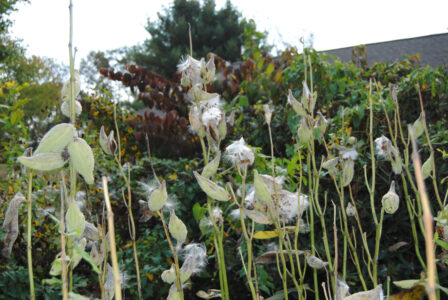
At the top of a long stalk, the pods develop, with each pod containing several hundred seeds. As fall approaches the leaves fall off, leaving a long stalk with several pods, which will dry out and split open.
Inside the pod, each seed is attached to as many as 900 long, silky hairs. The hairs are waxed so that rain will not hamper their job of dispersing. The wind picks up the silky hairs, and the seed goes sailing away, sometimes traveling distances of over one mile.
If the seed falls in a favorable spot, a new milkweed plant will grow in the spring.
Although the milkweed plant has always held our interest, perhaps never as much as during World War II. The United States received its kapok for life preservers from the Dutch Indies. When the Japanese seized the Dutch Indies in 1942, the United States had to find a substitute for kapok.
Kapok is the fiber found in pods of the silk-cotton tree. These trees, which grew on large plantations in Java, supplied the world with kapok. Kapok was used to fill the Mae West life preserver vests that were used by the U.S. Navy. When kapok became unavailable the government turned to the milkweed plant to fill the life vests.
The Department of Agriculture spearheaded the program to collect the milkweed pods. Perhaps you were one of the pickers, whose slogan was "Pick A Weed, Save A Life." School children, scouts and concerned citizens armed with sacks went afield across the country in 26 states, including Pennsylvania.
The ripened pods were sent to a plant in Michigan. Here the pods and seeds were separated from the flossy seed hairs, which are waxy on the outside and hollow on the inside. Each tiny thread was an air-enclosing tube. A man weighing 150 pounds could be kept afloat in sea water for 48 hours with only 26 ounces of the milkweed's flossy hairs.
Although the government paid 20 cents a bag, the cost to produce was 75 cents a pound. During the last two years of the war, 25 million pounds were picked, enough to fill 1.2 million life preservers. Many sailors' lives were saved. After the war, the navy went back to kapok, which could be imported for only 10 cents a pound,
I titled this article "A Tale of Two Flowers" because there is another plant we depended on during World War II, but you will have to wait until next week to find out what plant I'm referring to.
Bill Bower is a retired Pennsylvania Game Commission Wildlife Officer. Read his blog and listen to his podcasts on the outdoors at www.onemaningreen.com.