
Through variety of ways, locals help give hellbenders a voice
Trending
Before a nervous, pre-teen Michael Kinney could react to the strange-looking creature at the end of his fishing pole, he was distracted by the reaction of everyone around him.
"They started backing away, calling it a mudpuppy. These older guys with tattoos were yelling, telling me I should destroy it. That it was bad for the fish - bad for the water," he recalled. "I got it on the ground, and I remember it crawling around and getting back into the water."
It wasn't until he was in high school biology that Kinney, of Williamsport, learned the strange salamander was actually called a hellbender, that they don't destroy a stream's ecosystem and later that they were important stream quality indicators.
"We didn't have internet back then at our fingertips to look things up, but even with all the resources we have today, there are still a lot of wrong ideas out there," he said.
The experience has been one of the main inspirations for Kinney's work behind the camera to better connection people with the natural world to better understand it, appreciate it and protect it.
Legal victory
On Sept. 5, 2023, after a two-plus-year legal case involving five environmental groups - including the local nonprofit Middle Susquehanna Riverkeeper Association (MSRKA) - vs. the US Fish and Wildlife Service, a federal judge overturned the service's 2019 decision to deny the eastern hellbender protections under the Endangered Species Act.
"There are few creatures as symbolically significant to our work in the Susquehanna River watershed as the eastern hellbender, a misunderstood and underappreciated species that is a critically important litmus test of water quality," said Middle Susquehanna Riverkeeper John Zaktansky.
"It is estimated by local hellbender expert Dr. Peter Petokas (of Williamsport) that as much as 95 percent of their habitat in our nearby river system is gone due to a wide variety of issues. Erosion and sedimentation, abandoned mine drainage and other legacy pollutants combined with a wide spectrum of emerging contaminants likely continue to narrow the range of the hellbender and may soon choke it out of existence in our area without some sort of intervention."
Included in the numerous files of information and evidence supplied by the legal team representing the MSRKA, the Center for Biological Diversity, Waterkeeper Alliance, Waterkeeper Chesapeake and Lower Susquehanna Riverkeeper Association were data and links to hellbender studies and content from central Pennsylvania.
Of course, that involved info from Petokas' nearly 20 years of work on local hellbenders and information about his efforts to augment habitat and restore the species' populations in certain stretches of the watershed.
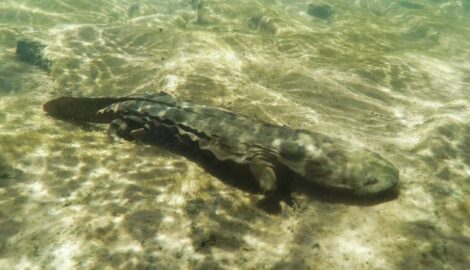
It also included photos and videos from Kinney that showed the hellbender in its natural habitat, in local streams where it has natively lived dating back potentially to prehistoric times.
There were even links to and social shares of stories and columns about local people, such as Barb Jarmoska, who lived her whole life along the Loyalsock Creek and was instrumental in reporting Clean Stream Law violations by a natural gas company a year ago that likely impacted hellbender habitat and so perfectly helped illustrate the dire situation the species faces in the region.
"I am an old woman who has been caring about this for so long, and because of my lifelong history in this exact spot, I have seen so many changes that have not been good for this area. It has been easy to lose hope," Jarmoska said. "However, these sort of moments - this legal win for the hellbender - allow us to heave a sigh of relief and admit the fight is worth fighting."
A voice for the voiceless
As a child, Audrey Shipman, of Turbotville, enjoyed family trips to state parks.
"My mom got us into a lot of environmental education programming. I remember going to a camp and hanging out a lot by the Loyalsock Creek," said the recent Warrior Run High School graduate. "We went to a Lycoming College for Kids Camp and there was this professor who was into hellbender research, and as a kid I thought these creatures looked pretty cool."
Earlier this year, Shipman signed up for the Middle Susquehanna Riverkeeper Association's new EELS (Environmental Education Leadership for Students) Program and was excited to find hellbenders as an option to then teach younger kids about.
She gave two hellbender presentations this spring one to more than 80 first-graders in Hughesville and another to nearly 30 elementary students at Meadowbrook Christian School using materials from the association.
"I was surprised at how interested the kids were about the hellbenders and it felt so cool how this all was coming full circle for me. I could see myself as a kid getting excited about hellbenders as I was watching these kids light up about them," said Shipman, who is currently a freshman majoring in marine biology at Florida Gulf Coast University. "Hearing about the hellbender case and being a small part of helping spread awareness - of giving this quiet creature a bigger voice - there is something special about that."
Musician Bill Dann, of State College, felt compelled to champion the hellbender via the Middle Susquehanna Riverkeeper Associations Songs of the Susquehanna project after watching a video featuring Dr. Petokas.
"He was talking about declining numbers and what he was doing to try to help and I took it as my own personal plight. I figured it would make a good song, so I started working on lyrics," he said, taking those lyrics to longtime collaborator and friend Jack Servello.
"He's talking about this creature that is living in the water and trying to hide under a rock. I wanted the song to sound almost like it was a mystery, like you might see this salamander, you might not," said Servello. "I am overjoyed that songs can cause such a direct about face and create a chance for real change in how we care for our environment and our river's amazing creatures."
Meanwhile, Dave Miller and his 14-year-old daughter, Ella, also decided to work on a song about hellbenders for the project.
"We live on the river, and as much as we learned about this creature, to know we might have swam with it at one point and never knew about it was fascinating," said Dave. "As we better understood the real issue with this species, we kind of got mean with the listener because as humans, we really screwed things up for the hellbender. We wanted this song to talk about how bad things are and how we need to get our act together and clean ourselves up. We wanted this to be real, to give a real voice to this creature which we've taken for granted for ways too long."
The lessons, songs, photos and even a series of original hellbender posters created at local outdoor shows by numerous children all add different elements to the bigger voice of the hellbender and can be viewed in a growing collection of stories and other elements at www.middlesusquehannariverkeeper.org/hellbenders1.html
That continued awareness is critical as the hellbender's status under the Endangered Species Act goes back under evaluation both by the US Fish and Wildlife Service and by the court of public opinion.
"A while ago, I recorded a video of a local hellbender and uploaded it online. Feedback was like 50-50. Some people knew what they were. Others didn't. Others thought they did," said Kinney. "I would read the comments and with some I'd be inspired, and with others, I felt as traumatized as I did that day as a kid fishing. It is disappointing that there are still people today that don't care to understand how valuable hellbenders are and still want to get rid of them."
Back on the Loyalsock Creek, Jarmoska agreed.
"It's not over. This gas company is still at it, and it is just one little company in the bigger macrocosm," she said. "Still, it is nice to acknowledge this victory and for a moment to take a breath and lay some cynicism aside.
Then, tomorrow, we wake back up and keep at it."
The Middle Susquehanna Riverkeeper Association serves an 11,000-square-mile watershed of the Susquehanna River, including Sullivan, Lycoming, Clinton, Union and Northumberland counties. Read more at www.middlesusquehannariverkeeper.org.