
Reflections in Nature: An in-depth look at the oak tree, acorns
Trending
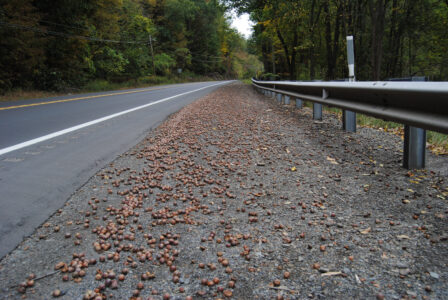
Here in the Troy area, our oak trees have not produced their usual crop of acorns. However hunters have told me that in other areas, the oak trees — especially the chestnut oaks — have produced a bumper crop of acorns.
The acorn is the fruit of the oak tree. Not all acorns produced will become trees, however, every acorn that falls in the forest is used and some are used repeatedly.
Most acorns are eaten by a wide variety of animals, from the small mouse to the large black bear. During a year when acorns are plentiful, a black bear can put on thirty pounds in one month's time by feeding on acorns.
Acorns, which are rich in carbohydrates, are soft and easy to chew. While an acorn is still on the tree, a weevil will bore a hole in the shell to deposit an egg. There are a few moths that lay eggs on the outside of the acorn shells. Their larva will chew through the shell and into the acorn's embryo.
The gray squirrel will begin collecting acorns before they fall from the tree. The squirrel climbs a tree and chews the branches off, allowing the acorns to drop on the ground. Then the squirrel collects the acorns on the ground and buries them to be used during the winter months.
A squirrel will discard an acorn found with larva inside. However deer, mice, bear, and other mammals aren't as fussy and will eat the acorn and larva.
Acorns that are missed by the larger animals are consumed by the smaller ones. After the larva inside the acorns eventually exit, mold and fungi start to breakdown the acorns. This breakdown riddles the shells with more holes. Then, the centipedes and ants will set up residence inside the acorn shells.
Finally, the shells collapse, and earthworms turn the shell pieces into humus. This rich soil will help the few acorns that survive to become oak trees.
In one study where 15,000 acorns were tracked, 83% were eaten by animals, 6% were attacked by insects, 10% were naturally imperfect and less than 1% sprouted.
Of those that sprouted, half died as seedlings.
Add to this the fact that a young oak tree does not start producing acorns until it is at least ten years of age. So it's almost a miracle that we have oak trees in the woods. Oak trees are known as the Methuselah's of the East and can live up to 400 years. An oak tree can take up to a century to reach its full maturity.
The oaks belong to the genus quercus. There are two great groups of oaks: white and red. While the white oak group is distributed all over the northern hemisphere, the red oak group is found only in North America. There are more than 300 species of oaks found throughout the world and some 40 species are native to North America.
We all know that the worst place to be during a thunder and lightning storm is under a tree. If you're in the woods, the worst tree to be under is an oak tree. It is said that the mighty oak is one of the species struck by lightning more often than other trees.
The Greeks were led to consecrate oaks to Zeus, the notorious hurler of lightning. The ancient Norse associated the oak tree with Thor, the God of Thunder. If you need to seek shelter under a tree, the best one seems to be the beech tree. Our ancestors believed that a beech tree planted near a house would protect the dwelling from lightning.
Now this superstition held some truth. The beech's trunk, which has a high oil content, is smooth whereas the oak has a rough, ridged bark that can be three to four inches thick. This rigid bark does not allow the rainwater to run evenly down the tree as it does on the smooth bark of the beech.
If lightning strikes, it follows the rainwater on the outside of the tree to the ground. On the oak, the lightning cannot follow the water path and ends up entering the tree's liquid sap, causing it to boil and then explode.
Sometimes it can be confusing when deciding what type of oak you are looking at because the leaves can vary even on the same tree. The leaves on a seedling or a sucker shoot can be quite different from those on a mature tree. In identifying an oak, one must first decide which of the two great groups it belongs to: white or red.
The acorns on the red oak are approximately one inch long, straight sided, with a distinctive shallow cup and shells lined with woolly hairs. On a white oak tree, the acorns are approximately three-quarters of an inch long, with prominent cups that have a granular beaded surface and the shells are smooth inside and not lined with woolly hairs. While red acorns are bitter, the white oak are edible with a pleasant, sweet taste.
The red oak produces acorns each year, but one year's crop takes two years to mature. In the first year, they grow into minute acorns and hang on the tree throughout the winter. During the second year, they mature before falling from the tree.
The white oak tree's acorns mature in one year and begin to germinate in the fall when they drop from the tree. Before winter arrives, the white oak's acorns will have sent tap roots into the ground, where they rest until spring before starting to grow.
An ancient motto of the Benedictine Monks: Parvise glandibus quercus – meaning, tall oaks from little acorns grow.
Bill Bower is a retired Pennsylvania Game Commission Wildlife Officer. Read his blog and listen to his podcasts on the outdoors at www.onemaningreen.com.