
Reflections in Nature: With Halloween approaching, a look at the witch hazel
Trending
We are coming to the time of year when spooks, goblins and witches will be roaming about. Perhaps you will want to find a branch from a witch hazel tree for protection.
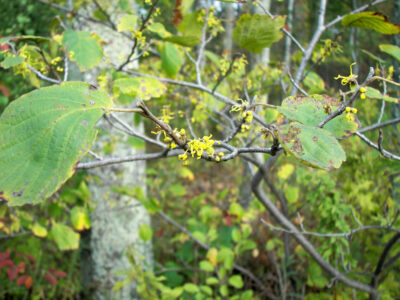
Although this was written in jest, I did make a special trip to check on a witch hazel tree to write this column. After the leaves have fallen from this small tree, it will be in full bloom, giving the witch-hazel special abilities.
Witch hazel belongs in the family hamamelis virginiana. The genus name hamamelis comes from the Greek words hama, meaning at the same time, and melon, meaning fruit. This refers to the fact that the tree can have both flowers and fruits appearing at the same time, which is a somewhat rare feature. The species name virginiana means the plant is from Virginia. The flowers appear as yellow ribbons tied on the bare branches.
I suppose a plant with the word witch in its name is bound to be seen as different in some way. The word witch as we use it today comes from the old English word wicca or wizard. However, it is said that the word witch in witch hazel originated from the Middle English word wiche, which means to bend."
Our word wicker comes from the same root word, meaning pliable branches that bend. The hazel part of the witch hazel name is derived from the resemblance of its leaves to those of the hazelnut tree, with both being broadly oval and scalloped. They are distantly related, but one difference is that the witch hazel leaves are uneven at the base.
The Native Americans called the witch hazel "Oc-eh-nah-kwe-ha-he," meaning spotted stick. The branches of the witch hazel tree go in all directions, and they are also brown speckled, with light brown dots. Two common names for the witch hazel tree are "cannon of the forest" and "spotted alder."
There is yet another surprise.
While the tree is in bloom, it also contains the seed pods from the previous year. This is our only tree that produces ripe fruit and blossoms at the same time. The fruit is a two-celled capsule that feels as if covered with suede. After the new capsules are formed with blossoms, the capsules are dormant throughout the winter months and summer.
Twelve months after being formed, the capsule comes to life. As the seeds ripen inside the capsule, the capsule begins to dry out and shrink.
The capsule acts as a cannon holding the seeds. As the capsule dries out in the warm sun, it shrinks and shrinks until the two dark seeds inside are fired. Have you ever held a seed between your fingers, and squeezed? If you have, you know that the seed goes flying when too much pressure is applied. The witch hazel works on the same principal.
How far do these seeds travel? The record seems to be about 40 feet. Of course, it all depends on the angle the capsule is pointed on the branch. An angle of about 45 degrees seems to produce the greatest distance. On a warm fall day, a witch hazel tree lays down quite a barrage. Seeds are fired in all directions. All types of wildlife, especially grouse and turkey, feed upon these seeds.
Since the witch hazel blossoms in the fall at a time when no insects are available, the plant pollinates itself. Its half-moon-shaped buds are rolled inward in a closed spiral. Inside the buds are the anthers which hold the pollen. Each anther has two small doors that remain closed throughout the summer. In the fall, these doors fly open, throwing pollen on the blossoms. Fertilization is completed.
The witch hazel is a native tree, but its name comes from Europe. In Europe they have a similar looking tree that was associated with lore and magic. Legend has it that you could use its branches to find witches and to find gold and water. When the settlers came to America, they named our look alike tree the witch hazel, and it inherited the mystique.
In Colonial America, the witch hazel was used as a folk medicine, for such things as bruises, sprains, ulcers, skin rashes, and eye inflammations. The American Medical Association still recognizes its medicinal value. Today, witch hazel is used as an additive in rubbing alcohol and in treating poison ivy, insect bites, bee stings, and minor burns.
The branches are also used in water witching.
The two black seeds of the plant are edible. Tea is made by boiling the leaves and sweetening them with maple sugar. The tree is remarkable from its October-November flowers to the exploding seeds, to its self-pollination and is truly one of nature's wonders.
Well, it is now October, a time when witches roam the land and Halloween is at hand, you may want to protect yourself with a branch from the strange witch hazel tree.
Bill Bower is a retired Pennsylvania Game Commission Wildlife Officer. Read his blog and listen to his podcasts on the outdoors at www.onemaningreen.com.