
HERE THEY COME: Finches are returning this winter in Pennsylvania
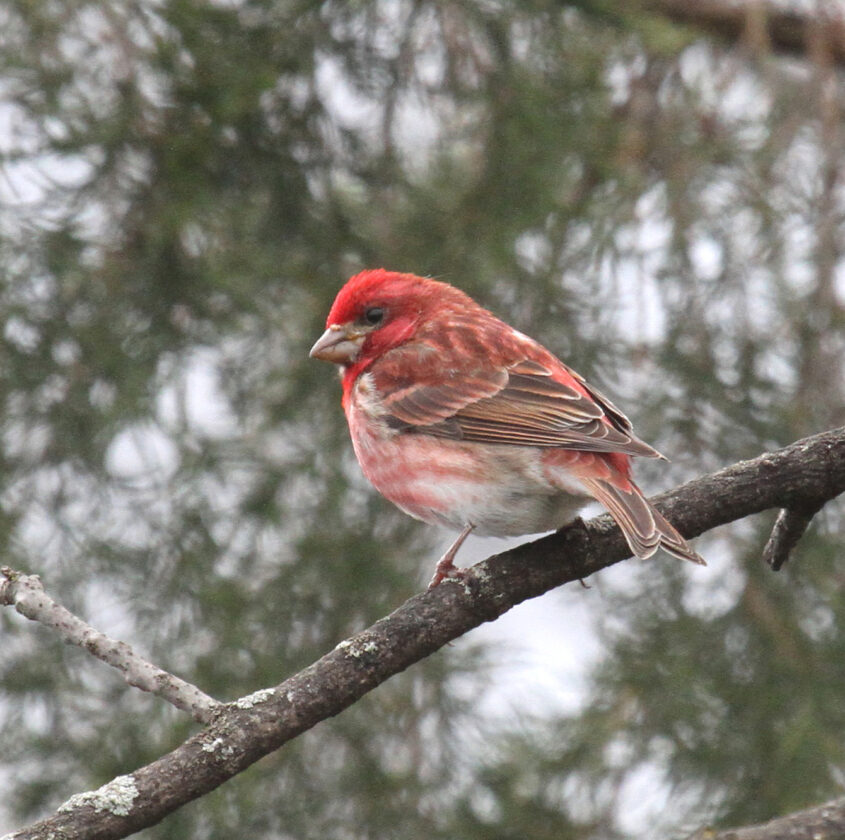
PHOTO PROVIDED Shown is a male purple finch in this photo by Wayne Laubscher.
If you haven’t already done so, get your feeders filled and ready. Winter finches are returning. Moderate-to-good flights of some species are occurring now and more are possible.
Much of the northern forest across the Canadian interior has a very poor to below average cone crop. Interestingly, the widespread forest fires in Canada earlier this year have apparently had no effect on finch movements because most of the burned areas had little to no cone crops.
However, the boreal forest east and south to the northeastern United States has widespread areas of heavy white pine cone crops and excellent deciduous tree seed and fruit crops. Some of the following species are already in our region and a few more will possibly show up.
Good numbers of purple finches will likely spend the winter in the northeastern United Staets. Several areas in Pennsylvania have been reporting them for several weeks. They favor black oil sunflower seeds at feeders.
Pine siskins have been showing up in moderate-to-good numbers in many areas of the region since early fall. This flight could develop into a strong movement as winter progresses. This gregarious and very vocal species prefers thistle in tube and sock feeders. They also feed on spruce and tamarack cones.
In irruption years, pine siskins sometimes will remain into spring to nest.
Small nomadic flocks of red- and white-winged crossbills are moving south into the northeastern states. In fact, red crossbills have been reported in this region since at least late this summer. There is one record of red crossbills nesting in Clinton County this summer.
A few white-winged crossbills have been reported recently as well.
Look for crossbills feeding primarily on white pines but also red and white spruce into early spring. Stands of other pine species and also Norway spruce should also be checked. Crossbills are able to nest during any month of the year if adequate food is available.
The spruce and birch crops across most of the boreal forest are poor. Some common redpolls are expected to move south and may appear in our region. Look for them in alder and birch as well as weedy fields. Check for the rarer hoary redpoll in flocks of commons.
It is a much paler species that may be found. Redpolls will come to feeders with nyjer and black oil sunflower seed.
The large, showy, and noisy evening grosbeak is not expected to make a significant flight into this region but some are expected to winter in New England and New York. There have been a small number of sightings in Pennsylvania, however, so be on the lookout anyway. They readily consume black oil sunflower seeds on platform feeders.
Keep your feeders up and filled and hopefully you will be rewarded with a great bird show this winter.
A thank you and information acknowledgment goes to forecaster Tyler Hoar and the Finch Research Network (finchnetwork.org) where more information can be found.
Wayne is the Clinton Co. compiler for the PA Birds publication, a member of the Lycoming Audubon Society board and a board member of the Pennsylvania Society for Ornithology. He is a native of the Lock Haven region, residing in Swissdale.
BIRD LORE is produced by the Lycoming Audubon Society (serving Lycoming and Clinton Counties) and Seven Mountains Audubon (serving Union, Snyder, Northumberland and Columbia Counties) and Tiadaghton Audobon Society (serving Tioga and Potter Counties). Information about these National Audubon Society chapters can be found at: http://lycomingaudubon.blogspot.com, http://sevenmountainsaudubon.org and https://tiadaghtonaudubon.blogspot.com.
Outdoors
Effort underway to save, restore, reopen Muskrat Blind as educational venue at Montour Preserve
Outdoor community calendar for Week of Dec. 2
HOLIDAY WREATHS WITH PETE GSTALDER WHERE: Rider Park WHEN: Sunday, Dec. 7 (1-3 p.m.) NOTES: Rider Park is ...
Montour County solicitor clarifies rezoning hearing will be legislative and outlines steps for public participation
Reflections in Nature: Looking more closely at the porcupines
Recently I have been asked several questions concerning an animal. One question was what could be chewing on an ...
Could it be possible that birds enjoy playing?
Reflections in Nature: Many animals seek shelter, dens in winter
Are you prepared for another Pennsylvania winter? Our furnace and chimney have been cleaned, filters have been ...