
Native wildflowers are abundant in our region
Trending
In our region we host wildflowers galore from May through September. These wonders of nature grow in every size from two inches high (violets) to towering overhead (mountain laurel, our state flower).
Native wildflowers are important food sources versus non-native wildflowers, which have been imported since colonization. Non-natives compete with natives and are often more aggressive, pushing out the native wildflowers
So what is the problem with that? Survival of the fittest isn't a problem, right? Our native wildflowers have evolved to support local ecosystems which includes being food for native animals, being pollinators, or supporting specific insects that are needed for specific birds for instance.
Non-natives can't fulfill these functions.
Perhaps the easiest non-native plant/flower to help explain this concept involves Japanese knotweed which has taken over creek banks along mile after mile of Loyalsock Creek, Muncy Creek and Lycoming Creek. So what is the problem with that?
For all those miles of knotweed, what you are not seeing is our native wildflowers which have been, for many miles, totally choked out by the knotweed. You can view the knotweed just by driving into Montoursville and looking up or down the Loyalsock Creek.
Why is knotweed so prolific? Animals and insects won't eat it.
What makes this more complicated relates to the fact that you will see bees - which are of course important pollinator insects -- visiting non-native wildflowers for sweet nectar. But here is the problem: non-native wildflowers, and other plants such as shrubs and trees, often can't support the insects which are needed to feed birds.
Birds need insects, not nectar, to feed their fledging bird babies. That is the issue.
Another major reason to care about wildflowers doesn't have to do with botany at all. Rather, wildflowers are yet another field where we can open to an endless world of learning, appreciation and wonder regarding the intricacies of nature.
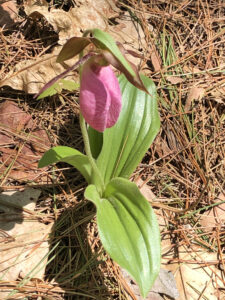
Some wildflowers in our woods are rare, such as lady slippers which are blooming right now. These magical pink slippers are one type of orchid in Pennsylvania, while our entire state boasts about 60 species of orchids. Magical.
In Pennsylvania, 2,100 native plants been documented. How many could you name?
From now through fall, wildflowers are easy to find on the water authority trails in Armstrong Township; at Ryder Park in Warrensville; at Canfield Island, on Mill Street in Montoursville; or up Little Bear Creek Road on Route 87 about ten miles north of Montoursville.
A few wildflower resources are the following: the Audubon Society Field Guide to North American Wildflowers, Peterson's Field Guide to Wildflowers, and Newcomb's Wildflower Guide which leads the reader through a step-by-step process of elimination to identify a specific flower.
Several apps have been created to help identify flowers as well. Send a picture on your phone to the app which then identifies the flower. I Naturalist is a good example.
But these apps are not as accurate as wildflower reference books or websites.
Facebook plant identification groups also have sprung up. Send a picture of a flower and an actual person identifies the flower for you. This method has a higher accuracy rate than apps.
Examples of such plant identification groups are the Pennsylvania Native Plant Society Discussion Group, Native Plants of the Northeast, and Pennsylvania Wildflowers.
Finding wildflowers requires old-fashioned walking versus speeding by in a car. And, the more you slow down and look, the more amazing types of wildflowers you will find.
May all your weeds be wildflowers.