Counting birds for community science bird project
-
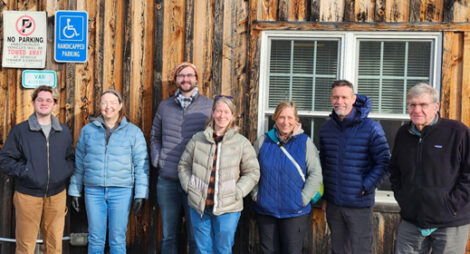
- PHOTO PROVIDED Shown is a group of individuals gathered to count birds recently in this photo by author Bruce Buckle.
-
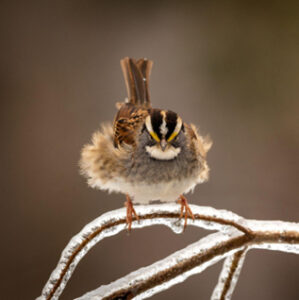
- PHOTO PROVIDED Shown is a white-throated sparrow in this photo by Doug Dearinger, which won a 2021 Audubon Photography Award.
-
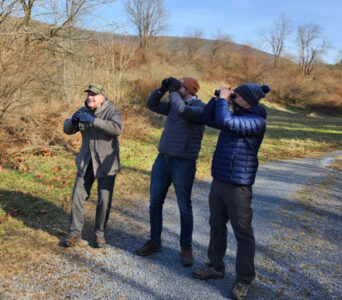
- PHOTO PROVIDED Shown is a group of individuals gathered to count birds recently in this photo by author Bruce Buckle.
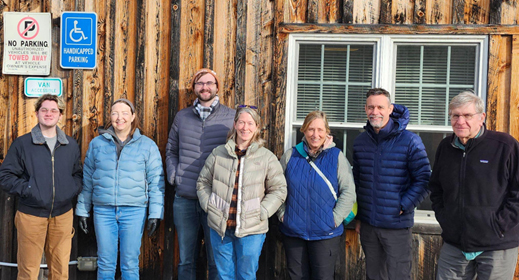
PHOTO PROVIDED Shown is a group of individuals gathered to count birds recently in this photo by author Bruce Buckle.
There were eight of us from different walks of life. One of us was 80 years old, another just 20. We had one task: to count every bird we saw or heard during a cold, but sunny Saturday in December.
We were Lycoming Audubon volunteers participating in the National Audubon Society’s Christmas Bird Count, the nation’s longest-running community science bird project.
Our group was one of several traversing roads and trudging along paths within the Williamsport circle — a designated count area with a 15-mile diameter centered on the bridge that leads into Montoursville. This count circle stretches from just east of Pennsdale to west of Lycoming Creek, and from north of Warrensville southward to the Lycoming County Landfill along Route 15.
Other count circles in our region include the Northern Lycoming circle, the Mansfield-Wellsboro circle, the Lock Haven-Jersey Shore circle, the Bald Eagle State Park circle, and the Lewisburg circle.
Begun at the urging of pioneer ornithologist Frank Chapman, the first bird census was held on Christmas Day in 1900. Then, 27 dedicated birders counted about 90 different species of birds at 25 different locations across the country. Today the Christmas Bird Count is held worldwide.
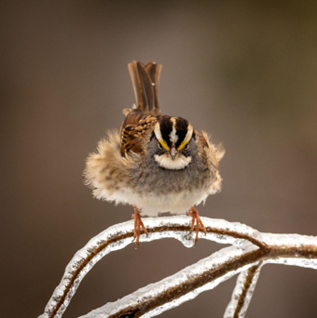
PHOTO PROVIDED Shown is a white-throated sparrow in this photo by Doug Dearinger, which won a 2021 Audubon Photography Award.
Last year, across 21 territories and countries in 2,693 count circles, more than 80,000 volunteers tallied 2,503 species and more than 44 million birds.
The other day someone asked me how do you count birds? Well, with binoculars in hand and ears attuned our group began our count in Eldred Township, just west of the Slabtown Bridge over Loyalsock Creek. Our group’s assigned area within the Williamsport circle also includes the hills and valleys of Upper Fairfield Township on the east side of Loyalsock.
A thoughtful member of our group provided coffee and donuts to share before we broke into teams to bird. One of the first birds spotted that morning, by the youngest and newest birder in our group, was a bald eagle taking flight from an open field into a nearby tree. Shortly after that we caught sight of a Cooper’s hawk headed into the woods from an unidentified perch.
A quiet interlude followed our initial excitement at seeing two raptors, but it wasn’t that long until we ran into a mixed flock of songbirds. Dark-eyed juncos were plentiful, and white-throated sparrows were hopping around in the brush. There was the eponymous call of a black-capped chickadee, the repetitive whistle of a tufted titmouse, and the nasal yank of a white-breasted nuthatch.
Someone spotted a downy woodpecker and several northern flickers were seen and heard. Just above us a red-bellied woodpecker was working a tree limb. With the melodic song of a Carolina wren and the distant, but familiar chatter of a kingfisher, our eBird checklist grew to more than 20 species and well over 100 individual birds.
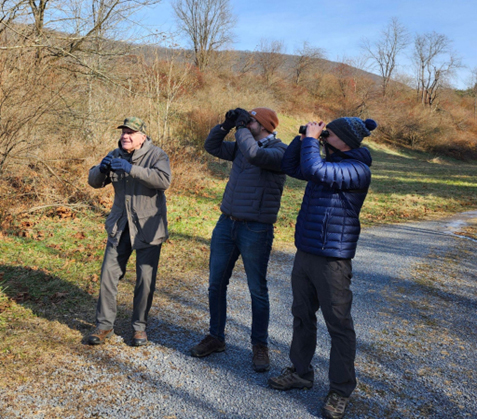
PHOTO PROVIDED Shown is a group of individuals gathered to count birds recently in this photo by author Bruce Buckle.
Our colleagues birding a different area were having great success as well. They saw or heard a hairy woodpecker, pileated woodpecker and yellow-bellied sapsucker. Of the seven woodpecker species found in our area, we only missed the red-headed woodpecker.
Another disappointing miss was the brown creeper, but we were glad to see and hear a couple of northern mockingbirds before the day’s end.
After two hours birding we regrouped to finish off the donuts before splitting up to do some feeder watching at the home of a long-time Lycoming Audubon volunteer, and to bird other hotspots in our assigned area.
Some road birding followed. Though usually not as enjoyable or productive as a good walk, a few members of our group spotted a rafter of turkeys. After lunch at Grimm’s Diner in Warrensville a couple of us continued birding and some new species were added to our list.
All told, our group counted 40 different species and 1,301 individual birds.
In short, that’s how you count birds.
The Christmas Bird Count is just one of the ways to enjoy birds during the winter months. You can discover other opportunities to learn about birds and their habitats by contacting your local Audubon Chapter to learn about their programs and activities.
Happy birding.
Bruce Buckle is a retired educator and President of the Lycoming Audubon Society. BIRD LORE is produced by the Lycoming Audubon Society (serving Lycoming and Clinton Counties), Seven Mountains Audubon (serving Union, Snyder, Northumberland, Montour and Columbia Counties) and Tiadaghton Audubon Society (serving Tioga and Potter Counties). Information about these National Audubon Society chapters can be found at http://lycomingaudubon.blogspot.com and http://sevenmountainsaudubon.org and http://tiadaghtonaudubon.blogspot.com
Outdoors
Birds breeding in the winter months? Eagles and owls do
Reflections in Nature: The squirrel leads a remarkably long life in the wild
Here we are in the dead of winter with nighttime temperatures falling into single digits, and despite this I am ...
Counting birds for community science bird project
Going outdoors this season? A quick guide to winter hiking
For many of us, winter can make the outdoors feel a little less inviting — but it doesn’t have to. With the ...
2026-27 hunting seasons and more at next PGC meeting
HARRISBURG — The Pennsylvania Board of Game Commissioners will hold its first meeting of the new year on Friday ...