
Reflections in Nature: Formation of snow in winter months is far from simple
Back when the television weatherperson was predicting the January snowstorm he stated that our area was to expect about a foot of snow. While the flakes were falling, PennDOT was announcing on the news what the cost of snow removal, from our roads and highways, would be.
Several nights earlier I had watched a segment on the same television station about how happy the proprietors of local ski areas were with the cold temperatures. A video was shown making snow. The snow guns were spraying a fine mist of water into the dry cold air, where it froze and fell back to the earth as snow.
The announcer stated that the snow guns would operate throughout the night so that skiers would have snow. Although snow making is expensive, it ensures the skiers that there will be snow on the slopes. If you stop to think about this, it is quite humorous.
When nature makes snow we spend millions of dollars on salt for melting the ice and the shoveling, plowing of the snow from our sidewalks, roads and parking lots. This road salt is not good for our environment.
Did you know that snow is not frozen rain? Do you know what it is? Snow forms by sublimation of water vapor — the turning of water vapor directly into ice without going through the liquid stage. High above the ground the chilled water vapor turns to ice when its temperature reaches the dew point.
The result is a crystal of ice, usually hexagonal. Snow begins in the high clouds in the form of these tiny hexagonal ice crystals. As water vapor is pumped up into the air by updrafts, more water is deposited on the ice crystals, causing them to grow. Soon some of the larger crystals fall to the ground as snowflakes.
Although it is said that no two snowflakes are alike, scientists have never found a law of nature that prohibits two snowflakes from being identical. Each snowflake contains approximately 180 billion water molecules coming together in such a random way and under such a variety of conditions that observing two identical snowflakes is extremely unlikely.
However in 1988, Nancy Knight accidentally found twins in samples formed 20,000 feet over Wisconsin. Snow scholars hesitated to call these ice crystals identical but referred to them as “very much alike.”
It takes about 20 minutes for a snowflake to travel from the cloud to the earth. In this 20-minute fall the ice crystals would have to go through the same temperatures, pressure and moisture content. While falling they would have to have identical collisions with other ice crystals.
While snowflakes are falling, they are continually being changed. One snowflake could hit another, the wind could break off part of a fragile flake, the sudden jar to a flake hitting the ground and one flake falling on top of another. Finding two snowflakes that are identical in every respect is close to impossible.
Snowflakes are extremely good insulators, and proof of this is that a lot of air is trapped inside the ice crystals that make up the snowflake. This is why there is an eerie quiet to falling snow. It is also why the temperature on the surface of the snow cover might be below zero degrees; while seven to eight inches below the surface, the snow temperature might be 26 degrees.
The rule is that ten inches of snow is equivalent to one inch of rain. However, if it is wet snow, that ratio can drop as low as 6 to 1. Meteorologists measure the water content of snow by collecting it on a flat surface, allowing it to melt and measuring the runoff.
Snow is white because many, many tiny reflective surfaces are formed on the crystal particles, and air spaces are trapped between these particles, which make the snow white. When the sun comes out the snow reflects the sun’s rays, making the snow dazzling white.
A Nor’easter is a storm which blows onshore off the Atlantic Ocean laden with moisture. It is because of this moisture that Nor’-easters are responsible for the heaviest snowfalls in our area.
If the weatherperson says we are going to have snow showers he is predicting a brief, localized snowfall that can be isolated or scattered. If he or she says we will have snow squalls, it means that we will have brief but very intense snowfalls, in which visibility can be limited. If snow flurries are predicted, these are very light snow falls that produce little or no significant precipitation. If periods of snow are predicted, widespread precipitation can be expected.
A snowflake is an insignificant thing. You can crush one between your fingers and reduce it to a drop of water. However, when a multitude of these tiny flakes merge, they can halt traffic, close schools, crush buildings, topple trees and generally bring our lives to a standstill.
For most wildlife, deep snow is devastating, however, for some, heavy snowfall makes for easier living. As the snow accumulates, rabbits, which are light enough to walk on top of most types of snow, can reach higher to get food. Snowshoe hares and ermines are protected from the color of the snow because their fur changes to white in the winter months. Voles and mice are easy prey to hawks and owls because the frost kills all the vegetation, which helped hide them during the summer months. However, a deep snow cover again hides them from the eyes and ears of the predators.
Even hibernating animals such as woodchucks benefit from heavy snow. The woodchuck must keep its body temperature above freezing while hibernating. This is done by shivering when its body temperature drops, however shivering, which produces heat, uses up body fat.
A snow cover on the ground acts as an insulated blanket, which keeps the frost and cold from penetrating down to the woodchuck’s den.
Bill Bower is a retired Pennsylvania Game Commission Wildlife Officer. Read his blog and listen to his podcasts on the outdoors at www.onemaningreen.com.
Outdoors
Community Outdoors calendar for Week of Feb. 17
AUDUBON EVENT: COMMUNITY WORK DAY AT RPANA WHERE: Robert Porter Allen Natural Area (meet at the ball field ...
Bass Fishing HOF angler Iaconelli will retire competitively
Every legend comes to an end; it’s just a matter of time. Bass fishing legend Mike Iaconelli recently announced ...
Reflections in Nature: Formation of snow in winter months is far from simple
Back when the television weatherperson was predicting the January snowstorm he stated that our area was to expect ...
Yaw, Boscola propose restoring traditional opening day of rifle season
HARRISBURG – A bill to restore Pennsylvania’s traditional opening day of statewide firearms deer season to the ...
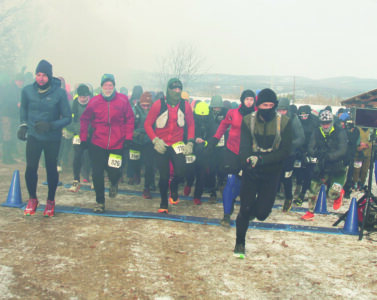
Hundreds brace sub-zero temps at Frozen Snot race in McElhattan
CWD seminar is scheduled for March
A free seminar on Chronic Wasting Disease is scheduled at Penn College for March 28 with speaker Marcelo Jorge, a ...