
Plastics becoming a major threat in Susquehanna according to survey by experts and river users
Trending
A Middle Susquehanna Riverkeeper Association poll of people who use our river in very different ways highlighted a very similar concern.
Plastics have infiltrated our aquatic ecosystem and become a major threat.
The 16 people polled, including everyone from professional anglers to college professors and state agency researchers, responded with an average score of 7.375 out of 10 as far as their state of concern about plastics in our waterways - with 10 indicating "worst possible threat to our ecosystem."
"I have fished the river ever since I was a baby," said 16-year-old Ty Magargle, of Danville, a three-time BassMaster state champion angler who has fished lakes and rivers all across the country. "Throughout my life, the river has gotten worse with plastics and trash along the shore and floating in the current."
Ben Franek, an associate professor of physical and environmental sciences at Bloomsburg University, has been studying the Briar Creek watershed (Columbia County) for a number of years with his students. They scoop up soil and rocks from various parts of the watershed's streambed and take those samples back to the lab for assessment.
"What we've found, in every sub-watershed of the larger 33-square-mile Briar Creek watershed, are lots of microplastics. Every site (about 12-15 sites) and basically almost every sample has a variety of plastics in various forms," he said. "There are plastics from bottles, from discarded fishing line - some can be hard to determine because they break down into smaller pieces but never really go away."
He pointed out that while all these plastic components are found in the Briar Creek watershed, that doesn't mean they all originated there.
"They are broken down over years throughout the region. Also, if you have microplastics, you will have nanoplastics, but those pieces are too small for our equipment," he said. "Beyond the Briar Creek watershed, we have found plastics in other locations, too. We have identified lots of microplastics in the Catawissa area and even on a golf course in Lewisburg. Every place we have gone, we have found plastics."
Franek's colleague, Thomas Klinger, Professor of Biological Sciences at Commonwealth (Bloomsburg) University, has done similar studies with his students at various places within our watershed and beyond.
"I have found plastic litter in most second-order and above streams I have visited," he said. "Many of my students have focused their research on microplastics in streams in Northeastern Pennsylvania. They have never failed to find microplastics."
They're everywhere
Middle Susquehanna Riverkeeper Association Board President Michael Kinney paddled the entire West Branch of the Susquehanna River in 2024 and spends a considerable amount of time on our waterways in general.
"River islands with no access have high amounts of plastic trash. Areas with lightweight flood debris have high amounts of plastic. Heavily populated fishing areas have high amounts of plastic, often with no trash cans present," he said. "When looking closely, there are high amounts of shredded plastic from riverside landscaping."
The proliferation of plastic in all these areas and beyond isn't a surprise to Faran Savitz, of PennEnvironment, who conducted a study of waterways across the state several years ago with surprising results.
Their group pulled 315 water samples from 53 bodies of water and determined conclusively that every major waterway in Pennsylvania is polluted with various microplastics.
"I knew we'd find plastic. I knew we'd find a lot of it, especially at places like the Schuylkill River or the Ohio or Allegheny (rivers), but I didn't expect to find it in every single waterway we tested and in almost every single sample we collected," he said. "I think all but two or three of the 300-plus samples contained at least one or two elements of microplastics. It didn't matter if it was an urban river or a less-traveled one - or a place with visible litter or without - they all had quite a bit of plastic."
According to Savitz, the study was focused on the presence of microplastics and not the prevalence, looking specifically at microfibers, microfilm/flakes and microbeads. The study wasn't designed to determine which waterway was more polluted than another, but they did discover a few interesting trends in the final data.
"Every single site had microfibers - which is striking because they come from our clothing, from any sort of textile that uses synthetic fibers, and they're washed directly into our waterways from washing machines," he said. "So the fact that we saw these in every single waterway is very telling."
The study also discovered quite a bit of microfilm in waterways across the state.
"That can be an indicator of all the packaging and plastic bags we use," Savitz said.
Lots of litter
Plastic bags are among the variety of plastic waste seen by Columbia County Conservation District Manager Abby Frey.
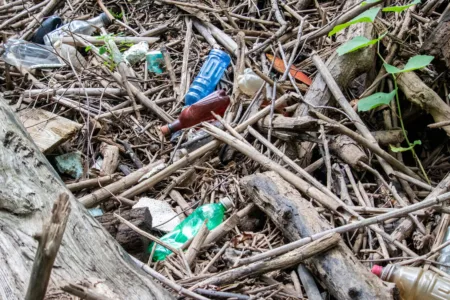
"The biggest issue I see with plastics is litter on streams and river banks," she said. "General trash, bags, soda bottles and caps, fishing line, etc. I see a lot of dump sites along back roads, as well."
As a volunteer with the Buffalo Creek Watershed Alliance, near Lewisburg, Sandy Costello helps with many trash pickup events.
"Along Route 192, during pickups, we have found a lot of plastic," she said. "When going to parks, there is litter and plastics."
Sandy Field, one of the founders of Save our Susquehanna, helped with the annual spring litter pickup near Sunbury.
"It was mostly plastic," she said.
Susquehanna University graduate Samantha Chillis studied the trends in plastics and litter both before and during the pandemic under the supervision of professor Dan Ressler.
"We had samples from 2019 before everything closed down and took more in 2020 during the shutdown," said Ressler.
Chillis collected the samples from a study in East Buffalo Township near Lewisburg along sections of restoration on Limestone Run, known locally as Bull Run.
"For a majority of Bull Run, I looked at pools and eddies," said Chillis. "For the pool sites at both upper and lower Bull Run, we saw an increase (of microplastic particles) in them."
In the lower Bull Run segment, Chillis was finding five to six pieces of microplastics per each 30-gram sample of sediment from those pools in 2019 collections vs. eight in 2020. In the upper Bull Run section, the amounts doubled from four (in 2019) to eight to 10 microplastics (in each 30-gram sample) from 2020. For context, 30 grams is about two tablespoons of sediment material tested in each sample.
Those microplastic particles included flakes "from plastic bags or anything else that can break off into smaller pieces that aren't hard or thick plastic," harder 3-D particles "ranging from little white pieces that may have broken off from plastic silverware or little microbeads" and microfibers "from clothing and even little wiry remnants that almost looked like they were from a frayed rope," said Chillis.
"When you look at a study like ours, we don't have million-dollar-funded research projects with state-of-the-art equipment, but even with the simple tools we have, we found microplastics a lot more broadly spread than originally expected," said Ressler. "The fact that we can turn over a rock in any part of our region and find microplastics is notable. It would be easy to just say that this is a Bethlehem or Philadelphia problem, but then you realize just how much of an issue it is right here in our region."
Laundry list of
concerns?
In 2019, as Susquehanna University professor Jennifer Elick transported her class to a wastewater treatment facility tour and water sampling opportunity in eastern Snyder County, one of her students started feeling sick.
"I dropped her off at the local laundromat with some fleece blankets and had her run them through the wash cycle," Elick said. "Every 10 minutes, she took a sample of the washer's water."
Meanwhile, Elick and the rest of her students proceeded to the treatment facility and took samples of both the influent water and effluent discharge before taking all the samples back to the classroom for testing.
"In the collected laundry water samples, after they filtered out the water, not only was it full of dirt, but also tiny strands and filaments from the blankets," said Elick. "They were very colorful blankets, so the students were better able to see the microplastic filaments."
The water taken both before and after the treatment facility's cleaning process also discovered a high number of microplastic particles.
"When the students went on winter break, I went on to collect samples from eight different wastewater treatment facilities that fed into the main stem of the Susquehanna and up both the North and West branches," she said. "Every one of them was discharging water containing microplastics into the river."
Wastewater treatment facilities that lack filtration for such contaminants is just one source for microplastics entering our waterways.
"It is critical that we better identify how microplastics might be entering our ecosystem as they can come from a variety of sources, including stormwater runoff, wastewater treatment effluent and even from the wind," said former Susquehanna University Freshwater Research Institute Director Jon Niles. "We need to work to reduce the amount entering our waterways."
Niles and his students tested the contents of 206 smallmouth bass stomachs collected over a three-year span from 2017 to 2019.
In 2017, 87.5 percent of the samples contained microplastics, with an average of 2.3 microplastics per fish. That number climbed to 95.5 percent in 2018 specimens (6.1 per fish) and 100 percent of those collected in 2019 (28.9 per fish).
The Middle Susquehanna Riverkeeper Association serves an 11,000-square-mile watershed of the Susquehanna River, including Sullivan, Lycoming, Clinton, Union and Northumberland counties. Read more at www.middlesusquehannariverkeeper.org.