
Trending
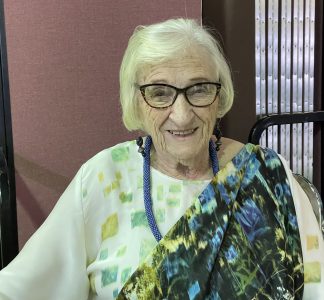
Arlene Brown will tell you she is not a missionary. She is a woman with a mission.
That mission has taken her from Williamsport to Africa, specifically Rwanda, where she now lives, working to bring educational opportunities and better living conditions to the children there, offering them a chance to live a more prosperous life.
Brown was in the area, recently, speaking at her home church, St. John's United Methodist Church in Newberry.
A native of Indiana County, Brown, who is known as "Mama Arlene" by the children whose lives she has touched, was born in a small town called Commodore in 1930. She will celebrate her 91st birthday the first week in December.
She believes that God used her childhood experiences, growing up in that time, to prepare her for her work in Rwanda.
"We had outdoor toilets. We didn't have running water. No indoor plumbing at all. I went to Rwanda and these are the conditions I went into, but I already knew how to live with them, so it wasn't a big problem," she said of her life growing up.
"My father was a coal miner. So, I'm the original coal-miner's daughter," she joked.
Her mother's family was from Clearfield County, which is where Arlene went to high school and then nursing school. She married a man from that area and then ended up in Williamsport when her husband was transferred here by the railroad.
After she arrived here, Arlene got a job working at Sylvania when she wanted to help pay for her son to attend college. Even though she was trained as a nurse, she decided that she would need to bring her training up to date in order to pursue a career in that field.
Fast forward to her retirement years.
"I did everything you're going to do that is so exciting when you're going to retire -- sleep late, eat what you want to, travel when you want to. You know, after a while it got to be very boring because just going anywhere was just the same thing only a different location. There was nothing very exciting about," she said. "This was not a life for me."
"I needed more of a purpose in my life. I laugh because I say be careful what you pray for because God might send you to Africa," she added.
"This is how this all happened, because of my discontent with being retired and not being ready to quit," she said.
"I feel so often people retire and wait to die and that's not me. I can't wait to die, I have to work my way there," she added.
Arlene first went to Africa to work with Rwandan refugees in 1996. She went to Zaire, which is now the Democratic Republic of Congo, to work in the refugee camps there. She said at the time she didn't realize that the people in the camps were actually the perpetrators of the genocide that had taken place in Rwanda and not the victims.
During a period of civil war in Rwanda in 1994, around 800,000 members of the Tutsi minority ethnic group as well as some moderate Hutu were slaughtered. The conflict pitted neighbor against neighbor and when it ended, up to two million people had fled the country and about a million people were displaced inside the country. Of the 2 million who had fled, many were the Hutu ethnic group perpetrators.
Estimates are that 75,000 children survived but had suffered the loss of one or both parents.
"I was working with children and it doesn't matter what side of conflict mom and dad are on, children are the victims," she said.
"I'm not sorry I was there. I was there for children," she added.
When asked if she felt called by God to return to Rwanda, Arlene is quick to answer no.
"I didn't feel called. Not ever. I say God didn't call me, he got behind and pushed," she stated.
"I envy people who say they had this calling from God. I don't know what they're talking about. I really and truly do not. I just know that at one point I was pushed into a situation and that developed into something else and it developed into something else and I ended up in Africa," she shared.
"I don't know if it was my plan, but apparently it was part of God's plan," she said.
A missionary is somebody who trains to go on mission and they do all this happy stuff. This was not me. I simply needed something different in my life, so I went with the mission trip through the United Methodist Church.
"When I came back, somebody there said what do you want to do now and I said I would like to go back and start a home for little girls."
Someone heard of her desire to do this and sent her a donation of $500 with a note that read, "this is your first money to get you back to Rwanda."
"That was when I wanted to go to Rwanda…that's where the need was. That's where the victims of the genocide were trying to come back to having a good life," she said.
Arlene speaks lovingly of the people she has encountered in Rwanda, who have so little and have endured so much.
"I have never found a more God-loving people. Their faith put even me to test. I don't know if I had gone through what they went through during that genocide, if I would have had the strength and the faith to say that God was with me all the way," she said.
"The Rwandese people have that faith to this day. They could come here and evangelize this country with the faith they have," she said.
When she returned to Rwanda, she opened a home for girls, seven years of age and older. She admitted that she chose that age range because she had already put in her time being a mom, grandmother and great-grandmother to babies and toddlers.
After that, things just kept moving forward.
"I don't plan how things are going to happen, because I'm at this point now where I know that whatever is going to happen, God's going to provide and it's going to be there. And the people that I need to have help me will be there also," Arlene said.
"I don't have to do it on my own. I simply have to be the tool that keeps things moving and I can do that even at 90," she added.
The children are brought to her, some only hours old when they are abandoned after birth at a birthing center near Urukundo, the name of her learning center located on a mountain near the town of Mahunga. Urukundo in Rwandese means love.
When she opened Urukundo, the plans were to provide education to pre-k children, but that soon changed.
The home she was living in at the time was adapted as a classroom and 13 children entered the school. Soon other parents were bringing their children and more room was needed. Arlene said that a donor from Pittsburgh sent $25,000 to help add two more classrooms.
"So then every year while the school year was going on, we built two more classrooms, until we reached Primary 6, which is the highest in primary you can go," she said.
In Rwanda, schooling beyond the sixth grade is boarding school and most parents can't afford that, so a child's education ends at grade six.
"That's not enough education to make a living. They're 12-year-olds. They don't need to be sent away from home. They're not ready to go on their own to a boarding school and far away from home," she said.
Arlene's current goal is to build a secondary school on the top of her mountain, on land donated by the government, so that the children can live at home and finish high school.
"When they have finished high school they are more ready to go to university or go on or to find some way to make a living," she said.
Currently the primary school has a staff of 34 teachers and 27 classrooms. She also employs 103 full-time workers at the learning center and about 50 people for part-time projects.
"All of our employees are only one from a family. We will not hire two people from the same family because the economy needs to be lifted," Arlene said.
"Rural communities in Rwanda are very, very poor, so there is where the help is needed," she said.
Arlene is also adamant that her employees are Rwandese so that the children learn about their culture, so that "they know who they are and they are proud of who they are."
"This to me is very important. They are Rwandese and that's who they need to be proud to be," she stated.
What started out as a home for school-aged girls has evolved and grown into a learning center, a worship and community center, a dental clinic, a sewing center, a farm and the Mama and Baby project, which cares for mothers following the birth of a child.
All but three of the original students will finish their education at the university level. One young woman had messaged Arlene while she was here in the states to tell her that she was graduating from law school at the beginning of December.
Although the learning center is thriving, the original home is no longer in existence. Arlene shared that sadly, an organization in Rwanda decided that the children needed to be placed in foster care rather than in an orphanage.
"We didn't feel that we were an orphanage, we were simply a home for clinched," she said.
The children were placed in different homes, but Arlene's organization still supports them for school, for food, clothing and make sure that they are cared for. Several of her staff adopted some of the children.
"One of my little boys said, 'Mama they didn't want me when I was a baby, why do they want me now,'" she said.
Arlene has written a book about her experiences in Rwanda, "Hope Made Real, the Story of Mama Arlene and the children of Urukundo."
Hope Made Real is the name of the non-profit which supports the ministry in Rwanda.