
‘We’re in danger, follow me’: Rabbi recounts fear, heroism during deadliest antisemitic attack in US history
Shooter's actions undisputed, but defense argument over motive aims to avoid death penalty
Trending
PITTSBURGH -- Rabbi Jonathan Perlman took the witness stand wearing the yarmulke he had on the day a gunman burst into his Pittsburgh synagogue during Sabbath services and began shooting anyone he could find.
The skullcap Jews wear as a reminder of God's presence fell off during the Oct. 27, 2018, attack on the Tree of Life synagogue, which was the deadliest antisemitic attack in U.S. history. Authorities kept it as evidence for years, and Perlman, the rabbi for one of the three congregations who shared the building, only recently got it back.
As he recalled the terrifying events of that day, Perlman, 59, also assumed his role as a teacher to explain the stitched Hebrew lettering on his yarmulke, which reads, "There is nothing aside from Him,"
"This is a God who is present to all aspects of creation," he told the federal jury.
It was one of several moments during the trial over a brutal act of violence against Jews in which survivors educated the jury about their faith -- a show of defiance before the man who tried to destroy them and who has expressed little emotion while seated at the defense table.
Robert Bowers, a 50-year-old truck driver from the Pittsburgh suburb of Baldwin, faces 63 federal charges related to the killings of 11 worshippers, who came from all three of the congregations who used the synagogue -- New Light, Dor Hadash and the Tree of Life. If convicted of certain charges, which include 11 counts of hate crimes resulting in death, Bowers could face the death penalty.
Prosecutors say Bowers expressed a hatred of Jews online and at the synagogue on the day of the attack. One of his attorneys acknowledged during opening statements last week that Bowers carried out the attack but tried to cast doubt on whether the hate crimes charges were applicable. His defense team's legal maneuverings have focused not so much on preventing his conviction as on preventing his execution.
Perlman, the rabbi of New Light Congregation, recounted arriving at the congregation's basement sanctuary in the synagogue shortly before worship began on that Oct. 27. Member Melvin Wax led in an opening prayer in which "we talk about how grateful we are to start a new day," he recalled.
Perlman then heard what he immediately recognized as gunfire coming from elsewhere in the building. "I said, 'We're in danger, follow me.'" He guided Wax and two other worshippers, Carol Black and Barry Werber, into a nearby storage room in the labyrinthine building.
He said Wax, who was 87 and hard of hearing, wanted to see what had happened. "I said, 'Please don't. Stay inside.' He didn't listen to me."
Wax opened the door to look out and was shot and killed.
Perlman had left the area and was "trying to find my own hiding space" when he saw Tree of Life member Stephen Weiss. He called Weiss a "man of extraordinary courage" for coming down to the New Light area, even while the attack was underway on the main floor, to make sure New Light members in the basement knew what was happening.
Perlman eventually found a side exit, climbed over a fence into a neighboring yard and found police, informing them of where the others were hiding. With the attack still ongoing, "they told me to get the hell out of here," and he went home.
Weiss told jurors Wednesday that he was one of 12 worshippers that day at the start of Tree of Life's service, which was being held in a separate chapel. He knew the head count because, as a ritual leader of the congregation, he made sure there was the required minimum -- a minyan -- of 10 adult worshippers in the room. After worshippers heard a loud crash, two them went to see what happened. Weiss went to the chapel door but stayed in the room to maintain the minyan.
He heard gunfire, saw shell casings clattering on the floor and turned back into the room, where Rabbi Jeffrey Myers was evacuating those who were able to move quickly and urging the more frail members to get down.
Weiss escaped through a door at the front of the chapel and, after going downstairs to warn New Light members, found his own way outside.
He noted that although the synagogue's door was locked on weekdays, when the office staff could buzz people in, it was routinely unlocked on the Sabbath.
"We prided ourselves on having our doors open" to all people, he said.
Asked by a prosecutor if his Tree of Life congregation has been able to gather a minyan as easily since the attack, Weiss said it hasn't.
"We don't have the same attendance from those members who were very reliably there," he said. When asked why not, he said: "Because they have been killed."
Seven people, including five police officers, were injured in the attack.
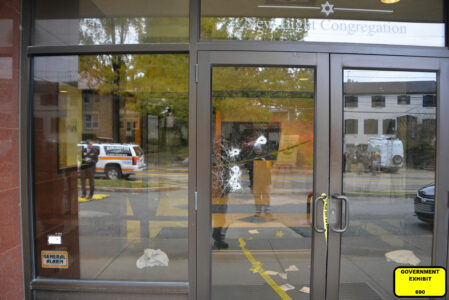
One of them, Officer Daniel Mead, testified Thursday that he had just reported to duty when he heard the call about an active shooter at the synagogue. He and his partner, Michael Smigda, rushed to the scene and, moving cautiously along the wall, Mead said he turned a corner in front of a glass entrance and was immediately met by gunfire.
"When I stepped out, stuff hit the fan," he said.
"I can remember plain as day," Mead said. "I can hear the shot. I can see the muzzle flash. This all happened so quick."
Mead said his hand was dangling "like a rag doll," so he went to a waiting ambulance for treatment. He said the bullet shattered bones throughout his hand, and that he hasn't been able to return to work as an officer.
Asked why he rushed to the synagogue that day, he said: "It's what we do."
In addition to police, worshippers and others' testimony, hundreds of court exhibits showing the aftermath in the Tree of Life synagogue building are on the record.
A prayer book torn by gunfire. A bullet-damaged glass door. A prayer shawl on a floor, a yarmulke on a stair, left where they had fallen from worshippers during the attack.
And photos of bodies shattered by high-powered weaponry -- images so sickening that the court is not making them public.
All this to prove what? Everyone agrees on who the perpetrator was and what he did, though there's some dispute over what he was thinking.
Ultimately, this is about life or death for Bowers.
Defense lawyer Judy Clarke admitted in her opening statement on May 30 that there is "no dispute and there will be no doubt" that her client committed the attack. That he entered a synagogue and "shot every person he saw."
Clarke couldn't say it out loud to the jurors at this point in the trial, but she is laying the groundwork for preventing Bowers' execution. Judge Robert Colville had already made clear that any discussion of the death penalty would have to wait until the penalty phase of the trial.
"The only issue in this trial is whether or not the defendant will be sentenced to death," said University of Pittsburgh law professor David Harris. "That is the only issue. ... But I think the way that this impacts every bit of trial strategy, every statement, every tactical move, is sometimes forgotten."
In fact, during the lengthy screening process for the jurors and alternates, Bowers' defense team barely asked anything about whether the jury candidates could consider an acquittal. The defense focused almost entirely on the penalty phase -- whether prospective jurors would even consider a life sentence without parole, rather than execution, in the case of a man charged with hate-motivated killings in a house of worship.
Each side had some success in eliminating potential jurors with inflexible views for or against the death penalty.
The second week of the trial wrapped up Thursday with testimony on topics ranging from DNA samples to the leases of congregations that could no longer worship at Tree of Life. Friday was a regularly scheduled off day.
Clarke has represented some of the nation's most notorious killers in potential death-penalty cases. They include Boston Marathon bomber Dzhokhar Tsarnaev, who is currently appealing his death sentence, as well as Unabomber Ted Kaczynski and 1996 Olympics bomber Eric Rudolph, both serving life sentences.
Unlike with some of Clarke's previous clients, however, federal prosecutors refused to accept an offer by Bowers' defense team that he plead guilty in exchange for a life sentence. Most families of the slain worshippers have voiced support for seeking the death penalty, though some family and synagogue members favored a guilty plea in return for a life sentence, in part to spare survivors the ordeal of reliving the attack in court.
And so the trial came, four and a half years later.
Bowers is accused of 11 counts each of hate crimes resulting in death; the obstruction of the free exercise of religion resulting in death; and the use of a firearm to murder in a crime of violence.
Clarke didn't address all of the 63 federal charges facing Bowers; she focused on the hate crimes, which are not among the capital offenses. The charges that do carry the death penalty involve the lethal disruption of religious practice and the murderous use of a firearm.
Clarke said rather than killing the victims due to their "actual and perceived religion," Bowers was acting out of the delusion that by killing Jews, he was saving children from the genocide he believed was being perpetrated as Jews helped immigrants resettle.
Bowers was killing out of the "unthinkable, nonsensical, irrational thought that by killing Jews, he would attain his goal," Clarke said.
But if that sounds like an insanity defense, it isn't.
Bowers' lawyers have already given notice that they aren't mounting an insanity defense, though they plan to introduce evidence in the penalty phase that Bowers has schizophrenia, epilepsy and brain impairments. Prosecutors conducted their own mental health evaluation; its results aren't publicly known.
"It is very difficult to mount a successful insanity defense," Harris said, noting that in legal terms, the concept requires not just proof of mental impairment but of how that affects a suspect's thinking. Juries are typically skeptical of such defense, he said.
"The prosecution must prove beyond a reasonable doubt that he wanted to kill the victims because they were Jews, or in order to prevent them from worshipping," Harris said. "Clarke is arguing that the prosecution can't prove those things, because the evidence … will show that he was irrational -- he was killing Jews, but it was to stop the activity of settling refugees, a la the racist and bigoted great replacement theory."
Clarke has almost no hope of an acquittal, but "it gives her an opportunity to argue, in advance, about the death penalty," Harris said.
Bowers could have pleaded guilty and gone straight to the penalty phase, as did the Parkland, Florida, school killer, who received a life sentence without parole. Harris said Bowers' defense there may be strategic or legal reasons, or both, for doing otherwise.
Clarke further sought to lay groundwork for sparing Bowers the death sentence in describing him as a socially awkward loner who didn't live on his own until age 44, two years before the attack, and hadn't previously pointed a gun at anyone. She said he took care of relatives with health needs but had few friends and spent a lot of time on his computer, becoming absorbed by the "vile, extremist content" he found there.
The prosecution, meanwhile, is also not mentioning the death penalty at this point. But the evidence it presents -- from the firearms used in the killings to the antisemitic ravings of Bowers to the the prayers that were so violently disrupted -- is building toward its goal of a guilty verdict on charges that carry the death penalty.