
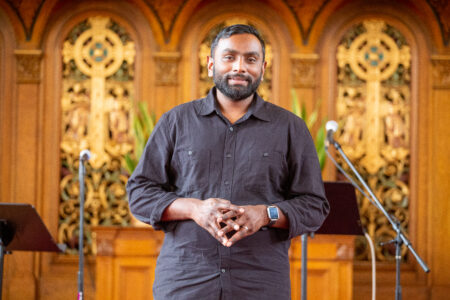
Pastor reminds people to love their neighbors, put Jesus above all else
Trending
What does it mean to live a life fully surrendered to Jesus' teaching and the mandate He has given to "love your neighbor as yourself?" In a world where that might mean finding a common ground with someone who does not vote the same as you, love the same as you or live in the neighborhood where you do, how is that possible?
In the Old Testament, there were about 600 commands that God had given, according to City Alliance's lead pastor Nithin Thompson. But Jesus refined it down to two commandments.
"Jesus was asked what the greatest commandment was and so he said, "Love God, love your neighbor," Thompson explained recently.
"If you get into the nitty gritty, to show your expression of loving God, you love your neighbor," he said.
"I think Billy Graham once said that if you want to know the barometer of your love for God, how do you love your neighbor," he added.
Jesus often taught with parables, word stories that illustrated the truth He was offering. The parable he used to illustrate who your neighbor is, is known as the Good Samaritan.
"If you look at the story of the Good Samaritan, the twist in the story is that Jesus makes the Samaritan the hero," Thompson said.
The story involves a man who was attacked along a road and left for dead. The people in his tribe and his ethnic group -- the priest and the Levite -- they stepped over him. The Samaritan, who was part of a group of people that were hated by the Jews at that time, picked up the injured man, took him to an inn and paid for his care before moving on.
"They were the other," Thompson said, referring to Samaritans, "and so when Jesus makes him the hero, what Jesus is saying is your neighbor isn't the person that looks like you, talks like you, thinks like you, votes like you."
"It's the person who lives next door, who is struggling, who's vulnerable, that you can come alongside and help and serve. I think when Jesus talks about loving your neighbor, he is expansive in that concept," he said.
Most people at some point have heard how the Samaritan illustrates how we are to show the love that Jesus modeled for the least and the lost in society, but often there is a disconnect between knowing and acting on that knowledge.
Admitting that's what "frustrates pastors," Thompson said, "As a Christian I believe in this thing called sin, and I think there's three dimensions to sin. There's a dimension of sin that we do. There's things that we do that break relationships with other people and with God."
"There's sin that's been done to us -- like, we've been sinned against. We've been wounded, betrayed, things like that," he continued.
"But then, we also live in a broken world. There are systems that are broken and because of that, I think the default is there's things that are pulling us away from the way of Jesus, both intentionally and unintentionally," he said.
As followers of Jesus, Thompson said, our environment, our family, our culture can influence and shape us even if we're not aware of it.
"Because of that, you know Paul, who's one of the early church leaders, says, 'Do not be conformed by the patterns of this world, but be transformed,'" Thompson said.
"And, I think because Christians are human beings, we miss that all the time. We kind of flow right into the rhythms of our world and our culture without really evaluating it from a biblical perspective or a biblical worldview. We kind of pick up whatever the assumptions and allegiances and values of the culture around us are, rather than letting Jesus and the Scripture kind of re-evaluate what those things are," he said.
Those allegiances and assumptions can lead to polarization not only politically, but spiritually as religion is used to support political views. Thompson believes keeping Jesus as the center point creates unity even amongst diverse groups.
"I think for a lot of people there's an assumption that they have about, this is what the Bible says, or what the Bible teaches. But a lot of times, we are bringing our own assumptions and our own values into what the Bible is saying, rather than letting the Bible read that back into us," he said.
"I think because we have so many different kinds of people in our church, I, as a pastor, I'm always telling people, hey, what is the one thing we build our unity around? ...it's around Jesus and if Jesus is our center point, whether you're a Republican or a Democrat, whatever your partisan identity is, we're essentially saying that our identity as followers of Jesus has to come above that. It has to come before that," he said.
City Alliance just finished a series called "Loving Your Neighbor," and they will be joining with Christ Community Worship Center beginning next month to offer an interactive experience designed to bring people together.
"It's funny, you know, doing a series called Love Your Neighbor, you would think it's not revolutionary, but the conversations I've had with people in our congregation have been varied. Some who have been like, 'I'm really having a hard time with this series, because it feels like, you know... the other and what does that look like," Thompson said.
"And so again, for them, the conversation about, hey, it's about Jesus and he's going to help us. So that's been helpful for some people in our church, and for other people, they're like, 'Well, Nithin, we're not going far enough.' Like we are not really pushing into some of these things. But again, if Jesus is the center that we're pushing into, I have to believe and trust that the way of Jesus is going to form our people. But it's usually a slow process. It's a long process. It's a challenging process too," he said.
Thompson quoted Dr. Martin Luther King Jr., who said that Sunday morning is the most segregated hour of the week, because people tend to worship with people that are like them.
"They think like you; vote like you; look like you -- all those kinds of things. We all kind of live by the people that make the same amount as we do, so share the same values," he explained.
"So the fact that we can all gather together and worship and come from different socio-economic backgrounds; we can come from different cultural and ethnic backgrounds; we can come from different political backgrounds. We don't leave those at the door, because it's part of who we are, but we're going to say that there's something bigger that we are going to unite around. And if we're all uniting around, Jesus, it means I'm going to listen to you share your thoughts, even if I disagree, even if, when I hear you say those things, it kind of makes me chafe, and so I'm going, 'Nope, this is my sister in Christ, and I'm going to choose to love her and accept her.' We may not agree, we may agree to disagree, but I'm still going to love you as my brother, as my sister, regardless of that, because our ultimate identity and our unity is in Christ, who models that first," he said.
Jesus' disciples were a diverse group, some coming from opposite ends of the political spectrum at the time. Matthew collected taxes for the Roman government. Simon the Zealot was a revolutionary who sought to overthrow the government. But they all agreed about one thing, Thompson said, "that Jesus is our ultimate master."
"And as they spent time with Jesus and became more like Jesus, they did the things that Jesus did, and it transformed an empire, and it was very different than what I think they would have thought," he said.
"I think that's the same that we're trying to shoot for. It's how do we help all of our people take steps closer to Christ and look at his life and live that out and imitate that in all of our relationships, in every area of our lives," he added.
City Alliance is also committed to helping those neighbors in the community, as Thompson said, both in spiritual -- through prayer -- and practical ways. Thompson, who came to the church just under four years ago, said that it was already in the culture at City Alliance to move beyond the walls of the church to see where the needs were in the community.
"This past Christmas, we did a Christmas offering, and we were able to raise money to help Sojourner Truth buy an HVAC system. We basically said, don't worry about getting grants. Use that for other stuff here. Here's a check. Get what you need...because you guys are on the front lines helping the last, the least and the lost," he said.
"In the past, we've done community engagement events with the police. Like trying to engage the community with the police. We are always going, what are the needs outside," he said.
"One of the things that our church does is we do meal trains, but what's been unique is we don't even just do them for people in our church. We do them for people that don't go to our church, that aren't Christians, that don't hold our same views. (They) may never show up here, but we're like, how do we look outside of ourselves and bless people in those kinds of practical ways," he added.
Once or twice a year, they take a Sunday morning and go out in the community to serve.
"We built a ramp over at Sojourner Truth. There's one of our neighbors who was handicapped in a wheelchair that we went to and with some Penn College students that attend our church, who are engineering students, they rebuilt his porch. It was amazing -- they built it better than what it was before. We had our kids engaged. They were kind of cleaning up garbage in the neighborhood," he said.
"It's just part of our church where we're always looking on the outside, not just spiritually, like, who's far away from Jesus, but who needs help, like who needs their physical needs being met, and we're always looking for ways to do that, and how can we continue to do that better, and how can we do that in deeper ways that are substantial, not just like window dressing, but hey, how can we actually help our city and our culture in this area," he said.
One way is sponsoring Living Undivided, which urges people to join the conversation to build bridges for a stronger community.
They do six-week cohorts around teaching on injustice, peacemaking and similar topics. They create safe spaces where people from different ethnic backgrounds can have honest, raw conversations that will lead to greater understanding and eventually lead to, what can we do as we look around our city... how can we be part of what God's doing in our city to bring about justice and things like that, he said.
"What Living Undivided does is it helps communities; helps church theologically; because we're going to be doing this with different churches. It helps us gather together so that we can say, what can we do together? Because we can do more together than we can apart and we have more in common," he said.
"There's more that we have unity around, that we can do good with. That's beyond partisanship. It's beyond kind of some of those things but actually towards productive ends," he added.
One thing that Thompson wants people to understand is that there needs to be grace because everyone is fighting their own battles.
"I think that if we can understand … the people around us are fighting battles -- the people that are posting on social media, they're fighting battles. How can we treat each and every person with the care and consideration that, hey, they're in the middle of something right now, and so maybe they're posting this, maybe they're sharing this and it's coming from somewhere. How do we give people the mercy and the space and the grace to express what they need to express and to be able to cultivate curiosity and compassion and empathy in the midst of that?" he said.
The sessions will be held from 5:30 to 8:30 p.m. on Sundays beginning April 27 and running through June 8. For more information and to register, visit the church's website, cityalliance.org/events.