
Advent brings a time of preparation — New Covenant United pastor reflects on the season that celebrates the coming of Jesus
Trending
As the calendar moves toward the time when darkness overtakes daylight, the season of Advent reminds us that we await a light coming into the world as the birth of Christ is celebrated on Dec. 25.
Although it is not known exactly when Jesus was born, the date in December was established in the 4th century by Pope Julius I.
Leading up to Christmas Day, the Christian season of Advent begins four Sundays before that. This year it falls on Nov. 29.
"The definition of Advent is coming. So the season of Advent is a time of preparation for the coming of Jesus' birth. Very much like the season of Lent is meant to be a time of preparation for the events of Holy Week and ultimately Easter, Advent is meant to be a time a season of preparation, to prepare for the coming of Jesus' birth," said Pastor Brad Walmer, of New Covenant United Church of Christ (NCUCC).
A familiar sight in some churches during the Advent season is the Advent wreath with four candles, usually three blue or purple and one pink, circling a white candle, the Christ candle, in the center of the wreath.
Walmer noted in churches that follow the liturgical calendar -- the different seasons of the church year, the Advent wreath continues to be significant.
"It's a visual reminder that each week we're one step closer to the coming of Jesus' birth," he said.
"We start with lighting one candle, and then by the 20th of December, all four candles are lit and we're right on the cusp. The Advent wreath is still a visual symbol that's used almost like a countdown clock, so to speak, to remind us that each week we're getting closer and closer to celebrating the coming birth of Jesus," he said.
Each candle symbols some aspect of the character of Jesus.
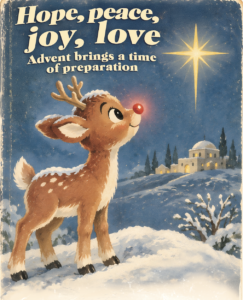
"The first candle is the candle of hope. The second candle is the candle of peace. And then there's a pink candle, which is usually lit in the third week. That's the candle of joy, and that different color is to symbolize that, wow, we're really getting close. And then the fourth candle is love. So you have hope, peace, joy and love are the four Advent candles," Walmer said.
It's significant, too, that the wreath is lit during some of the darkest days of the fall and winter seasons.
Walmer shared that there is a legend that the tradition of lighting the Advent wreath originated in the Scandinavian countries.
"Of course in the Scandinavian countries, it's even darker than it is here. There's even less light, and so...it symbolizes the light of Christ in the midst of the darkness," he explained.
Advent also serves to remind us that there is a period of waiting for the expected celebration of Jesus' birth.
"I think for me it's a season of preparation. Nowadays, our culture, our society jumps to Christmas almost immediately after Halloween," Walmer said.
"Oftentimes Thanksgiving is even skipped over. We turn the calendar from October to November and it's like all of a sudden the light switch is turned on and it's Christmas. It's Christmas on the radio. It's Christmas in the stores. It's Christmas on television," he said. "So there really isn't that time of preparation that the season is meant to be."
Walmer pointed out that during Advent, the teachings of John the Baptist are featured.
"He preaches to prepare the way. He preaches a message of baptism and repentance. Repentance not meaning sit in your ash heap and feel sorry for yourself, but repentance meaning turn around, turn from those things that in your heart and mind that are are not what you should be doing, but turn back to the things of of of of Christ, love, peace, joy, hope. Turn away from the things of the world and turn back to those things," he said.
"So Advent is meant to be that time of preparation, so that when we finally hit Dec. 25, we can celebrate. We can celebrate where our hearts and minds are in the right place, and then we celebrate for 12 straight days. We celebrate the 12 days of Christmas until we reach the season of Epiphany on Jan. 6," Walmer said.
The tendency to rush ahead of the season is a challenge for pastors and music directors because people want to move right into singing Christmas carols, forgetting what comes first, he said.
"Nobody wants to sing 'Oh come, oh come, Emmanuel.' Everyone wants to sing 'Joy to the World,'" he said.
"It is a challenge for pastors and music directors, because you feel that pressure from the congregation, from the outside influences that are telling you that it's already Christmas, and so you should be singing the Christmas songs," he said.
"Sometimes, when I have the conversation, 'Would you like to sing Christ the Lord is risen today on Maundy Thursday or on Ash Wednesday?' We would never think of doing that. That doesn't make sense. But yet we want to rush into the Christmas season because of all the outside influences that are telling us that Christmas is already here. So yeah I think Advent is a very important season for us to prepare and to get ready for the coming of Jesus' birth and not rush into celebrating it so quickly," he said.
This year at NCUCC, they're celebrating the Advent season with a sermon series focused on the seasonal favorite "Rudolph the Red-Nosed Reindeer."
"Every year we kind of do something a little fun, a little different during the Advent season. The last couple years we tried to match what CTL (Community Theater League) was doing. 'A Christmas Carol' was their holiday performance, so we did a sermon series on 'A Christmas Carol' and Scrooge and his visits by the ghosts of past, present and future. The year before that, they did 'Miracle on 34th Street,' and so we did a sermon series on the movie 'Miracle on 34th Street' and the spiritual themes that are found in the movie," he explained.
"This year we're using the Christmas special 'Rudolph the Red-Nosed Reindeer' and how, in the land of misfit toys, Hermie doesn't feel like he fits in because he wants to be a dentist instead of an elf. Rudolph doesn't fit in because he has a red nose and none of the other reindeer have that. Charlie in the box doesn't fit in because he's not a Jack-in-the-box. The sermon series is going to focus on the fact that we're all misfits but God loves us and our gifts are needed," he said.
"Rudolph's gift was needed. Santa needed his gift to deliver the toys. Hermes' gift was needed. The elves needed a dentist. Even though we're all different, our differences are something to be celebrated. God made each and every one of us unique and special, and so our differences are something to be celebrated. No matter who we are, we're loved by God, and the world needs our gifts. No one is to be forgotten. No one is to be left out. We're all needed," he said.
The series will culminate on Christmas Eve when everyone gathers to celebrate the birth of Christ. Walmer said that sermon will speak specifically to how Rudoph's red nose lights the way for Santa's sleigh on the dark, foggy night, just as "Christ is the light of the world that leads us in the darkness," he said.