
Trending
DANVILLE -- The stage in a young bald eagle's life between hatching and flight can be perilous, and two immature bald eagles recently released here found that out the hard way. The Pennsylvania Game Commission wildlife conservation officers and wildlife rehabilitators recently helped a couple of these birds get a second chance to fly, according to William Williams of the commission.
Pennsylvania's bald eagle population stood at three nesting pairs in the early 1980s, and the species stood at the brink of being extirpated here. Their comeback has been one of the greatest wildlife success stories in modern times as the number of active bald eagle nests in Pennsylvania soared to a high of over 280 nesting pairs last year, he said.
The growing eagle population is resulting in more injured birds being rescued by wildlife conservation officers, treated by wildlife veterinarians and cared for by wildlife rehabilitators.
A fledgling eagle that was spotted on the ground along the railroad tracks in Danville in June posed a dilemma for the commission.
When hundreds of young birds attempt their first flight each spring, some end up on the ground, finding their wing muscles not up to the task. Others might land in water and expend valuable energy trying to reach the shore, Williams said. A period of rest and wing exercise, combined with some feeding by the adult pair, is sometimes all that is needed to get them airborne.
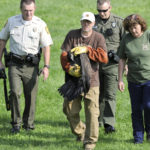
After allowing time for the eagle to fly on its own without success, it was time for human intervention. Montour County Wildlife Conservation Officer Michael College captured the eagle and delivered it to staff at the Carbon County Environmental Educational Center in Summit Hill. Center director Susan Gallagher said the beleaguered bird had no obvious injuries but was weak, dehydrated and underweight.
Another eagle was far from being flight-ready when a violent storm swept it off a nest in Bonneauville, Adams County. A prompt call from a caring citizen led to Game Commission officers transporting the eagle to the Red Creek Wildlife Center in Schuylkill Haven for evaluation and emergency care.
It was then treated for internal injuries and a wing fracture by Leonard Donato of the Radnor Veterinary Hospital in Montgomery County.
"The eagle had fluid in its chest cavity that just needed time to reabsorb and pins surgically inserted into its right wing were removed in only three weeks," Donato said. "It's amazing how fast these birds recover."
Both eagles were ultimately introduced to the education center's flight pen, a 100-foot netted enclosure, to help them build muscle strength and acquire the skills necessary to fly and perch. They were both given the green light recently to attempt flight in the wild.
Wildlife rehabilitator Franklin Klock positioned two specialized metal boxes on a knoll overlooking a football field in Danville while the birds within perched in complete darkness. The elevated position provided Klock with an excellent vantage point to evaluate their flight behavior.
The Bonneauville eagle was hesitant but, after a little coaxing, leapt from the box and flew low across the field. It ascended just in time to split the goal post uprights before landing high in a hemlock tree along the Susquehanna River.
However, as the Danville bird flew, Klock noted that the right wing was stiff and the bird was not getting lift. After flying across the length of the field, it landed unceremoniously into low vegetation. The young eagle was recaptured and would head back to the center for additional time in the flight pen.
The wildlife rehabilitators in Danville that day did not consider this short flight a failure, rather a part of the rehabilitation process.
"Eagles in this situation sometimes get pumped up with adrenaline and it affects their flying ability," said Red Creek Wildlife Center Director Peggy Hentz. "Although it could have regained its composure after a time, we couldn't take a chance by leaving it there."