
William Hepburn called the ‘father’ of Lycoming County
Trending
The name Hepburn is seen throughout Lycoming County, given to streets, school buildings and municipalities. In big white letters, "Hepburn" is prominent on a green highway sign near the Wegmans and the Market Street overpass on Route 180 in Williamsport.
But have the modern residents of Williamsport and Lycoming County, busy with their own lives, forgotten who Hepburn was?
The Hepburn who graces so much in the area was a judge who played a large role in establishing Lycoming County, said Scott Sagar, curator of the Thomas T. Taber Museum in Williamsport.
"William Hepburn was a judge and he played a big part in the founding of Lycoming County," Sagar said. "He had a vested interest in making Williamsport the county seat."
A closer study of Hepburn's life reveals he was a man who had connections with many of the heroes of the American Revolution.
Hepburn worked with Jacob Rush, the brother of Benjamin Rush, a signer of the Declaration of Independence. He would earn the respect of founding father Thomas Mifflin and married into the family of Robert Covenhoven, a daring Revolutionary War scout, spy and soldier. After the passing of his first wife, Hepburn married into the family of Pennsylvania Supreme Court Justice Charles Huston.
Hepburn was born in County Donegal, Ireland, in 1753.
According to the Sept. 25, 1897, edition of The Harrisburg Telegraph, Hepburn came to this country in 1773 "with his brother, James, and settled in the West Branch Valley of the Susquehanna."
Historian John Meginness recorded in "The History of Lycoming County" that Hepburn was employed by members of the Culberston family and helped "in digging the race" for a mill that the Culbertson family was building near Mosquito Creek, which is near today's South Williamsport.
Meginness said Hepburn served the local militia, "took an active part in protecting the frontier settlers and soon rose to the rank of colonel, with headquarters at Fort Muncy" during the Indian attacks that occurred in 1777 during the American Revolution.
"He proved himself a thorough soldier, and his name frequently occurs in the colonial records," Meginness said.
In 1777, Hepburn married Crecy Covenhoven. According to history writer Leon Hunsinger, he bought 300 acres of land that he called "Deer Park." The couple had 10 children.
Hunsinger mentioned that while being a farmer, distiller and a merchant, Hepburn cultivated a reputation as "a very generous man."
It was this reputation that earned him the office of the Northumberland County commissioner from 1789 until 1791 and then other political offices in the future.
"(Hepburn was) a mainstay as (a) justice of the peace (and) was elected to the state Senate to fill a vacancy in the Northumberland district," Hepburn's Pennsylvania State Senate biography read.
He also is credited, as the a member of the state Senate, for pushing the "passage of the bill forming Lycoming County, (on) April 13, 1795." Hepburn was also responsible for hiring Michael Ross to survey the new county seat of Lycoming (County), Williamsport."
Besides being in the local and state governments as well as a farmer, he was a man of faith and several sources credit him as a founder of the Lycoming Presbyterian Church on Arch Street in Williamsport. He also helped found the first Freemason lodge in the county.
Soon founding father Thomas Mifflin, then governor of Pennsylvania, appointed Hepburn as an associate judge and he was also "elected president judge for 10 years." It was at this time he worked with fellow judge Jacob Rush, the brother of Benjamin Rush.
Meginness wrote that many of the official papers and orders "issued by Judge Hepburn (had) his name and that of Judge Rush each appearing on them during that period." Meginness commented that Hepburn was "without legal learning," but "he discharged the responsible duties of judge with ability and fairness."
Tragedy struck Hepburn in 1800 when his first wife, Crecy, died on April 8. Later, Hepburn would marry Elizabeth Huston and they would have five daughters and four sons.
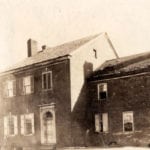
Hepburn continued to serve as a judge and received awards for his service to his country and community. At the age of 68 years old, he died on June 25, 1821, "at the old-fashioned brick house, now standing at the foot of Park Street" in Williamsport. He was buried at the Wildwood Cemetery next to a boulder that has two plaques honoring him.
In 1804, when part of Loyalsock Township decided to break away, the citizens decided to call the municipality Hepburn.
Looking back at Hepburn's life, Hunsinger said the judge "can be regarded as the 'father of Lycoming County.' "
With Hepburn Street being a major thoroughfare in Williamsport, Sagar said pondering how such streets are named does add something to the day.
"I sometimes wonder about the streets, who they are named for, and I think doing that adds a little spice to life," Sagar said.