
Mayoral candidates debate safety, finances
Trending
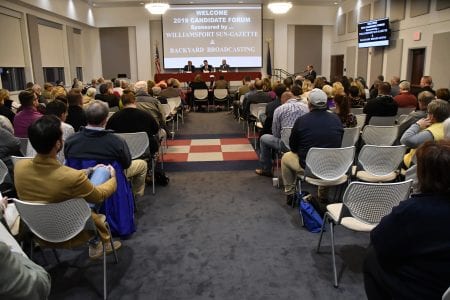
Candidates for mayor of Williamsport laid out their plans, fielded questions and queried each other in a lively political forum Tuesday night before a packed house at Trade and Transit Centre II at the Michael Ross Event Room ahead of Tuesday's general election.
For mayor, City Councilman Derek Slaughter, a Democrat, and Republican Eric Beiter along with incumbent Mayor Gabriel J. Campana, who is seeking releection through a write-in campaign, sat on the panel before 130 individuals watching and others listening on radio and watching live stream.
The forum was held by the Williamsport Sun-Gazette and Backyard Broadcasting. It was moderated by Jason Fink, president of the Williamsport/Lycoming Chamber of Commerce.
The forum featured introductory and closing statements, questions from a reporter panel consisting of Mike Maneval, city editor of the Sun-Gazette and Freddi Hammer, news editor at Backyard Broadcasting, and questions from the audience in attendance.
Mayoral candidates had an opportunity to ask one question each for both of their challengers to answer.
The session became heated when Campana used the public opportunity to press Slaughter, who has been publicly critical of the mayor and his administration regarding what the councilman considered to be a lack of transparency over finances and criticism of pricey consulting firms and what they bring in for economic development.
"He's talking about finances, okay, but when he says that he voted against the budget. Yes, he did," Campana said directing his attention at Slaughter.
"But you had an opportunity to put in the budget four police officers," Campana said, adding, "you never made that motion."
Campana continued: "Second of all, you have stated about salaries of the mayor, you should know this and you've not done your homework, council sets the salary of the mayor, controller and treasurer."
"What an insult when you say you don't even know who the consultants are, and you go to the finance meetings," the mayor said regarding Penn Strategies Inc. and Delta Development Group, two consulting firms that have done work for the city.
"They have brought in over $15 million," Campana said. "So please take a look at some of those things before your campaign creates these erroneous comments," Campana said.
Beiter, for his part, stayed clear of the skirmish between Campana and Slaughter.
In a question regarding recent crime and how as mayor he would work with council and police, Campana said the clearance rate was "one of the best."
He said the city hired women officers, one of whom is an agent (detective); how it has a records management system, a crime summit, officers able to use Narcan for narcotic overdoses, and in a bit of breaking news noted how the police would be working with four Drug Enforcement Administration officers in 2020.
Beiter answered the public safety-related question by saying "addressing diversity is one of the most important issues that we can do to keep our citizens safe."
He added that attracting new residents to grow the city is a means of helping with safety.
Moreover, Beiter said he supported community policing, which he described as a partnership between police, citizens and their government, but also included local media.
"You have to make sure that we all embark on this major transformation together, because it is leadership that will drive that transformation in the mayor's office, and the police department, and also in the community, there must be community involvement, there must be buying in -- not only from the mayor's office, and the police department, but also from down below, from the citizens on the street," Beiter said.
He implored more people to be involved in their neighborhood watch groups and other community organizations that help people be more aware of who is in their neighborhood, and why they are there. He asked people to watch the police arrest rates, check on response times, ticket issues and crime rates.
"They're all great ways to measure the department, but they're all reactionary," he said.
"We need a proactive approach that allows a community to develop solutions to find the root causes," Beiter said.
Slaughter said the city currently has three initiatives that police officers have instituted: Park and Walk, High Visibility and a Clean Community -- all volunteer - but a part of the professional police department.
"The other thing we need to do is we need to restore the number of cops that we have as part of our force," Slaughter said, noting how the city budgeted 51 officers last year but currently has 47 because of a number of issues, including deployment overseas as part of the military.
"So that was a budget I voted against," Slaughter acknowledged. "I voted against cutting our police officers."
"We don't have the current manpower to have one of our officers as part of the county Narcotics Enforcement Unit," Slaughter said.
"So if we can reinstitute officers, as part of the budget, then we will be able to have the manpower to put officers onto the streets to help to decrease the crime, hopefully."
Slaughter promised his administration would work with council to ensure the city is safe and the manpower of police department is appropriate.
A question regarding the effectiveness and timeliness of snow removal was asked of the candidates. "With winter just around the corner, how do you plan to deal with the annual problem of snow removal and timely plowing of city streets?"
In a light-hearted moment, Beiter said the city can't depend on weather forecasters, who he asserted were wrong about 60 percent of the time and still get to keep their jobs. Some of the audience snickered along with the panel.
"Unfortunately, that's the way that works in today's world," Beiter said of the guess work with winter storms. "But knowing when those individuals need to be called in, knowing when we can put them off a little bit longer, is going to be some of the most important things that we can do so that we don't run over budget as well," Beiter said. He said he didn't want the city to be incurring overtime costs.
Slaughter noted how he rode along with snowplow drivers from the city and it was informative and an experience.
He said the city needs to support the unionized street workers during winter and summer, pointing out how the city was looking at possibly adding another street sweeper operator position for spring and summer months.
He suggested enforcing the codes that are on the books in terms of clearing snow and ice from sidewalks and off streets.
"It's all part of the budget and it all costs money, but is how my administration would work," he said.
Campana said the department has dedicated workers who head out in all weather.
A question was posed asking how can the mayor's office develop stronger and more collaborative leadership with council?
Slaughter said he would work with administration and department heads.
"Right now, we meet a few times a few weeks before the budget is due, and expected to vote on it, one month before, or one month after we start," he said. "I think we need to start that process way earlier; we need to know where the spending is going, what line items could be increased, what line items could be decreased, and how we make a budget that works for the taxpayers and for the citizens of Williamsport, so my administration absolutely would work with the department heads would work with City Council to make sure it's a process that makes sense, that's is efficient, transparent and accountable, and that the taxpayers are not always shouldering the burden."
Campana chose to use his time on the question to address Slaughter. "Why don't we just say councilman, that if somehow you're elected as mayor you are going to find out it is a different job than what you think it is," he said.
"When it comes to finances … people have to do their homework, and I need to call you on certain things that you have said that has misled the general public," Campana said.
Beiter was direct with his answer. "I think that boils down to a question of emotional intelligence," he said.
He continued: "If leaders don't set the tone or organization in such a way that they are too self-aware, that they're going to self-manage …" Beiter said -- "they need to be socially aware and they need to manage relationships wisely."
"We need to make sure that we do not have a toxic culture in City Hall, city council or the mayor's chambers because it is not about one person doing this job," said Beiter. "It's about everybody on council, working with the mayor and the other elected officials."
"If they do not work together," he continued, "if they don't admit their own faults and admit their mistakes, the city will not grow and we will continue to repeat the cycle that we have."
Panelists were asked what kind of opportunity do they see for riders of River Valley Transit when routes are extended into other counties, and do they see this as a benefit for Williamsport.
Campana said the bus service expansion to other regions is an opportunity for improving economic development.
"You take a look at the downtown and we we've heard already about growing it. We've done it. We have had $600 million of development in this city with over 250 new businesses," Campana said.
"The state has trusted the city to operate into moving to other communities … we're fortunate … speak to senior citizens that are delighted that they have this service. There's other cities throughout the Pennsylvania that do not have this type of ability or service, we should embrace it."
Beiter said the city has a bus transportation system that is going to service up to 10 counties.
He questioned such expansion: "Is that something that the city should still continue to take responsibility for. Is that something that the taxpayers in the city should still be taking responsibility for. Should it be its own authority? There's a lot of questions that we need to ask ourselves, and that should be examined before we continue to expand," Beiter said.
Slaughter said Beiter hit on some points he wanted to share. "It all boils down to money," he said. "We're looking at ways we can market and promote our city. However, we cannot continue to put these burdens on the backs of the taxpayers. So, if it's fiscally responsible, then we should do it; if it isn't, then we should not."
Beiter got a chance to ask the candidates a question. "Please explain the successful experience you've had managing employees and budgets?"
Slaughter noted how he has worked with the unions, with department heads in the administration and was the only candidate endorsed by the AFSCME, the city employee union.
He said he understood the budget, got behind the scenes to look at what has transpired the last few years and knew how to move the city forward.
"I feel like it has been a great success for me to be on council, to understand the problems and know what to do moving forward, and I look forward to doing that, if I'm fortunate enough to be the next mayor."
Campana said he'd worked on 24 budgets, 12 during council and 12 as mayor.
"There are tough choices that you have to make when you prepare a budget," he said. "Being a mayor can be very very challenging, especially when you do not get the assistance from the state or the federal government, especially when you have these federal mandates like the levee, municipal storm sewer system responsibilities," he said.
"We have created a brand new image for this city in the past 12 years with working with so many entities … we've saved over $1.2 million instead of hiring a public safety director, and that's something that I would like to know, with these two candidates, where they stand on that."
Beiter noted how it was his job to manage and oversee 100 employees at the family business.
"If I don't manage them successfully, we do not have a successful business," he said, adding he was responsible for training, ensuring they understood policies and procedures and mentorship.
He said as a store manager he discusses with employees strengths, weaknesses and tries to building them up so they become better.
"With my position as mayor it is to build those up around me so that way they can succeed where I may not be able to."
Slaughter then asked the two: "Can you give specifics as to how you intend to pay for your projects, without raising taxes, yet again, or borrowing even more money?"
"We've done this for several years now," Campana said. "We've made tough choices. We look at each line item to see if we can afford it."
Campana noted the city is one of few its size in the state that is not in financial distress.
"I've done it, and I will continue to do so," he said.
"One of the most important things that we can do is go after grant money," Beiter said.
"If we don't go after it, other communities will.
"If we don't take advantage of the state and federal government's opportunity in front of us, we will lose it, and then we will be a position where we have to raise taxes."
Beiter also said he would regionalize where possible to control costs.
"If we do not start to work with the adjacent municipalities, we will continue to have problems here in the city and 80 percent of our budget will increase to 85 and then 90 percent will go to police and fire."
"All services are vital and very, very important to the city, but we cannot afford to go on the same path," Beiter said.
Slaughter said the mayor must work with council and understand where the money is currently going and where the money should go in the future.
"That's what my administration will do. And as I said tonight, it will not continue to put the burden on the taxpayers. We have to learn at some point to start living within our means, and start doing what is right," he said.
"As a city government elected official, we should be held to a higher standard. And we cannot always push that on to the residents and taxpayers. We should, and my administrator will be, accountable."
Campana asked whether the council, as part-time employees, should receive full medial insurance and what they planned to do about it.
The answer from Slaughter was blunt. "Clearly, this was one of the city council meetings that the mayor has missed, because we did vote on health. Council members voted seven to zero, we are going to start paying into our health care, starting in June," Slaughter said.
Campana countered by asking the councilman, "Why do you feel that you're privileged that you do not have to pay now -- you're not contributing one dime towards your health care … that costs the citizens, get this, $25,000, a year per family.":
In an audience question, the candidates were asked, "Because of how toxic relationships between the city council and the city administration has been for a number of years, what can council and the mayor do to unit the city while still respecting the system of checks and balances?
Beiter said the foundation of his campaign was a "fresh start."
"It is what the city needs. I come to this as an individual who is willing to work with every single member of council, because I want to see Williamsport succeed.
"Quite simply, we just need to work together," Slaughter said. "You hold each other accountable. You do what you say you're going to do. You have a plan in place, and then you execute it.
"We have to start working together; it's not difficult.
"Once there's a plan, then the taxpayers and the residents know what we're doing, and then they can and should hold us accountable. Right now, it's not happening. It's what motivated me to run for mayor. I love this city, and I want to see us doing better as elected officials and as a city in general.
"So absolutely, my administration would work with council, a new council and former council members, that are already there to move our city forward to work together. You do what you say you're going to do. It's as simple as that."
Campana said it actually good to have differences of opinion.
Questions were posed regarding City Hall, and what the next step should be. Campana said he believed it to be a moral issue to make the building accessible.
Beiter said more exploration is needed as the city looks at a comprehensive public safety building with the county, perhaps as an anchor tenant at the Park Avenue area near UPMC Susquehanna.
Slaughter, too, said he would be for looking elsewhere and working with the county on that project, but noted it was a matter of finances.
A regionalization question was posed to the candidates. Slaughter said it was necessary to restore trust in the mayors office because Williamsport would need to be the driver of those regionalization discussions.
Beiter said a study would need to be done just as it was in Jersey Shore and it would need to include discussion with city unions -- and which ones that may have to be "dissolved to make it work."
Campana said he'd done that with the alliance of fire in Old Lycoming Township and was moving toward an arrangement on codes enforcement between the city and South Williamsport. He also suggested that Loyalsock Township had an advantage tax-wise because of state police coverage, when the city taxpayers had to cover expenses related to police and fire unions with combined budgets of $16 million in the departments.
All three candidates have promised to be full-time mayors.