
Trending
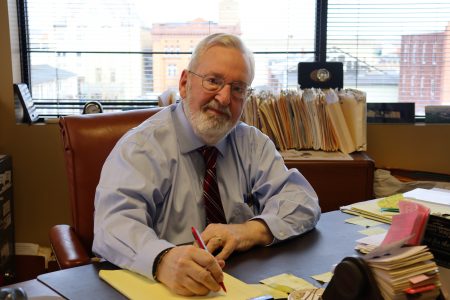
Celebrating his 50th year as a member of the Lycoming Law Association, a local lawyer helped expand the adoption rights of children before Supreme Court judges in the 80s.
Charles F. Greevy III can trace his family's lawyering legacy for more than 120 years in Lycoming County, beginning with his grandfather, who began practicing in 1900 and served as District Attorney from 1916 to 1919.
Greevy's father was elected as one of the county's two judges in 1951, and under him Greevy was accepted into the Lycoming Law Association in 1969.
He began in his uncle's office, practicing general law at 29 W. Fourth St.
The office soon picked up county legal services and Greevy worked as the Children and Youth solicitor -- a post he would keep for 40 years.
He also worked for the county planning commission and mental health department.
In 1976, during the first year of his work with the county, the Pennsylvania Adoption Act was ratified.
"Before that it was just mainly abandonment cases, where if you left your child for six months the biological parents' rights could be terminated," he said.
With the passage, the court would be able to find that for various reasons to remove a biological parent's right to their child.
"I became involved in what's called a termination of parental rights, where three young men have been in foster care for seven years. And the children and youth agency made the determination that their mother would never be able to directly take care of all three of them, particularly as they got older, and we went to court," said Greevy.
The children, then ages 7, 11 and 13, had been out of their parents' home for six years and both the foster parents and the children wanted to proceed to adoption. With the parental rights still valid, the children would be held in limbo until the court made its decision.
President Judge Thomas Charles Raup did side with the agency in 1978, however the parents' appealed to a higher court, arguing that the state Adoption Act was unconstitutional.
"That decision was appealed to the Pennsylvania Supreme Court determined that Judge Raup's decision was correct, and that the boys should be eligible for adoption," he said.
The case was appealed again to the United States Third Circuit Court of Appeals in Philadelphia, which only takes about 5 percent of the cases sent to them.
"I've had a number of other cases that have been submitted to the US Supreme Court but that was my opportunity of my career. It was the only time when I've actually been before them to argue my case," said Greevy. "It was truly a milestone in my long practice of law was being able to be there and do it."
There the judge found that the parents had no standing or legal right to arguing on behalf of her three children, he said.
In all the process took four years, the oldest boy was unable to be adopted at 17 years old, but the two younger boys, at the ages of 15 and 11, were adopted by their foster parents.
Several years later, Greevy said he believes state legislatures took notice and put timeline restrictions where parents must comply with court demands within 15 months to retain their parental rights.
"I think that was surely a factor that showed them why there were a great number of children that were being kept in foster care because the parents could not respond as they should," he said.
All of the hearings leading up to the termination are concerned with helping the parents find services to help with a variety of issues keeping them from getting their children back.
Advocating for children took on a personal tone for much of Greevy's life as he worked to help Children and Youth find the best place for children, he said.
"I think one of my rewards in practicing law has been the many children that particularly I worked with in children," he said. "My main thing there was making sure if they could go back to their natural parents or biological. That is what's the best."
If that was not an option, then it was his imperative to move the children into a permanent situation as soon as possible to ensure they will find an education and an opportunity to become good citizens, he said.
Another reward of having worked on so many cases is seeing the people who were helped be active in their lives, he said.
"They will come up to me and say you were there for my case and thank you for what you did" he said. "It's good to see a young person get into a permanent home and a permanent setting that they can grow and mature the way that they want to."
Greevy retired from soliciting for Children and Youth in 2016 and In the next few years, he'd like to take slow down in his private practice and enjoy his grandchildren, he said.