
Charles E. Kiessling Jr.: Fighting for clarity in state’s COVID statistics
Trending
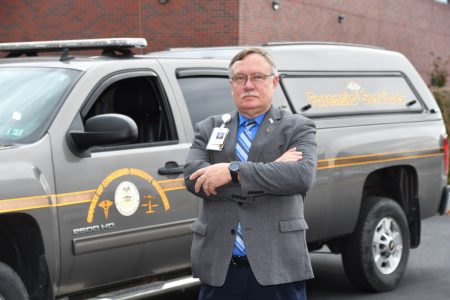
As the deadly coronavirus was making its way across the commonwealth in the spring, Lycoming County Coroner Charles (Chuck) E. Kiessling Jr. contacted local hospitals and nursing homes, telling them to alert his office of any COVID-19 deaths.
He informed them state law stipulates that, whenever a death was caused by a pandemic, the coroner's office must be notified.
"The Coroner Law requires that any death caused by a contagious disease that constitutes a public health hazard must be reported to the coroner's office," Kiessling, the county's coroner for 20 years, said.
Beginning in late March, the state Department of Health began issuing daily updates on a website, reporting the number of coronavirus cases and deaths county-by-county.
No COVID-19 fatalities were reported in Lycoming County by the health department until April 20-21, when two deaths appeared on the department's website.
That was news to Kiessling.
"These first two cases suddenly showed up on my screen for Lycoming County, yet they had not been reported to my office. I reached out to the Department of Health and asked 'What's going on here? These were not reported. Who were they and where did they die,'" Kiessling, who also heads the Pennsylvania State Coroners Association, said in a recent interview.
"We wanted to try to find out who they (the decedents) had contact with since this was a contagious-disease situation. Contacts are critical if you're trying to reduce the spread of an infection throughout your community," he said.
"I had already reached out to the hospitals and the nursing homes in the area early on. I thought I had covered all the bases, and then all of a sudden there were these two COVID deaths that I didn't know anything about," said Kiessling, who before becoming a flight nurse for Geisinger Medical Center, Danville, in 2005, worked for many years as a nurse in the emergency department at the Williamsport Medical Center (now UPMC Williamsport).
"I was surprised," he said.
When he contacted the health department to try to get the information he felt he needed, his efforts were met with a bureaucracy that was unwilling to share information to which, according to Kiessling, he was entitled.
"The department sent me an email that included a seven-to-eight page document that I had to fill out, a research-request type-thing. I was going to have to pay $9 to get a copy of each death certificate.
"Well, there was no way I was going to do that. I was not going to spend county tax dollars to get information from the state on something that clearly should be shared with me. It's the law," Kiessling said emphatically.
"I was very frustrated. I called the health department and told them I wasn't going to fill out documents or pay the state $9," he added.
Kiessling's challenge to the health department did not at all surprise Tim Shumbat or others who have worked closely with him for many years.
"Whenever Chuck gets passionate about something, I don't think there is a barrier, there is nothing that is going to cause him to have inhibitions about moving forward to address an issue," said Shumbat, who has known Kiessling since the two were in elementary school.
"The issue with the pandemic, in March and April, is an ideal example," Shumbat said.
Both men are life members of the Old Lycoming Township Volunteer Company. Shumbat currently is president and was a long-time deputy chief. Kiessling is the township's assistant fire chief, a position he has held for more than a decade.
"He and I had several conversations about the pandemic because we were trying to formulate a plan on how best the fire department could respond to it. He was struggling with the information that was coming out of the health department," Shumbat said.
"Chuck was very skeptical. He felt their data was skewed. They were stating facts of things that were off. He challenged them head-on because the Department of Health was doing things they should not have been doing," Shumbat said.
"They were reporting deaths in Lycoming County that Chuck didn't know anything about. He should have known about them since he is the coroner. State law requires that the coroner be notified when it involved these kinds of deaths," he remarked.
Very soon after Kiessling called the health department, the two deaths listed in the Lycoming County column vanished as quickly they appeared.
"The two supposed deaths were no longer on the department's website as COVID-19 deaths. To this day, I don't know who those people were, where they died or if they died. Was it a clerical error on someone's part? We still don't know," Kiessling said.
"It certainly makes you question the accuracy of the statistics that the state was putting out," he added.
Kiessling said the health department was not following state law, plain and simple.
"The health department was reporting a COVID-19 death based on the decedent's mailing address and not where they died," he said.
"So the individual could have died anywhere in the United States, but still have a mailing address of Lycoming County. So the health department was counting it as a Lycoming County death even though the person, say, died in Florida," Kiessling explained.
Coroners offices don't operate that way, he added.
If a death occurs in a certain county, the coroner for that county will list the death in their statistics and not some other county, Kiessling said.
"In this office (and others throughout the state), we record deaths that happen here in Lycoming County. If they die here, they are recorded here. I don't care what the person's mailing address is, be they from Colorado or whatever," he remarked,
"The health department and state coroners offices were reporting COVID deaths two different ways," he said, adding that the way the health department was doing it exacerbated the problem of trying to find out who last had contact with someone who was dying from the pandemic.
"From a contact-tracing standpoint, it is really important that such deaths be reported to the coroner so that if there are questions brought up about someone having contact with the decedent, then we make sure that the decedent gets tested for COVID-19. We had a couple of cases where a decedent was tested, just to see if they were or were not COVID-19. Some came back negative," Kiessling said.
"We need to be able to do that. We have no department of health in this county. If an EMS person, or a family member or a police officer had contact with a deceased person and those persons are concerned about contracting a health hazard, they typically reach out to my office. 'Hey, we had contact with this person. I did CPR on them and I'm concerned,' " Kiessling explained.
It is important the coroner be alerted to any COVID-19 deaths so that anyone who had contact with the decedent can begin to take precautions such as quarantining themselves or seeking medical attention if necessary, Kiessling said.
"They could be at risk," Kiessling said, adding there is nothing he can do to protect first responders or family members if he is not informed of a COVID 19 death.
Kiessling and Beth Wilson, a retired state police criminal investigator who was assigned to the Montoursville barracks for more than 20 years, worked together on several deaths, including suicides and homicides.
"I don't believe this county realizes just how lucky it is to have him as our coroner," said Wilson, who served as one of Kiessling's part-time deputies from 2005 to 2007 after leaving the state police.
"Chuck is not political," Wilson said, adding that if Kiessling sees something he believes is awry or plain wrong, he is going to do all he can to try to make it right, she said.
"Chuck is there for the people who put him in that office," Wilson said.
Carol Sides, who has known Kiessling for more than 20 years as the two have worked together on the Lycoming County DUI Advisory Board, said "Chuck means what he says and says what he means. You can depend on it."
Wilson described Kiessling as a "compassionate, hard-working, dedicated family man."
The retired trooper said when Kiessling sees a problem, "he is not going to shy away from it. He is going to face it head-on with knowledge that he has learned from experience or from experts he has contacted in certain fields."
Wilson pointed out that other coroners across the commonwealth have appreciated and valued his skills by "electing him to head their state organization." Kiessling has served as association president for the last five years.
Sides concurred saying Kiessling is "very well-respected. He is not just known in the city and the county, but statewide as well."
Many people throughout the commonwealth, even in other professions, know Kiessling and "have a very high regard for him," Sides, who has served for many years on the state Board of Engineers, said.
Wilson said "Chuck does not back down. He also is a person that if he is wrong, he will admit it and learn from his mistake. When he is right, he will stick to his guns. He is not going to change and he shouldn't change." Wilson said.
Kiessling said the first actual COVID-19-related death in the county was reported to his office by a nursing home on April 29.
"The patient was in their mid-60s and had other medical problems," the coroner said.
All the COVID deaths in Lycoming County involve patients battling a slew of other medical issues, such as heart and-or lung conditions, diabetes, dementia and strokes, Kiessling said.
"In many cases, COVID-19 was a contributing factor to their deaths, but it wasn't the only reason why they died. I have not seen a single case in this county in which someone died just of COVID-19. The average age of our COVID-19 deaths is 84," he said.
By the middle of this month, the number of coronavirus deaths in the county neared 100 with cases split pretty evenly between men and women, Kiessling said.
"The nursing homes obviously had the biggest uptick in COVID deaths right away. A few deaths occurred at the hospitals; one or two at home," Kiessling said.
Nursing homes got hit especially hard again when a second wave of county COVID-19 deaths occurred in November and continued into this month, he said.
During one seven-day period between Dec. 3 and Dec 10,, the county coroner's office handled a record 22 coronavirus deaths, Kiessling said, adding that his office never saw such numbers in the spring.
In most cases, it is a doctor or a health care provider, not a coroner, who is signing and issuing the death certificate which lists the cause of death, he said.
"They are the ones who decide if it's a COVID-19 death. You can look on a death certificate, and it may have a COVID-19 positive test on it. However, the patient likely had other medical issues that reveal that their immune system was broke with other problems such as diabetes, lung issues, strokes and cancer. They all had these added medical problems. They just couldn't fight this virus," Kiessling said.
Kiessling believes that coroners officers "should be the right hand of the health department." However, with the coronavirus, the health department has kept the coroners in the dark, he said,
"The health department's legal counsel felt very strongly that these COVID-19 deaths were natural deaths and therefore did not need to be reported to the coroners. That really set us up to fail" in trying get accurate numbers, he said.
"COVID-19 deaths are natural deaths, there is no doubt about that. It's not accidental, a suicide or a homicide death, which would require that the coroner's office be notified," Kiessling said.
Both the coroners association and the health department "sparred back and forth. In the end, I finally said to the health department 'We are going to have to agree to disagree.' And we left it at that. The health department wasn't going to budge and I wasn't going to budge. I instructed other state coroners, 'You need to reach out to your hospitals and nursing homes and make sure they follow coroner law and not the Department of Health,' " he said. The Coroner's Law dates back to 1933.
Shumbat, a trained paramedic who retired in 2017 as director of pre-hospital services for the former Williamsport Medical Center after 37 years at the facility, said Kiessling "had a lot of courage" to take on the health department.
"A lot of people believe that the only thing coroners do is pronounce people dead," Shumbat said. Kiessling does so much more, he added.
"He has a passion to help people. He has done things that no other coroner has done before. Chuck has tried to prevent deaths through educational programs and by being the public's advocate," Shumbat said.
Shumbat experienced that first-hand on a personal level when he became gravely ill in January 2009.
"I was unconscious, on a ventilator for six days. He was there at the hospital, most of the time, supporting my wife, Sylvia. To this day, she says Chuck was an angel," Shumbat said, adding that Kiessling played a key role in helping him get on a path that eventually led to his recovery.
"He interceded for me when I could not do it myself. He basically was my advocate and an advocate for my family," he added.
Wilson, the retired state trooper, also has seen first-hand Kiessling's compassion and sensitivity.
"When Chuck was deputy coroner (1986-1998), even then you could tell he cared very much about people and families," she said.
"Chuck doesn't just worry about the victim, the person who is deceased. He also worries about the families, the survivors. He will tell them 'Look, if you need help, I will point you in the right direction,'" Wilson said.
Sides, a former music education coordinator for her family's business, the Robert M. Sides Family Music Center, said if Kiessling sees a growing problem in the community, be it teen suicide – heroin overdoses or babies suffocating while sleeping with a parent, he will not hesitate to put a spotlight on the issue in order to get people's attention, all with the hope of saving lives.
Kiessling is credited with creating the county's Child Death Review Team in 2001. It is a group of professionals made up of medical personnel, police officers, social workers, teachers and counselors who meet two to three times a year to review deaths involving children. They will discuss how and why it happened.
"From the team came the coroner's office Cribs for Kids program. So many babies were dying from sleeping with their parents. Those on the team were saying 'Look at all the babies that have died because of this. We need to get this out to the public,' " Wilson, a former team member, said.
The program helps educate families on how infants can sleep safely at home in a crib. More than 200 cribs have been given out free to families in need since the program started.
"That was Chuck's project. That is just one example of him going above and beyond. He is always looking at how can we prevent accidental deaths, not just with babies, but with anybody. That is a big one for him," Wilson said.
"He gets things done," Sides said.