
Essential workers: ‘We had a job to do, so we did it’
Trending
Picking up trash from homes and businesses is not the easiest job under normal conditions.
Add in a pandemic and it becomes all that more challenging, even potentially hazardous.
Bus drivers, sawmill workers, and commercial businesses all faced new hurdles and changes in the way they've conducted their daily approaches to work for much of the past year, especially early on in the pandemic last spring.
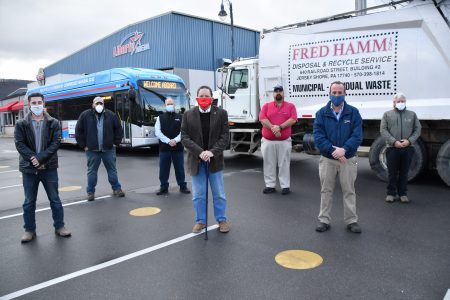
"A lot of guys were just afraid of being out," said Steven Straub, a garbage hauler and supervisor with Fred Hamm Inc., Jersey Shore. "It was the garbage you had to worry about. People don't always tie their bags. There was a fear factor."
Dylan Hamm, vice president of Fred Hamm Inc., said it was a time of shutdowns and layoffs.
As a result, the company found itself with canceled commercial contracts and faced with the prospect of laying off people.
"We just tried to take care of our guys the best we can. We relied on the Paycheck Protection Program to do that. We are still waiting on that," he said.
Fortunately, the business did not lay off any people.
"It was definitely a challenging time this year," he said.
The reopening in the fall of schools, which have contracts with the garbage hauler, helped out, but the looming threat of shutdowns remains.
Hamm said he's fortunate to have a good corps of drivers.
"All of our guys really stepped up," he said. "They did what was asked of them. They decided to push through."
Straub added that the company didn't miss a beat.
He credited the good will of the family-run business for helping everyone through what has been a tough year.
"Obviously, everyone was scared," he said.
River Valley Transit bus driver Frank Perchinski has been working for the City of Williamsport for 34 years, but he's never been through anything quite like the pandemic.
The good news was the buses kept running.
"We never stopped," he said. "I'm sure like anyone else, nobody wanted to get it (coronavirus). Other than that, we had a job to do so we did it."
Initially, nobody knew quite how to react to the pandemic, he noted.
Before he knew it, bus drivers were wearing masks and caution tape was stretched across the fronts of buses to protect drivers from passengers. For the first few months of the pandemic, ridership was down and bus service was cut back with the last bus running at 6:30 p.m.
Some drivers with pre-existing health conditions stayed away from work.
"Our routes pretty much stayed the same," Perchinski said. "What they did do was put out extra buses. Nobody was to be standing in the bus. Everybody had to have a seat."
He said passengers have been very respectful of each other during the pandemic.
He gave River Valley management credit for working with drivers and other employees to keep them informed of what was going on and needed to be done.
"If we didn't have that cooperation between union and management, we wouldn't have worked it out," he said.
COVID-19 failed to hamper the workloads of some people.
"Our business kind of boomed during the pandemic," Geno Bragalone, of B&B Mechanical, Williamsport, said. "People weren't going out on vacation. They had money to spend on other things. They decided to spend it on their houses."
Bragalone, who installs heating and air conditioning systems, said his one real issue was sometimes securing equipment in a timely manner for jobs.
"A lot of businesses we couldn't serve, but I think we made up for it on the residential end," he said. "As far as COVID goes, it really didn't hurt us."
With pre-existing health conditions, Debbie Roig felt safe early on in the pandemic working from her home.
"I was amazed what I could sell from home," Roig, a sales consultant with Overhead Door, Williamsport, said. "I can sell over the phone very easily."
COVID-19 has significantly reduced traveling, which has kept more people home concentrating on remodelling their homes.
"All I know is I was never not busy," she said.
Roig sells residential doors and since returning to the office is able to meet with customers to show them the products.
She's quick to note, however, that the coronavirus has certainly altered how she and other employees do their work.
"It's just changing all the ways you do things," she said. "It's constantly cleaning down things and making it safe for everyone to come into our business."
Jack Schrader, CEO and president of RSJ Enterprises, under which Overhead Door and Shrader Architectural Products operate, noted that part of his business at the beginning of the pandemic.
The shutdown of construction across the state was a big factor.
"Things were waiting to be installed. Luckily, I kept myself in a good cash position," he said.
On the Schrader Architectural side, shipment of products were delayed. Finally, when shipments opened up, there was the problem of a large inventory and tracking everything.
"So that was a nightmare," he said.
Steve Hiller, general sales manager for Schrader Architectural Products, said, "It's been kind of crazy.
Early on in the pandemic, many jobs were delayed, but everyone simply had to adjust.
Schrader said he has ensured from the start that his business sites were sanitized and employees wearing masks.
Into the fall, some employees were still working remotely.
He referred to the Paycheck Protection Program launched by the state to help businesses hurt by the pandemic as "a lifeline" for his company.
Overall, he said the company took a pretty good hit, but will be fine.
"It was a very rough and different way of doing business," Schrader said.
Anxiety and fear ran through the offices of Lewis Lumber in the early days of the pandemic.
Like some other businesses, the company nearly shut down because it was not considered by the state as an essential business.
"We applied for an exemption to become an essential business," Marc Lewis said. "That got denied."
Lewis felt his sawmill near Hillsgrove was indeed essential. After all, without his type of operation, loggers and businesses tied to the hardwoods industry wouldn't otherwise have work.
Thanks to some help from Pennsylvania Forest Products Association and other groups tied to the industry, Lewis Lumber managed to get an exemption to stay open.
The pandemic, of course, changed the workplace.
Workers are socially distanced from each other and wearing masks..
"Initially, we changed how we did business when we delivered materials," Lewis said. "We used to take paper delivery slips and sign them. We have actually changed that around. We do things by email when we deliver."
The business was negatively impacted by the closing of companies it normally did business with.
"Small furniture factories got shut down, for example," he said. "It was almost similar to 2008."
The pandemic did allow for the buildup of inventory.
In the meantime, COVID-19 certainly remains a concern, even though the company had been fortunate into the fall to not have any employees infected.
A branch of the company, Lewis Lumber Products, Picture Rocks, produces hardwood and softwood mouldings and custom architectural millwork, flooring, paneling and decking.
"We don't have a sawmill here," Lewis Lumber Products Manager Keith Aderhold said. "We sell to furniture makers."
After COVID-19 hit, he and his staff found themselves with many back orders to fill.
"Prior to COVID we were pretty busy. We were probably operating at a level higher than we had in the last couple of years with volume of business," he said. "When COVID hit and restrictions enacted, it really put the kibosh on things. We had deliveries ready to go. Obviously, we had truck drivers who didn't know how they were going to operate. It was very confusing at first."
The second half of March and April were bad times for the business before things picked up.
But business remains a bit down from last year.
"Right now, the hardest things in business are keeping people safe and doing proper protocol," he said. "That is a daily task for me. Making sure people are wearing a mask. Keeping social distancing."