
Trending
For Amber Logan, of Montoursville, telling her story at the recent Transition Conference at the Pennsylvania College of Technology was an opportunity for other people with disabilities to understand how this shy, insecure high school student transitioned to be the keynote speaker for the event.
"To all the students, I hope that you have been encouraged by my message and also encouraged to advocate for yourself," Logan told the group who attended the conference.
Logan, who self-identifies as someone with diverse abilities rather than disabilities, because, she said, "I don't diss anyone's ability," shared with the students what her life was like until she began a work program during her senior year at Montoursville Area High School.
"Believe me when I say I was scared to go into the community after being in school. But little did I know what a good experience it would be for me to get out of the classroom and into the real world," she said.
Through that job, Logan said she learned that she needed to be responsible and interact and be a part of a team.
When she graduated from high school, at first she felt frustrated because no one seemed to ask her what she wanted to do.
"I feel like at times, they talked about me like I wasn't there. Do you ever feel like that?" she asked the students listening to her presentation virtually.
Following that time, Logan found a position at a local non-profit and at one point was working two jobs. Five years ago, Logan began working for Advocacy Alliance where she travels with a team to interview disabled individuals to determine their needs.
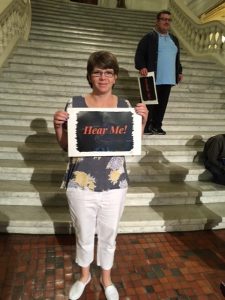
Logan has also shared her story of transitioning into the community at the state capitol.
"So, Amber Logan, the girl that was shy and introverted, I no longer walk with my head down. I walk with my head up and I'm proud to be me," Logan told the group.
Sponsored by the Intermediate Unit 17 and Penn College, the conference was held for students and parents in Bradford, Lycoming, Sullivan and Tioga counties' school districts. Over 150 people had signed up for the conference which encompassed sessions on pathways that students with disabilities could pursue after graduating from high school. According to Jeff Pelly, educational consultant with the intermediate unit, the conference was open to students with disabilities who are in their sophomore year or up in high school.
"We also open it to their families a well, because transition is a process. We have to make sure the students receive information but also their support systems receive information as well," Pelly explained.
Three pathways were presented to the students during the conference. One focused on students who were headed to some type of post-secondary education, while another pathway was designed for students going directly into the job market after high school. The third pathway dealt with ways people with disabilities could become involved in the community.
Overall the conference was designed to arm students with the knowledge of how to navigate these three pathways.
Pelly referenced a friend who likes to say that "knowledge is power" which he admitted may sound trivial.
"I think many students and their families lack knowledge about what supports are available no matter what their pathway might be," Pelly said.
"We have folks that go onto secondary education and training. That could be college or a trade school. We have folks that go right into the workforce. Then we have folks that are going to just do things in their community," he explained.
He noted that for all three pathways there are supports available to individuals with diverse abilities, although he added that sometimes it is difficult to seek out those supports.
He said that it is important for students "just knowing what is out there, what type of support. We try to bring those supports to the students, to their families, to help bridge that gap in terms of making knowledge accessible to everybody."
On a national level under the Individuals with Disabilities Education Act, students can begin the process of transitioning from high school to post-secondary life at age 16, while in this state, students begin at age 14, Pelly explained.
Most agencies start interacting with students when they are in high school, but some resources are available at a much younger age. Pelly used the example of a student with intellectual disabilities.
"They can receive from the county in terms of somebody called a supports coordinator and that can start from birth," he said.
"(For) a lot of families, and we'll throw COVID in there as well, there's just so many barriers and a lot of folks just don't know what supports are out there," he added.
Pelly explained that in terms of community participation, through waiver funding, money that allocated to individuals through the county, people can choose how to interact within the community rather than just spending the day at a day program.
"That's what community participation really is, having an individual have the autonomy to make the decisions to do that they want to do, something we like to call their everyday life," Pelly said.
"If they want to go to the movies, if they want to volunteer their time, if they want to go to a place with their peers and do some day programming, they can, but it really should be their choice," he stated.
One of the biggest challenges that students with disabilities face entering college after high school, is in assuming the responsibility for requesting the services they need, according to Dawn Dickey, director of disabilities services at Penn College.
"Understanding what those responsibilities are and then actually advocating for themselves," Dickey said. That's something that a lot of students haven't really had experience doing."
Her staff meets regularly with new students to work through these issues so that students can transition into college life.
During her opening statements, Logan said that during school her parents were her advocates.
"I would say that I have always had a supportive family and they advocated for me in school," she said.
Her sister, Erica Logan Hoyt, who is a life skills teacher through IU 17 at Montoursville, also spoke at the conference and admitted that her sister was one of the main reasons that she pursued special education as a profession.
Hoyt shared memories of her sister growing up, noting how she was shy and lonely and suffered from low self-esteem.
"Amber just wanted to fit in with her peers just like all of us do. We all want a sense of belonging," Hoyt said.
She said that facing graduation from high school was a scary time for her sister because of not knowing what was coming next. but as Logan moved out of her comfort zone, she become more active in the community.
"Amber has grown by leaps and bounds. She continued to learn and succeed after high school graduation. She is very in the community, works and participates in many local programs," Hoyt said.
"She speaks up about what she wants to do with her life and she is the pilot of her own adventure," she added.