
Trending
Williamsport/Lycoming Chamber of Commerce President Jason Finks calls it, "one of the most talked-about challenges facing companies."
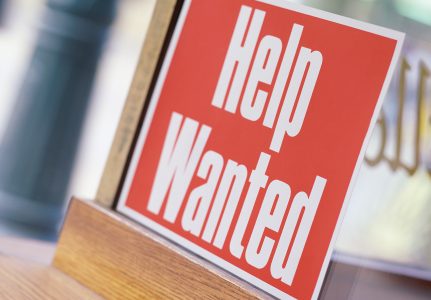
All one needs to do is walk or drive along busy commercial streets to see the signs on storefronts and businesses bearing the message: "Help Wanted."
Kevin Rosenow, plant manager, Leclerc Foods, calls this year the worst he's seen in his 11 years there hiring people to work at the Montgomery-area plant.
"We are about 15 people short," he said. "We are not alone. We think we are an excellent employer with a really good offering, but we are not fully staffed."
Sam Shea, human resources manager, PMF Industries, Inc., agreed with Rosenow's assessment.
"This past year has been like no other," he said. "I have open positions right now I could fill."
The vacant job slots, he and others noted, impact the entire operations of companies, making it more difficult to fill orders and produce materials.
Shea said the company presently has about 80 employees, about 10 percent below its full complement of workers.
Beth Kaiser, of Nesco Resource, Wiliamsport, a staffing company, said there has been a huge increase in the demand for workers during the COVID-19 pandemic.
And, some companies are meeting their staffing needs with incentives such as more competitive wages and benefits and more flexible working hours.
"Some are really thinking outside the box in recruiting people," she said. "Even with attendance bonuses and referral bonuses."
Nesco has become busier to the point that it added another recruiter and a talent sourcer to its staff.
"A talent sourcer searches resumes to see a good match for a position," she explained. "It's a kind of talent scout. That's all they are doing. That kind of frees up our recruiters to do what they are doing. We have really expanded our market and how we find people."
Kaiser feels the demand for Nesco's service will continue, too.
She noted that many companies are simply backed up with production due to shortage of materials and staff.
Kaiser said some companies are allowing newly hired people to work flexible hours.
"Before, it was very rigid with shift hours," she said.
Mike Shea, of American Customer Care, Montoursville, said the company is facing some of the "same pain" as other businesses during the pandemic.
"We are a company of 1,200 people in six different labor markets," he said. "Among all six markets, we are looking to fill 120 slots. We could probably fill 40 jobs here (in Montoursville)."
Shea noted that American Customer Care, a call center business, normally experiences high employee turnover.
"This year, it's been a struggle to keep our head counts. People are trying to strike a balance in working from home."
The company launched a strategy to train and recruit workers virtually, which has somewhat countered the problem of filling job slots.
Beyond that, many of the employees are working the phones from their homes.
The only people working in any of the company's actual call centers are those without fast-speed internet, he noted.
"I think the labor market is a little challenging right now," he said.
He said there may well be more people deciding to return to work once the federal pandemic benefits of $300 per week for unemployed state residents runs out in early September.
Dr. Elizabeth Moorehouse, associate professor of economics at Lycoming College, said the loss of jobless benefits may not prod people to get back into the workplace.
She noted that states that ended those federal benefits earlier this summer did not experience a big return to work.
"I don't think it had the effect they hoped," she said.
Many mothers, she said, are perhaps reluctant to go back to work with COVID-19 infections increasing and the possibility of schools closing, leaving them without childcare options.
"We have seen women workforce declines in the kinds of numbers we haven't seen since the 1980s," she said. "That could be a long-lasting impact from this pandemic."
Those who leave the workplace, she added, face an uphill battle to reclaim their former job status.
Some employers pointed out job seekers are in a position now to weigh their options.
"There is a lot of competition for labor out there," Mike Shea said.
Rachael Ulmer, site administrator for Pennsylvania CareerLink for Lycoming and Clinton counties, said job positions are open across all industries.
"It's really across the board," she said. "It's a job seeker's market."
There is no question, she said, that many employers are hiking starting wages to entice workers.
At a recent CareerLink Job Fair in Brandon Park, it was not uncommon for job applicants to be hired by companies on the spot.
Kyle Bryan, recruitment manager for UPMC in Northcentral Pennsylvania, said employers are faced with satisfying the demands of job seekers, from flexible scheduling and child care needs to competitive wages and benefits.
He said there is a concerted effort by UPMC officials to stress the health system's favorable work culture to job applicants.
"This is a place where they can make a career," he said.
There is also an emphasis, he said, on retaining present employees.
Still, he noted UPMC continues to face the task of filling many job vacancies.
"At any point in time, we probably have a couple hundred openings," he said.
Rosenow said LeClerc found it necessary to hold its own job fair to attract job potential employees.
Unfortunately, the event did not lure a large number of people eager to find work.
Some job applicants who showed up, he said, were offered jobs on the spot.
"We know we have to do that," he said. "The applicants have many other choices out there."
Fink referred to the low turnout of people at a Chamber of Commerce job fair in March.
Looking ahead, he is particularly concerned about manufacturers being unable to fill job slots.
"As larger manufacturers have problems, they potentially go to automation. You don't need as many workers," he said. "But you don't see them jump into automation because making machinery isn't cheap. You have to find space in the building too. But as labor force softens, you see potential for it happening."
Moorehouse noted how the present jobs situation could have a long-term effect.
Many employers will find it necessary to allow people to work remotely and accommodate their needs.
"I think over time it will be a good thing, and we will see adjustments," she said. "I do think the world of work will look different. (But) I don't think the office is dead by any means."