
Trending
Prompted by the opening of bids for printing absentee and mail-in ballots, Lycoming County Commissioner Tony Mussare argued that the expanded use of mail-in ballots is costing taxpayers money.
"This is a good example of what we discussed at a meeting last night with Act 77, the additional costs to the county because of this act," Mussare said.
Act 77 was enacted by the state legislature last year during the height of the pandemic to allow for expanded use of mail-in ballots.
"We're trying to put some numbers together," Mussare said, "but I have to think it's well over $300,000. That's not including the equipment that has to be purchased."
"This law, I'm not going to say it should be repealed -- I doubt very much that it will be repealed -- but it has to be reformed, and it should take place this year," Mussare said at a recent commissioners' meeting. "We have to get our legislators to look at the five major problems with the law, listen to our professionals that work in the county's office and get it done. I think this is a bi-partisan issue as well.
"We can get this done and make it more secure and less expensive."
On hand at the meeting was Forrest Lehman, the county's director of voter services.
"It has indeed been a lot of costs, Lehman said. "Some of them are perpetual because it's staffing -- more overtime, more people."
"It puts more stress on the county operations across the board because, even if I'm not hiring more staff, I've got people coming in from other departments who I need to help carry that load during the last few weeks before an election, and it has an impact on those departments," Lehman said. "I've got people over there helping to test voting equipment today. We just got 300 or 400 ballots in the mail from a three-day holiday weekend, and that's going to take a couple people probably most of the day to get those marked in as received in the voter registration system, sorted, so that when we start that pre-canvassing on election day, we're ready to go."
"And that's going to be every day, hundreds more coming in. That process has to repeat every day," Lehman added.
For the current municipal election, Lehman said that his department mailed a little over 4,000 ballots, which was a lot less than the 15,000 they sent out in November 2020.
"The important perspective is to look back at pre-Act 77," Lehman said.
"In November 2016, the previous presidential election, we had 2,500 absentee ballots. So, even in the slowest election year of the four-year election cycle, we're doing more ballots by mail now than we used to do in presidential elections, before Act 77. That's the gravity of the change," he said.
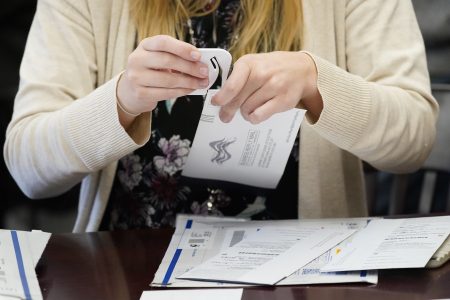
"You're running an entire separate election on top of your in-person operation, and it has costs associated with it. An entire new account had to be created and funded for print mail services, and you have the overtime costs, and you have equipment we had to buy like an envelope opener, and it's not necessarily the end. We don't know where the legislature and the government are going to go from here," he added.
Lehman noted that the number of people requesting mail-in ballots is up across the board, with county residents from both political parties seeking to access the service.
"The numbers are way up regardless of party affiliation," Lehman said. "The numbers are off the chart. And that's even before the number we mailed out so far. It doesn't take into account what we're receiving on a day-by-day basis. It doesn't take into account people who are going to be coming into the office wanting to get a mail ballot over the counter. We won't have like what we had last year when I had 50 people lined up down the hallway every day for almost two to three weeks before that election."
He said that he does anticipate a lot of people coming into his office given reports that the mail service could be slower because of staffing issues with the postal service. Lehman shared a story coming out of a county in the northeast part of the state where a community didn't receive mail for a week.
"Think about what that does to election mail delivery and it could happen both incoming and outgoing," he said.
Lehman described a scenario where it takes someone seven days to receive a ballot and then it takes another seven days for the ballot to be returned by mail.
Speaking anecdotally about the ebb and flow of the post office, Lehman said, "At the beginning of October when we start mailing ballots out, the mail is running pretty well, but as you get further into the month, the channels kind of get saturated with election mail, those delivery time frames slow down. Suddenly instead of three days, it goes to four, six, seven.
"By the time you get very close to the election, people are getting ballots in seven or eight days. That's exactly when you don't want it to be taking so long. We have more time at the beginning than we do at the end. And unfortunately the progression of mail delivery delays goes in the opposite direction," he said.
Three bids were received for the printing of absentee and mail-in ballots for a four-year contract, beginning next year. The bids were: Phoenix Graphics, $1.61 each; NPC Inc., $1.64 each; and David A. Smith, $1.79 each.