
Officials determined to convince community beyond greater Williamsport of levee’s importance
Trending
"Somehow, we have to have a conversation with people that the financial burden of taking care of the levee can't fall only on the city, South Williamsport and the townships protected by the levee."
That was a statement made recently by Lycoming County Commissioner Rick Mirabito, who shared his thoughts with the City Council's public works committee.
Mirabito was joined by fellow Commissioner Tony Mussare and the discussion included updates on the levee recertification and accreditation process but also on what steps might be taken to ensure long-term levee maintenance and flood resiliency among other communities.
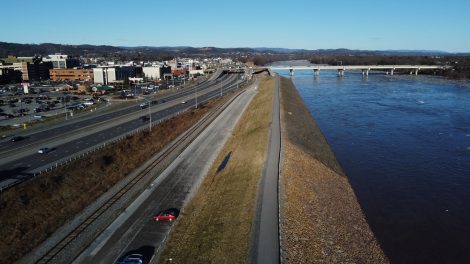
The levee is undergoing a process of recertification and accreditation with the Army Corps of Engineers and Federal Emergency Management Agency.
Officials have done studies, will do more and have sought successfully for state and federal grants to cover costs of replacing relief wells, replacing cross pipes, repairing pump houses, and strengthening flood walls.
However, the levee and the county's flood-prone areas are in need of a wider and more comprehensive plan -- a flood resiliency plan, as Mirabito said.
Paying for it cannot fall on the citizens of the city or those covered by the levee, he said.
"It is not fair," he said, of those being the communities that are the only ones which pay for the long-term levee maintenance.
One might ask why a resident of Jersey Shore or Muncy would have to contribute?
Mirabito answered that question, citing examples of how there are on a daily basis people who live in places other than Greater Williamsport, who travel here for their jobs, health care, functions and entertainment.
Maybe the levee recertification and long-term maintenance isn't on their minds, but, Mirabito noted, all of the county's communities needed a better levee maintenance and resiliency plans against flooding.
"We need to figure out how to go out into the community and get the plan supported by the public," he said.
Without these other communities' financial input, it is a "prescription for financial problems that Scranton has had," Mirabito warned.
One means of doing that is to establish, through a legal process, an authority, similar to what is done for water, sanitary and parking.
"Authorities can assess fees on entities that use services," Mirabito said.
For those living along Lycoming Creek in Hepburn Township, to those affected by Lawshe Run in Jersey Shore, and businesses and residents who are impacted in Montoursville, Muncy, and Montgomery, communities an authority empowered to collect fees, and a fee structure that is equitable and fair, could money for projects that protect and provide better resiliency against flooding of creeks, washes, runs and streams.
Mirabito referenced the enormously high cost of such plans, including what can be done with Lawshe Run in Jersey Shore.
To achieve a viable means of paying for long-term levee maintenance and these kinds of projects, Mirabito said the county needs to find a way to meet the resiliency issues to "ensure everyone contributes a small amount."
Resiliency for the levee now and for communities impacted by flooding in years to come
Lawshe Run, which runs under Allegheny Street, causes the water runoff to back up, said Cody L. Hoover, Jersey Shore manager, adding half of the borough lies in a floodplain.
The cost of fixing the Lawshe Run culvert is over $10 million, Hoover said.
Commissioner Tony Mussare agreed with Mirabito, adding that it may require putting a task force together to determine the steps to take, such as how much revenue would be needed for the levee and other flood-prone areas.
"How much would we need?" Mussare asked. "Is it $20 million? OK, and then go with sustainability."
That means, perhaps, putting together some sort of government body, or an authority, Mussare said.
It might sound arduous but once it gains public support the authority is the best means of separating governmental bodies away from costs that are too burdensome for the taxpayers and the municipal and township budgets.
"Creation of an authority is not a complicated process," said Jon Sander, the city engineer. It was done in Sunbury in Northumberland County, he said.
Sander cited, as an example, a $7 residential fee per month that Sunbury residents pay.
As more people are asked to contribute, such as across Lycoming County, any fee that potentially is established, would spread those costs out in a more equitable and digestible way.
As the levee recertification process began more than a decade ago, then-City Council President Bill Hall suggested an authority could levee a fee for long-term maintenance costs and it could be spread out among the entire county population to make it feasible and fair.
Spreading out the cost, overall, would provide capital for the cost of maintaining and operating the levee. It would also provide communities with capital resources to build flood walls and cover some or all of the costs for diversionary solutions such as retention ponds and the like.
Sander agreed. With enough people contributing that fee of $7 goes down to, perhaps, $2 per month, as is done in Sunbury.
The authority could also address the non-taxable properties, by assessing a fee on major educational institutions and hospitals and other non-profits.
While these non-profits do not pay real estate tax, per say, they contribute in the form of in lieu of tax payments and UPMC continues to pay the tax assessed at the time it had leveled properties to expand its medical campus.
The idea of gaining public support should also involve firms that are experienced in explaining these authorities and fee structures.
Wood Engineering, for example, which is working on designs for the levee recertification and Grafius Run flood mitigation, has such experience in such public-support-raising campaigns, Sander said.
Many entities could put their collective minds together such as authorities, watershed associations, planning departments and engage state and federal agencies regarding long-term resiliency plans, Sander said.
For now, the public works committee meetings between the spring through summer could involve updates on the levee and issues related to Grafius Run as well as county input.
Eventually, flood resiliency projects might become bundled, such as is what is done with bridge bunding with the state Department of Transportation, a package of projects.
For now, Councilwoman Bonnie Katz, public works committee chair, said she is hopeful. She is grateful for the county involvement, the consulting firms seeking federal and state grants on the levee, the portion of the American Rescue Plan funds in the city, about $25.5 million, that officials say some $2 million may initially be invested in levee infrastructure, and there are plans in place to continue to foster the working relationship with the Army Corps of Engineers Baltimore District on the levee recertification and accreditation.
Katz, too, favored concepts such as establishing an authority that would not happen until there were public meetings, input, legal review and then could collect levee/flood-resiliency fees with transparency, she said.
The consensus agreed -- the process, fee structure, if there is one, and entity that is formed must operate fairly and distribute the levee equitably, with the purpose of serving to protect communities from dangerous and costly floods.