
Trending
Old Lycoming Township supervisors this week fielded a cavalcade of questions from residents regarding steps taken toward regionalization of law enforcement coverage.
The supervisors recently brought in Tiadaghton Valley Regional Police Department Chief Nathan Deremer to be interim police chief and have since 2019 explored the potential benefits of sharing resources.
Residents had many questions at the prior meeting in early March, after which some received cease and desist letters, which rubbed those receiving them the wrong way and brought allegations of supervisors impinging on the right to free speech.
"It was not that all," said Old Lycoming Township Supervisor Linda Mazzullo, regarding the letters sent to some of the residents. "It was to tell them we expect proper decorum, not people yelling, clapping, talking over each other, but to be respectful to the board of supervisors.
"They don't have to be for regionalization or the interim police chief, they just have to be courteous."
The meeting, while emotionally-charged, ended with supervisors promising an open, transparent process to determine what is best in terms of police coverage in the township moving forward.
It was not without its drama, however, as Mazzullo, and Supervisors Sam Aungst and Dave Shirn held their regularly scheduled Tuesday meeting, conducting business that brought applause, such as approval of an Aldi store land development on Lycoming Creek Road.
Emotions ran high
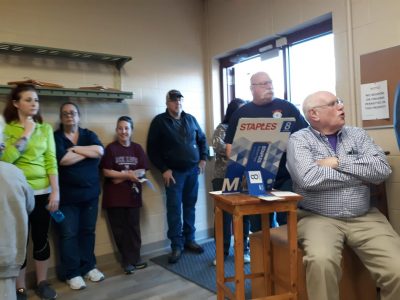
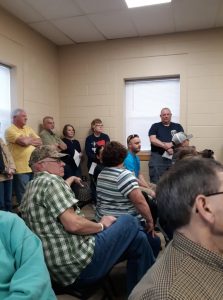
The small township building was completely packed, with some residents spilling out into the entrance door and others standing up, some of them lined along the wall with every seat taken -- waiting for the discussion on the interim chief.
The proposed plan that was explained by supervisors is a work in progress.
"Give us a chance," Mazzullo said, adding the supervisors need to gather data, such as financial and logistical information taken from the collective bargaining units of the two departments and watch how it goes this spring and summer under the leadership of Deremer.
Aungst went over a timeline of the steps taken thus far.
To provide the most people information, supervisors as a board said they will hold a special meeting in late August or early September to answer questions, which will allow for feedback and see whether a more regional approach to policing will work in the long run for the taxpayers.
"We want to do what is best for the township and its taxpayers," Mazzullo said, saying she prays daily for the safety of the citizens and the police officers.
Another factor coming into play, based on a regional police study, is the potential cost to neighboring townships to the north such as Lycoming and Hepburn townships. These costs may be too prohibitive and could result in a tax millage increase of 3 mills for those townships' residents, based on the study, according to a Hepburn Township Supervisor Heath Heller, who was in attendance.
Hepburn and Lycoming townships have signed an additional one-year contract for police coverage provided by Old Lycoming Township, which has provided these townships with police coverage since 2020. The price is up to $105,000 each to cover one officer and benefits, Mazzullo said.
"They signed a contract for one year because they want to see if we regionalize and are hoping if we do the cost will go down," she said.
Such costs can't be determined until the township reviews pensions, salaries and health care, she said.
Soothing the burn
As for the biggest sore spot, the cease-and-desist letters, residents were told by the law firm representing the Old Lycoming Township supervisors that those letters sent to some residents who spoke at the March supervisors' meeting were sent to the wrong individuals and an overreach.
The cease-and-desist letters further clouded a situation that was intended to provide more safety, security and more police officers-detectives on any given day to the residents.
Former Lycoming County Judge Marc Lovecchio, now an attorney with McCormick Law, said he completely understood, based on the statements at the meeting and his perception of what happened, about the outcry over some receiving the letters.
Some said they were told they were guilty by association, and Lovecchio said the letters sent the wrong message, especially to those residents who were simply asking questions of their elected leaders.
Lovecchio apologized to those who received the letters, including Tim Shumbat, who is blind and who devoted 50 years of his life in service to the township through the fire company and in other ways regarding law enforcement and emergency medical service.
Shumbat said he was "disgusted" by receiving a letter and said the letter was an attempt by the supervisors to impinge on the citizens' First Amendment rights.
Shumbat was not supposed to receive a letter.
"It was sent to him by mistake," Mazzullo said in an interview.
Deremer also was at the meeting and listened.
For the most part he frequently nodded in approval at the residents' questions and concerns, at one point, when someone said he might not be the proper choice to lead the township's law enforcement division, shrugged his shoulders and nodded in an affirmative manner.
It was cleared up that the supervisors did not violate the Sunshine Act, because the interim chief plan was voted on in what legally was an open meeting on March 8. In that meeting, supervisors voted on what was described as a memorandum of agreement for Deremer's services that began March 1 and continued until Dec. 31 of this year. Mazzullo and Aungst were in favor while Shirn voted against.
The supervisors said they advertised for the chief position and received 10 resumes from people interested in the top law enforcement spot. Sun-Gazette learned that they included some from retired state police members and other experienced candidates.
"If this does not work, and the township does not regionalize, the supervisors will be reviewing those applications," Mazzullo said.
Supervisors chose Deremer, who has six years as chief at the Tiadaghton Valley Regional Police Department in the Jersey Shore area with over 12 staff, as the right person who had the requisite requirements to bring on as the interim police chief in Old Lycoming Township.
Still, the changing of the guard and tradition as the township explores regionalization of its force troubled retired township Officer Robert Burns. Burns began working in 1974 and retired as a sergeant.
"This department needs a full-time chief now, not later," he said.
Mazzullo said those are legitimate issues that will be explored.
"Regionalization could end up saving $50,000 on up, with half the salary and benefits of a new police chief, if one had to be hired," she said.
Regionalization also could provide up to 22 officers for added protection and service to the residents, she said.
"Their department has 12 officers, and the township has I believe eight officers," she said. "It will be up to 22 officers combined that would, if decided on, be policing the new regionalization area," she said.
Another plus is in regionalization, the Old Lycoming Township police officers will be working in the township building as they do now on Green Avenue.
"We have no clue if it is going to work," Mazzullo acknowledged.
Mazzullo encouraged those in the audience and at home to wait until the data – such as performance, collective bargaining unit information on pensions and benefits and other factors – are calculated and presented at the meeting in the larger venue in the fall.
Interim does not equate to part-time.
Mazzullo said it has been a challenge and heard there were five officers who would quit if the regionalization process did not move ahead.
"We have four to five who said they would be leaving if the township did not work toward regionalization," she said.
An Old Lycoming Township Officer assured the residents the police will respond as they always have without question whatever is decided.
Potential benefits
Shared services and resources will end up saving dollars, Mazzullo said.
For example, if someone is injured or off work, rather than overtime, other officers can be used to keep overtime costs down.
Two officers were on standby outside the meeting room because of last month's meeting which had moments that were out of control and required the cautionary step to be taken.
Residents, afterward, outside, including those who have allied themselves to get answers to questions, said they only wanted to express their opinions without getting letters, and to learn more about the process of possible regionalization of the department moving forward.
In short, the township actually began the regionalization process three years ago, according to Mazzullo.
Former Old Lycoming Township Police Chief Chris Kriner has gone back to his sergeant-detective position at his request, she said.
The township advertised for the police chief position outside of the department due to most officers being new on the force and others of retirement age, Mazzullo said.
Costs are increasing and the township recently increased tax millage by 1 mill, she said.
Mazzullo noted that what Heller and others expressed as concerns are also their concerns at Old Lycoming Township.
Across the nation, regionalization of police and fire services is a trend that is being encouraged by officials from the state such as the Department of Community and Economic Development, which provide grants for communities and other agencies that see mutual benefits in bringing in additional resources, sharing service and providing more coverage.
"We are trying to do what is best for the taxpayers, while at the same time keeping our police department intact to provide for the same police coverage and safety for residents that deserve," Mazzullo said.